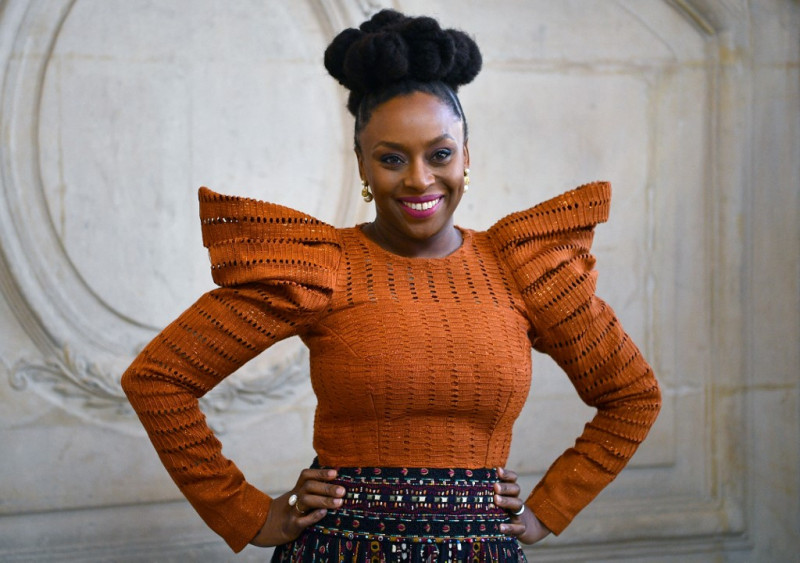

EARLIER this week, award-winning Nigerian author Chimamanda Ngozi Adichie published a blistering essay on her blog. In it, she eloquently railed against cancel culture (although she did name it directly) and the seemingly inconsistent private/public behaviour of two unnamed authors who are now highly critical of her.
These two authors once sought her tutelage and blessing, but have turned against her – oftentimes using social media to voice their animosity and displeasure.
Adichie accuses them of using her name to further themselves in the literary world, while stoking the flames of Twitter against her in the public sphere to reinforce their “sanctimony” and “ideological purity”.
One of the authors – who has since identified herself as Nigerian author Akwaeke Emezi – is called out by Adichie for using her name in the cover biography of her novel ‘Freshwater’, despite calling Adichie a “murderer” on social media.
Emezi – who identifies as nonbinary and transgender – for her part responded to Adichie by saying on an Instagram story, “I won’t be reading [the essay] because it wasn’t meant for me. It was designed to incite hordes of transphobic Nigerians to target me.”
For these two critics of Adichie, their distaste for the feminist writer stems from her comments regarding trans women back in 2017 and her apparent support for JK Rowling in an interview with The Guardian.
“Again JK Rowling is a woman who is progressive, who clearly stands for and believes in diversity,” she says in that interview from November 2020.
She also says, “I think in America the worst kind of censorship is self-censorship, and it is something America is exporting to every part of the world. We have to be so careful: you said the wrong word you must be crucified immediately.”
Whatever directly instigated the latest essay is unknown, but its criticism of a seemingly strictly enforced ideological orthodoxy on social media (in this case a progressive orthodoxy) has struck a chord with many.
Governments controlling speech is one thing and is a threat to free expression, but the exponential rise and prominence of social media over the last two decades has brought on another type of censorship.
“I have spoken to young people who tell me they are terrified to tweet anything, that they read and re-read their tweets because they fear they will be attacked by their own,” Adichie writes in the concluding paragraph.
There aren’t really people out there who reflexively think of themselves as defenders of ‘cancel culture’, but there is a tendency to minimise it. To paint those who complain about it as guilty of something themselves. And some progressives point out the positives of social media, that people who were used to being voiceless and unnoticed can now voice their complaints against the seemingly powerful.
But too often this anger can be weaponised and it can spiral out of control (if it was ever controlled in the first place). Celebrities like Adichie can have their reputations dug through the mud without much in the way of recourse. Of course, an equally large part of the social media space will support her and the people in her position.
In the end, the toxicity of social media will just serve to reinforce everyone’s position. The well-known will have every statement and word parsed for virtue, while rightful criticism will be amplified but also smothered by the mob. – The Vibes, June 20, 2021