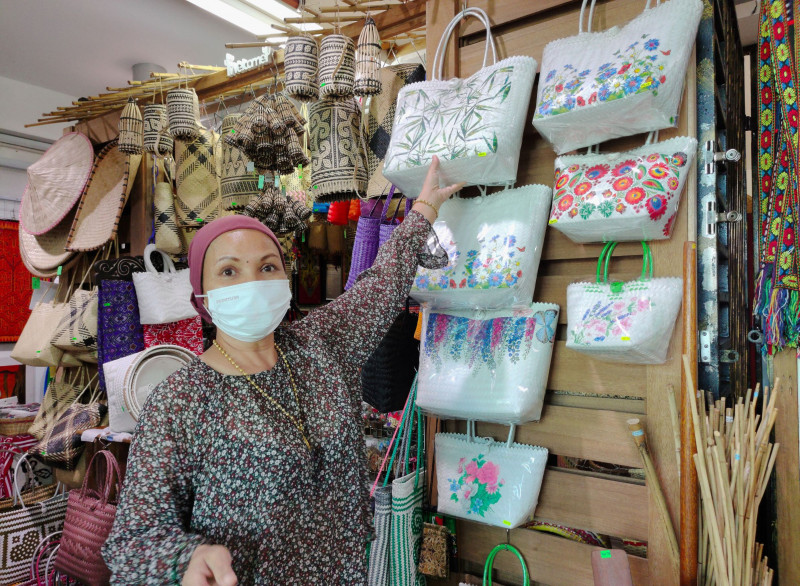
MIRI – The Penan community, which is synonymous with utilising forest products for survival, have taken a giant stride towards modernity as their indigenous art of weaving has produced signature handicrafts that have successfully penetrated the market in several European countries.
Although not directly involved in the marketing process of their finished products, the Penan community, famed for weaving rattan products, have applied their skills in producing handbags using recycled materials such as polypropylene, which are in high demand from countries such as Germany and Switzerland.
Divulging the details, Norsiati Ibrahim, 52, a trader at the Miri Handicraft Centre, said that she sells handicraft items bought from the Penan community in Ulu Baram, as well as some products that she herself makes.
“These Penan handbags are of high quality, and the finishing touches are very good, as can be seen from the high demand in foreign countries such as New Zealand, Jordan, Australia and Switzerland.
“More than 200 units of these bags have also been sold in Germany. I couriered the bags from Kuala Lumpur because I had to go through several processes such as declaring the material (in producing the bags) and whether it can be disposed of (sold) or not, before being given permission to enter that country,” she told Bernama.
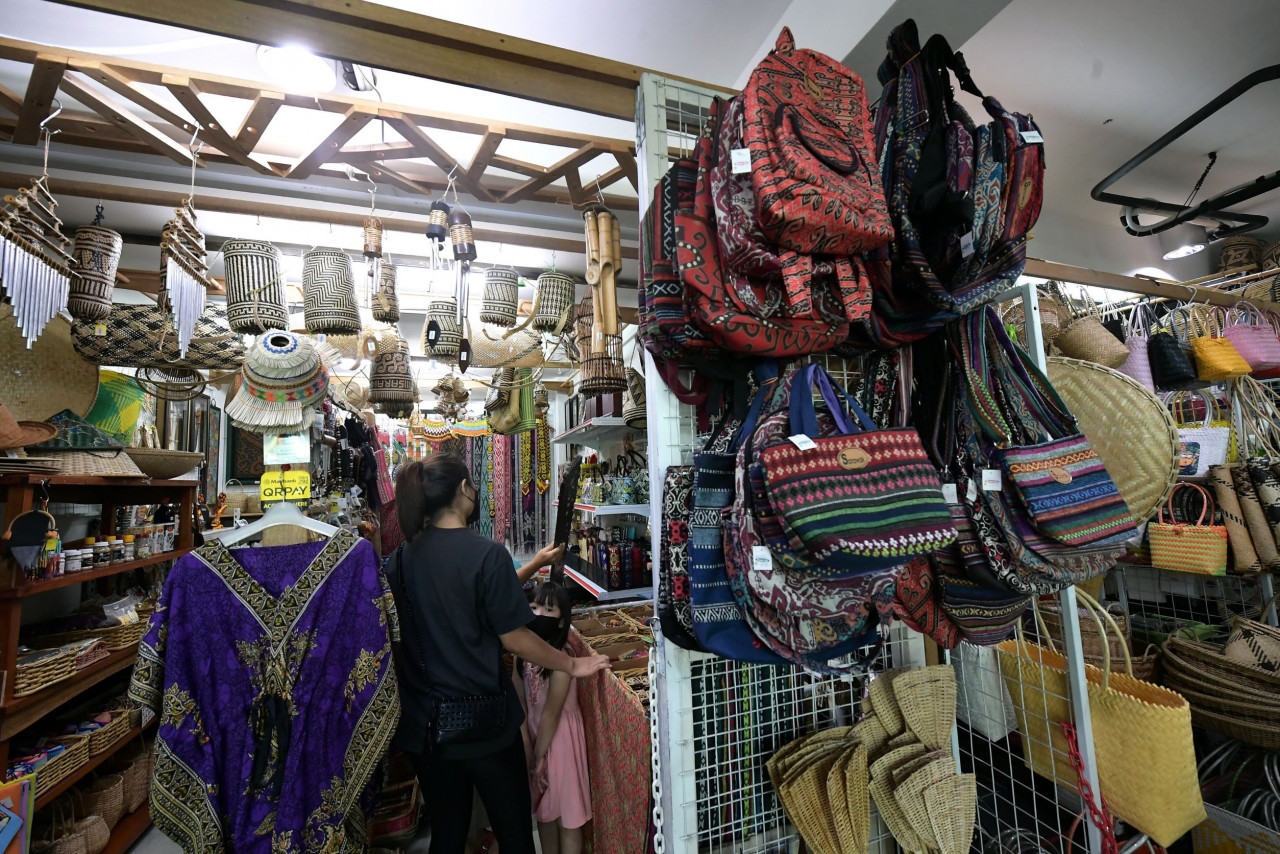
Norsiati said that apart from the indigenous woven bags being successfully sold in Europe, the Penan handbag also managed to penetrate the haute couture market at the boutique of the country's famous fashion designer, Bill Keith.
She first ventured into the field of selling handicrafts 21 years ago, and Norsiati said that only her steely determination and sheer enthusiasm brought her to her level of achievement thus far.
“I started with a capital of RM50. The handicrafts sold at that time were not many, little by little I pooled a larger capital with money from the sales. Finally, now I am able to make sales up to five figures a month,” she disclosed.
She said that, despite the many challenges she faced from the time she started her business until now, ‘despair’ was not in her dictionary and that was the secret of her survival all these years, to reach the level where she is at now.
On the Miri Handicraft Centre, Norsiati said the centre has become a focal point for tourists and locals to seek out the handicraft items they crave.
“With a place like this, it makes it easier for us traders, as well as buyers, and they no longer have to look far and wide to find these handicraft items. These items have their own fans or niche buyers, apart from being bought as souvenirs for special occasions,” she said.
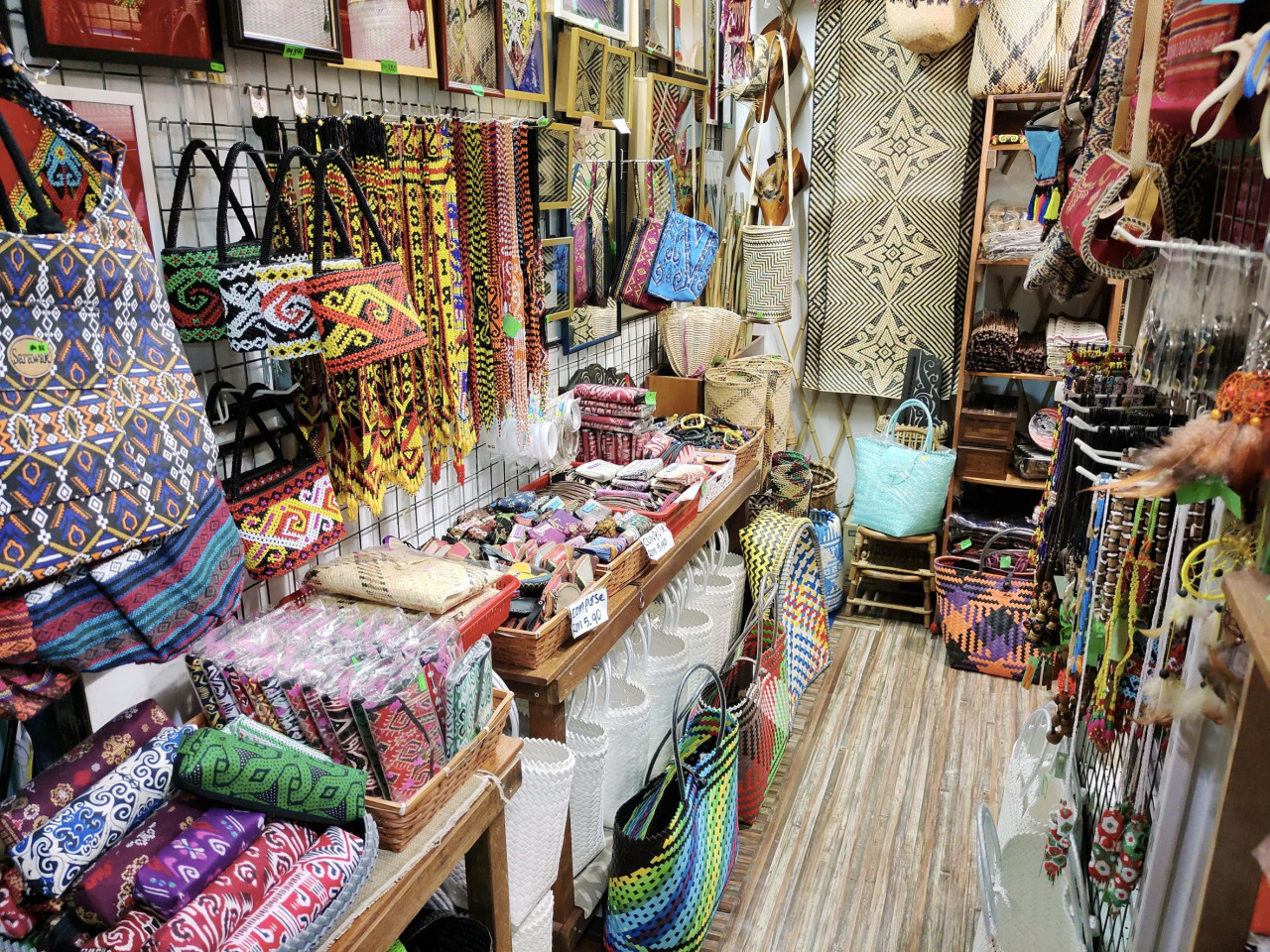
Meanwhile, another trader, Batheria Aming, admitted that the Penan handbags were ‘hot items’ and often caught the eye of customers stepping into the centre for the first time.
“Most customers, either locals or visitors from the peninsula, their attention will be 'pulled' to the handbag, perhaps, due to its various colours and fine woven quality,” she said.
Suffice to say that almost half of the shops in the centre sell Penan handbags, which indirectly attracts customers to enter their shops.
The Miri Handicraft Centre in Jalan Merbau here, costing RM1.9 million, has been operating since 2018 and has become a tourist attraction in northern Sarawak, aimed at helping to preserve the Bumi Kenyalang (Land of the Hornbills) diverse ethnic cultural heritage.
In total, there are 13 booths selling various handicraft products at the centre, with other booths selling traditional mouth-watering dishes found in the state; definitely an attraction for both locals and visitors alike. – Bernama, November 22, 2021