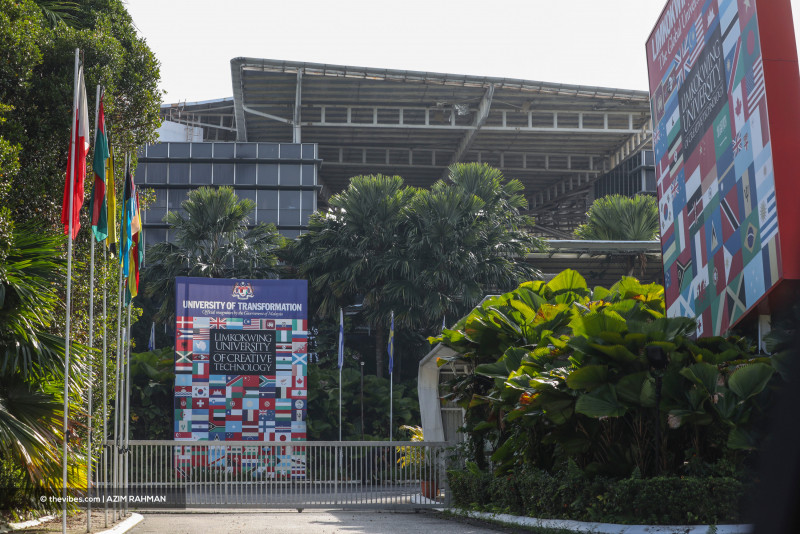

KUALA LUMPUR – When two students at Limkokwing University of Creative Technology (LUCT) complained that their programme accreditations were revoked by the Malaysian Qualifications Agency (MQA), alarm bells went off among many others enrolled in private colleges and universities in Malaysia.
One of the LUCT students, at a press conference, alleged that the accreditation for his master’s degree programme was removed in 2019. This means that he not only owns an unrecognised certificate, but also suffers losses from fees paid.
The varsity has had accreditations for eight of its programmes revoked. However, it has issued a statement, expressing confidence that the accreditations will be reinstated.
In February, two graduates of Monash University Malaysia’s medical programme filed a suit against the institution after they reportedly discovered that their degree was not gazetted under the Second Schedule of the Medical Act 1971.
As such, they claimed that they could not register with the Malaysian Medical Council.
There are many other cases of non-recognition of certificates and degrees by authorities, but these are settled out of court to avoid bad publicity.
Accreditation is an important feature of any academic certificate issued by a college or university.
In Malaysia, MQA sets the standards for this official certification. The failure to achieve accreditation by a programme, or its revocation, means students get no recognition upon graduation, thus affecting their job prospects.
Many colleges and universities take shortcuts by advertising courses that have yet to receive full accreditation. These programmes have obtained only provisional accreditation, and must fulfil certain criteria to meet the set standards.
Others receive full accreditation only to have it revoked when reviewed during MQA’s regular five-year audit.
This brings uncertainty to the issue of accreditation and leaves students in a precarious position thanks to the incompetence of a college or university in protecting students’ rights.
Malaysian students pursuing non-accredited programmes are not eligible for National Higher Education Fund Corporation loans, and cannot continue their studies at other institutions of higher learning or get credit transfers.
Graduates holding non-accredited certificates are not eligible to work in the public sector in Malaysia, while accredited certificate holders are the preferred choice even among private sector employers.
The MQA accreditation is also recognised by education consultant agencies and overseas universities for further study and credit transfer purposes via mutual-recognition agreements.
Non-MQA-accredited institutions cannot franchise their programmes to other varsities, whether in Malaysia or abroad, and this is often a key element of their transnational business.
Before signing up for a course, students are advised to check that an institution and its programmes are fully accredited by MQA. Specific subjects, such as law and medicine, must also be accredited by the relevant professional bodies and ministries.
While MQA accreditation and audits are often considered a burden by many private colleges and universities, industry experts stressed that without the agency’s quality requirements, the overall academic standard will collapse due to financial pressure to attract students and cut costs in an increasingly competitive market made worse by Covid-19.
Higher education specialist Prof Geoffrey Williams of Malaysia University of Science and Technology, is among those agreeing with this sentiment, saying that MQA is renowned for thoroughly vetting courses.
“MQA auditing is considered to be very rigorous, and cases where MQA denies accreditation are very common,” said Williams, who has more than 17 years of experience in the local higher education industry.
“Universities that fail MQA accreditation processes are given a grace period of 30 days to remedy the areas of non-compliance, with most responding quickly to meet the minimum compliance criteria within the given period.”
However, it is not common for a big number of courses or student cohorts to be affected at the same time, he said.

“In cases where there are repeated accreditation failures, or large numbers of courses or students are involved, MQA and the Higher Education Ministry should audit the whole university as this is a warning sign of systemic management failure, which must be rectified as early as possible to protect staff and students.”
Williams said the main factors in an MQA accreditation failure are poor leadership and management, a low-quality “corner-cutting” ethos, and financial pressure.
“Private universities need revenue, which comes from student numbers. So, they often introduce new programmes and fill up registrations before the courses are fully accredited.”
He said a lot of new courses follow market fads and are specialised, and some do not last long and are not properly market-tested.
A specialist faculty cannot be founded quickly, he said, and it is common for MQA to remove accreditation if there are insufficient faculty members with the right experience and qualifications to run programmes.
Often, the faculty (members) and managers are undertrained, demotivated or poorly supported.
“When accreditation pressure builds up, administrative and faculty employees become overwhelmed, and there is high turnover due to poor conditions and pay.”
He concluded that the effects of financial stress show up in poor management and the delivery of “marginal” courses.
MQA will catch these signs during its routine auditing process, and refuse or suspend accreditation for the overall programme, he added.
“Staff and students will suffer, and the university’s reputation will be damaged, both locally and internationally, as the failure will be made public, often via social media, by angry students.
“This is a failure of leadership and management, and MQA should not be blamed as it works hard to maintain standards.
“If this becomes constant, it will be very damaging to the reputation of Malaysian private universities, and affect the recruitment and retention of students, especially from overseas.” – The Vibes, May 10, 2021