
KUALA LUMPUR – Some Unified Examination Certificate (UEC) graduates revealed that they had no choice but to sit the Sijil Pelajaran Malaysia (SPM) exam to qualify for enrolment into public universities.
This highlights the downside of opting for the UEC route, as it is not recognised as a legitimate entry requirement for tertiary studies in the country.
In an interview with The Vibes, several UEC graduates shared their experiences sitting both examinations, generally referred to as double-tracking.
Having graduated from a Chinese national type school (SJKC) at the age of 12, Thasvini Raj Rajendran said she found it difficult to adapt when she continued her secondary school studies at Chung Hua Independent High School in Klang.
“I would cry every morning during the first six months of my Junior 1 (equivalent to Form 1). I was so afraid I would fall behind and was stressed because I was afraid that the UEC syllabus would be really difficult. It was a culture shock.
“Basically, every (private Chinese) school has its set of requirements. The students have to maintain a certain level. If we don’t manage to do so, we will need to repeat the whole year, unlike in national schools,” Rajendran, 25, said.

Despite the stressful experience, Thasvini, who is the eldest of three, passed her junior years with flying colours.
When she entered senior high (Senior 1, 2, 3), which is equivalent to Form 4, 5 and 6, she decided to also study for the SPM, although the double-track academic system is not compulsory in her school.
“I know that not all local universities would accept UEC qualification and some job applications only accept SPM qualification. Therefore, I took SPM as an option.
“How I think about it is that the UEC syllabus is more for my knowledge and to build self-discipline, whereas SPM is the key for me to enter universities in Malaysia. But I didn’t study for the SPM examination, I just sat for it to get my certificate.
“I actually used my SPM certification when I applied for my diploma in Aviation Management at University College of Aviation Malaysia,” she said.
Getting advice for double-tracking
Sharing a similar experience, Farhana Juanda, 21, said her teacher advised her to sit the SPM examination as she had a good chance of getting into a local public university.

“My mom made all the decisions for me. She told me if I only took the UEC examination, I could immediately progress to degree programmes in China, Taiwan, Singapore and most private universities in Malaysia.
“But during my Senior 2 year (Form 5), my English teacher told me about the ‘unfairness’ in the Malaysian education system.
“He advised me to sit the SPM examination as some career options require that particular certification.”
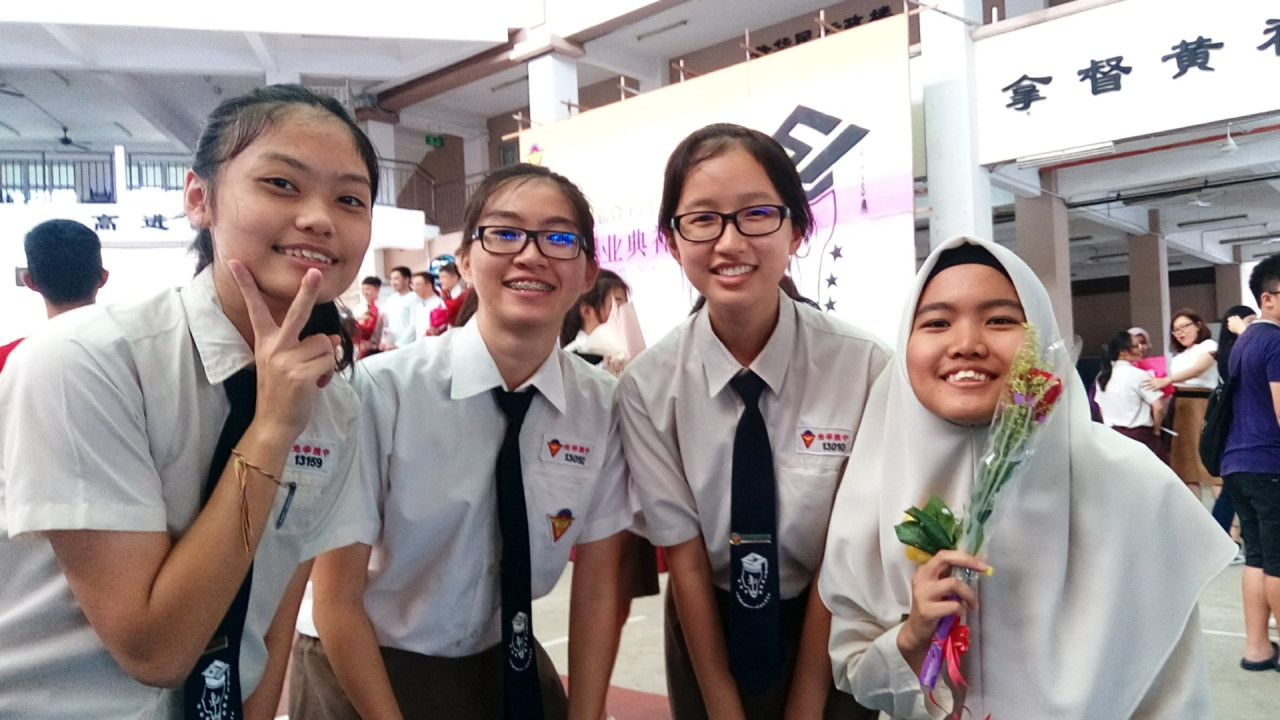
The former Kwang Hua Private High School student said she had to attend tuition classes just for the SPM exam.
“I was also afraid that I would be behind on my UEC subjects. I took extra tuition for SPM, especially for history.
“I was so stressed out juggling SPM and UEC studies at that time, I almost gave up. I didn’t have enough credits for my UEC qualification to enrol into private universities.”
Farhana said it was at that moment her mother realised the importance of the SPM certificate and pushed her to apply for local universities, such as Universiti Teknologi Mara (UiTM).
“At that time, my mom finally realised the importance of SPM and told me that our relatives were all studying in UiTM and I should try applying.
“I eventually got in, and that was when I realised the relevance of the SPM certificate. But students in my school didn’t know about the lack of UEC recognition locally and that we can actually enrol in public universities that are affordable compared with private institutions.”
Pricier than national schools
On the other hand, UEC graduate Nur Faziera Mohd Nasir has a different sentiment, saying it was an enjoyable studying experience sitting both examinations.
“I have never once wanted to give up, probably because I liked studying with my friends. In Chinese private schools, we only need to pay a fee to have teachers come in to teach SPM subjects.
“In my school (Chung Hua Independent High School, Klang), there were different schooling hours – 8am to 3pm for UEC subjects and 3pm to 5pm or 6pm for SPM subjects.
“The teachers knew we were tired, so they incorporated some fun in their teaching.”
When asked about the pros and cons of studying in a Chinese private school, she said one disadvantage was that it was a financial burden for her father.
“The school fees were high. For instance, in Junior year, it costs about RM200 to RM300 per month, whereas in Senior year, it’s about RM350.
“Chinese private schools are different from national schools. I do not come from a rich family. It was a burden to my father. The good thing was, my school provided scholarships and I managed to get one.”
Homogenous environment
However, Sharon – not her real name – who went down the same path as the rest of the interviewees, said she would have opted to attend a national-type secondary school (SMJK) if she could turn back time.
“After completing my studies at National Taiwan Chengchi University, I realised that I didn’t have many friends from different races and I faced severe language barriers when communicating with others.
“It would have been better if I could have had the chance to explore and mingle with friends from different backgrounds during my secondary school days.
“I am lucky enough since I work in a very mixed environment now. However, some of my friends are still working in fairly Chinese environments and I can see that they lack understanding towards other races and it’s quite difficult for them to come out of their comfort zones,” said Sharon, in her 20s, who spoke on condition of anonymity.
When asked about her hopes for the future of UEC in the country, Sharon said she hopes the government, particularly the Education Ministry, will officially acknowledge the examination as a legitimate entry requirement for local tertiary institutes.
“I understand that recognising the UEC is a long-standing and sensitive issue in Malaysia because of our history and racial tension, especially when the UEC schools syllabus is taught in Chinese, except certain subjects like accounts, which we learnt in English.
I believe that the Education Ministry and Dong Zong should, up to some extent, find a compromise if they really want to reach a consensus.
“I understand that it needs strong political will to solve this issue as it will take time. It’s impossible to satisfy all parties but we need to start somewhere.
“Since it will be a long and ongoing project, the people need to see the authorities, from the government to civil societies like Dong Zong, are doing something about it and have not appeared to have forgotten about it after the general election – merely a manifesto promise.”
Dong Zong (United Chinese School Committees’ Association of Malaysia) and Jiao Zong (United Chinese School Teachers’ Association of Malaysia) – now known as Dong Jiao Zong – are champions of Chinese education in the country and Chinese-community-run education.
UEC recognition stalled
In Pakatan Harapan’s (PH) 2018 general election manifesto, the coalition promised to resolve the matter of UEC recognition – one of the country’s longest-standing education issues.
Things appeared to have started off on the right foot following PH’s election victory, when then education minister Maszlee Malik set up a special task force to study the issue.
Last January, the Simpang Renggam MP resigned as minister following fierce pressure stemming from other issues. The appointment of Tun Dr Mahathir Mohamad as interim education minister all but threw a spanner in the works for the task force.
Not even a threat by PH component DAP to quit the ruling government if the UEC promise was not fulfilled was enough to push Dr Mahathir to move forward.
Just a few months later, infighting within the coalition led to the collapse of the government, dashing the hopes of many to get the certificate formally recognised. – The Vibes, October 9, 2021
Related stories
Malay rights groups dispute recognition of UEC for tertiary study