OpenAI’s ChaptGPT was launched in November 2022 and has taken the world by storm. There has since been a rise in the number of generative AI (artificial intelligence) tools being made available, with new releases on an almost daily basis.
Tools such as ChatGPT and Google’s Bard appear almost magical in what they can do. You can ask them almost anything and they will respond with a coherent answer that is syntactically and grammatically correct. Speaking as somebody who has lectured, researched and edited scientific journals on artificial intelligence, I am amazed at the advances that have been made in recent years.
It is not just text that these AI tools are able to generate. Midjourney and Descript, along with many others, can create images and videos and, like AI-generated text, the results are impressive.
The effect of generative AI
Many industries are both worried and excited about this new generation of AI technologies. It presents a double-edged sword to, say, journalists, who can use these tools to generate “copy” but are also aware that many others can now create articles via a simple prompt.
Authors face similar challenges, with examples of books being written in their style, using their name by somebody asking generative AI to create a book. These are openly for sale on markets such as Amazon.
Photographers are not immune. They know that images that may take them hours, or even days, to capture can now be created in seconds. Realistic images, that do not actually exist in the real world, are within easy reach of those sitting in front of a computer.
Artists are finding images on the internet which are based on their style. These have been generated by somebody asking for an image in the style of that artist. This is possible as the AI knows about the artist, and their style, as it has trawled the internet when building its underlying model, and used the images it finds. This raises questions about copyright, and if these AI tools justifiably use these images as part of its learning.
The list of sectors that are affected by these new generative AI tools is almost limitless, with almost every sector of society being impacted, whether that is call centres, marketing, manufacturing or finance. In truth, it is difficult to name a sector that will not be impacted by AI, indeed, that is not already being impacted.
Tertiary education
The education sector has certainly not escaped from the effects of AI and whether it is cause for celebration or worry is a matter for debate.
Some of the pros and cons, about tertiary education, are:
· It helps non-native English speakers check their grammar. Whether the use of AI to improve your English should be declared or not, is open to debate.
· Generative AI can be used to write parts (all) of a research paper. If this is done, current guidelines say that this should be declared but it can be difficult to check whether a paper has been AI generated.
· Assessment is made much more difficult as writing an essay, for example, can easily be delegated to AI and, like research papers, it can be difficult to detect.
· “Paper Mills”, write (often fake) scientific papers, which they then sell to those that want to be an author. These paper mills now have access to tools that they could only dream about a couple of years ago.
This is just the tip of the iceberg of the challenges and opportunities that tertiary education faces. The one certainty is that AI is here to stay, we cannot ignore it and we have to learn to live and adapt to this changing world, the pace of which is only going to get faster and faster.
Free seminar on aspects of AI
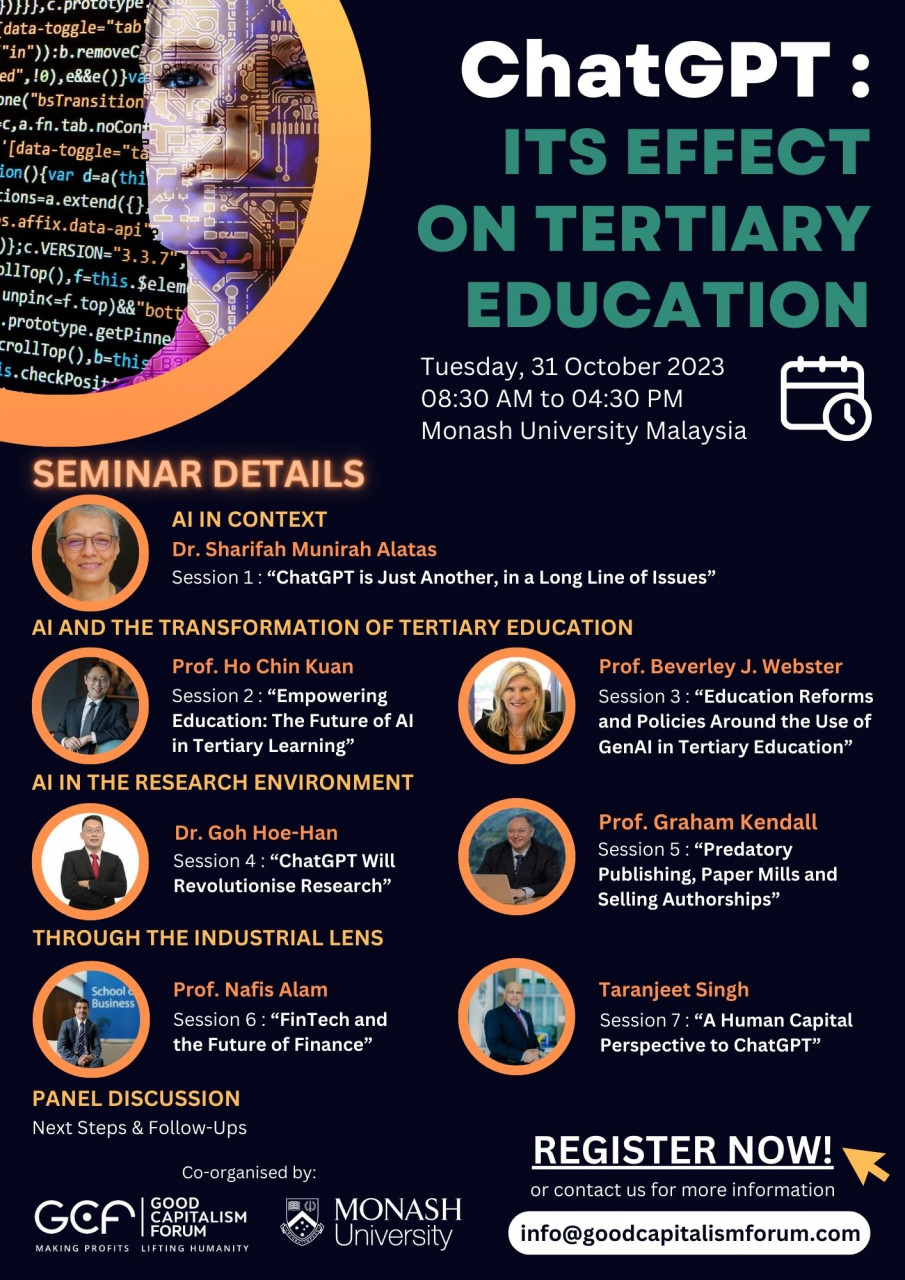
The Good Capitalism Forum and Monash University Malaysia are holding a free seminar on Tuesday October 31 (8.30am to 4:30pm) at Monash University in Bandar Sunway, Subang Jaya. It will feature seven speakers, looking at different aspects of AI and how it affects tertiary education, both good and bad.
If you would like more details, either as somebody interested in attending or being a sponsor, drop an email to [email protected], using the code “GPTVibes” in the subject line.
If you want to go ahead and register, follow this link: https://forms.gle/i5mMdeyCJYHRXajX6 . – The Vibes, September 10, 2023
Prof Graham Kendall is the chief executive of the Good Capitalism Forum, an emeritus professor of computer science and a previous editor-in-chief of an AI journal. He has recently published on the topic of predatory publishing, including the use of generative AI.