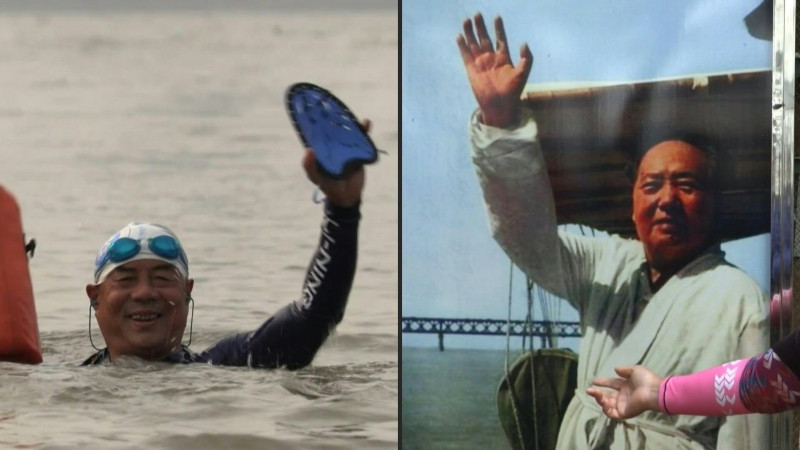
WUHAN – "I felt so happy, it was like being reborn," the 68-year-old said.
Even in winter temperatures of about 15 degrees Celsius, a steady flow of hardy men and women wade into the brown waters of the mighty river and swim into the distance.
The tradition pre-dates Mao, but it was embedded in Wuhan's consciousness in 1966 when the then-73-year-old founder of communist China launched a political comeback with a carefully staged swim to prove he was in robust health.
The riverbank is also usually alive with people singing, dancing, flying kites, fishing or simply enjoying a romantic walk.
All that stopped when the coronavirus emerged in Wuhan about a year ago. The city of 11 million people was placed into a strict lockdown in January that dragged on for 76 days.
Some even feared that the waterway might somehow be carrying the virus, which killed nearly 4,000 people in Wuhan according to Chinese figures.
"We did not swim for a few months after the city was closed and basically did not swim here from the end of January to the beginning of April," said the retiree Shen.
'Children of a river city'
At about 6,300 km and stretching from Tibet to the East China Sea, the Yangtze is the third-longest river in the world.
Together with a tributary, the Han River, it slices through Wuhan, and the two waterways are the central city's lifeblood.
Standing in her swim suit and now gleefully back to her daily afternoon swim, Shen gestures to a life-sized picture of a waving Mao on the riverside.
Shen says she did not learn to swim until she was in her 50s and like many others was inspired by Mao several decades earlier.
"We saw that chairman Mao in his 70s was still swimming in the Yangtze so we learnt from him to swim in the big waves of the river," she said.
"We're sons and daughters of a river city and people living by two rivers and four banks.
"Having such a good source of water, we must swim in the Yangtze River."
Taking the plunge
Mao made it famous but according to locals, people traditionally swam in the river in Wuhan because there used to be no pools, and the city is fiercely hot in summer.
But even on a recent damp afternoon dozens of swimmers – most of them male and in late middle age or older – stripped down to their trunks.
As a small crowd watched, the swimmers packed their belongings in orange flotation devices, did some stretches, then plunged into the river.
Some swam close to the riverbank in organised groups. Others went it alone or in pairs heading for the middle – even as vessels plough the waterway, which is up to 2,000m wide.
Many belong to various amateur swim teams and, underlining just how ingrained swimming in the river is in Wuhan life even today, there is a museum celebrating it.
'We might have died'
Zhang Jianmin is another who puts his enduring good health down to his bracing swims in the Yangtze.
But the 65-year-old also rescues people who get into trouble in the water, usually those who fall in.
Zhang leads Wuhan's river rescue team, which has about 2,000 men and women, all volunteers.
It lost its founder to coronavirus, something Zhang is not keen to dwell on.
He is more willing to talk about the 700 people they have saved from drowning since the team was established in 2010.
Zhang's most memorable rescue is the time when a little boy tumbled into the river, causing his father to jump in to save him, only he also could not swim.
"I was sitting here, next to the water, after swimming," said Zhang.
"We could see the father hugging his child but we could see their heads going up and down (under the water) so we jumped in and I was in first."
He admits it was chaotic, not a text-book rescue, but the father was still conscious and able to throw the boy towards Zhang.
"The kid was really scared and he clung onto my neck so hard that I couldn't breathe," he said.
"I was out of breath, swimming for the riverbank. Fortunately, it wasn't far.
"If it was a little farther, we might have died." – AFP, December 20, 2020