Animals

Ape escape: Indonesian orangutans airlifted back to the wild

The fuzzy-haired creatures were sedated with tranquillisers before their flight

Updated 5 years ago · Published on 24 Feb 2021 8:00AM

Ape escape: Indonesian orangutans airlifted back to the wild
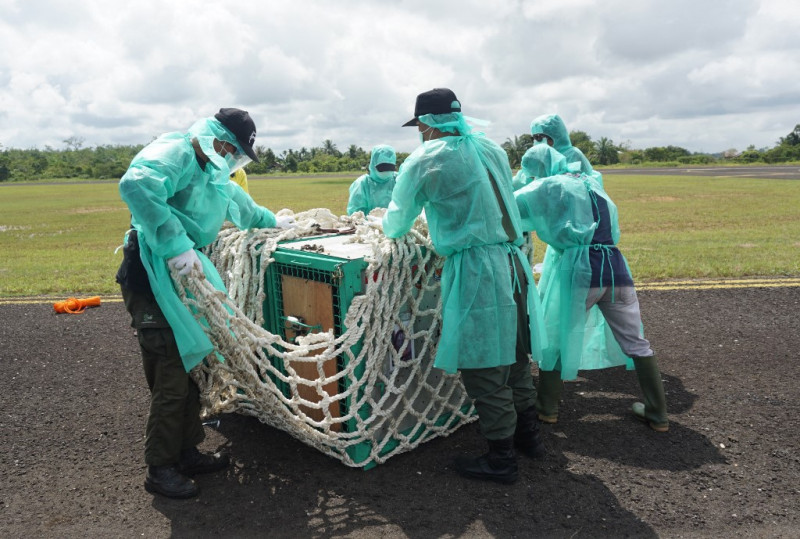
This handout photo taken on February 15, 2021 and released by the Borneo Orangutan Survival Foundation on February 23 shows conservationists handling a transport cage containing an orangutan, which was flown to location via helicopter, ahead of its release into the Bukit Batikap Protection Forest in Gunung Mas, Central Kalimantan. – AFP pic, February 24, 2021

JAKARTA – Ten orangutans have been airlifted back to their natural habitat on Indonesia's Borneo island, in the first release of the apes into the wild for a year due to the dangers of coronavirus infection.

The animals were flown by helicopter across the island's dense jungle earlier this month to keep them away from days-long land and sea routes that could expose them to the virus.

Orangutans share 97% of humans' DNA so conservationists have been on high alert for signs of infection. The pandemic has thrown up unprecedented challenges for conservation efforts.

"For an entire year, we have not been able to release orangutans due to the global pandemic," said Jamartin Sihite, chief executive of the Borneo Orangutan Survival Foundation (BOSF).

"We have implemented strict health protocols and introduced mitigation plans to be enacted in the event of an orangutan contracting the virus. The use of a helicopter... helps reduce the risk of spreading Covid-19."

The fuzzy-haired creatures were sedated with tranquillisers before their flight and were shuttled inside transport cages encased in netting.

At least one of the moon-faced animals banged on its cage's metal walls as it tried to make sense of the airborne mission.

The apes took a short boat trip after touching down, before arriving at the Bukit Batikap Protection Forest in Central Kalimantan – part of Indonesia's section of Borneo – where they took to swinging on vines.

Several apes were also released into another forest in East Kalimantan.

Poaching and habitat loss decimated the Southeast Asian nation's orangutan population before the coronavirus emerged as another potential threat to the critically endangered species.

"If an orangutan shows symptoms of respiratory problems, it's possible that it has been infected with Covid-19," said Vivi Dwi Santi, a veterinarian with BOSF.

"Also, if one of the staff tests positive... we will conduct tracing on an orangutan that's been in contact with them." – AFP, February 24, 2021


Related News

Malaysia / 5d

Child safety a priority in facing the increasingly worrying haze threat

World / 1w

Powerful earthquake strikes off coast of Indonesia; tsunami warning issued

Events / 3w

Former Indonesian president in Penang next month for inaugural Peace Dialogue

Malaysia / 2mth

Police investigate viral video of alleged cat abuse by restaurant worker (video)

World / 2mth

Trump's health: Weighs 108kg, heart age 14 years younger, hands bruised from frequent handshakes – Doctor

Malaysia / 3mth

Government’s RM5.7 billion spending cut a bold move to curb waste, says PKR leader

Spotlight

Malaysia

Elderly man admits to hitting neighbour with iron rod

Malaysia

Body found at KLIA2 in tyre storage compartment of aircraft from Japan

Malaysia

Factory operator faces rape, unnatural sex charges involving polytechnic student

Malaysia

Ismail Sabri granted RM300k bail after pleading not guilty to asset declaration charge

By Alfian Z.M. Tahir

Malaysia

Sunway Lagoon ride halted as safety probe seeks to protect public - DOSH

Malaysia

Malaysia ready to deploy military expertise for Nepal flood relief, says Defence Minister

Malaysia

Violence in Thailand: Visitors drop by almost 50 per cent

By Ian McIntyre

You may be interested

Places

Overwhelming response for Penang’s reopened museum

By Ian McIntyre

Tech

Australia’s under-16 social media ban begins to show cracks as TikTok use rebounds

Health

MOH weighs HFMD vaccine strategy as cases plunge 83%