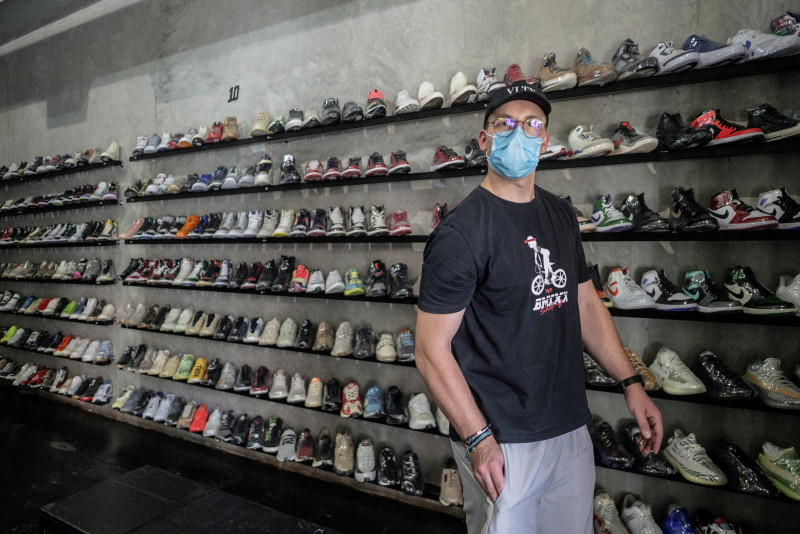
QUEUEING outside an upmarket Johannesburg clothing store, young fashion lovers hope to lay their hands on the latest sneakers to come out of the United States.
For South Africa's city dwellers, sneakers are more than just shoes.
As a marker of personality as well as social status, they are cared for and worn with pride, and youths compete to hunt down the rarest models from a market flooded with old and new sneakers – including many fakes.
"Sneakers kind of tell your story," graffiti artist Rasik 'Mr.ekse' Green said as he was spray-painting a commissioned mural on the rooftop of a building in downtown Johannesburg.
Green's elaborate graffiti designs – which he also uses to redecorate and personalise sneakers – are highly sought after.
The shoes are often an expression of geographic roots in a country with 12 official languages and dozens of ethnicities.
"For instance, we know Cape Townians love their bubbles," said Green, referring to a chunky, thick-soled Nike design.
And residents of the Johannesburg township of Soweto "love their (Converse) All Stars", he said. "It's kind of a code."
The athletic footwear craze is linked to African American hip-hop culture, which infuses South Africa's rich musical heritage as well as its fashion.
Collecting and trading shoes has become a hobby in Africa's most industrialised nation, with aficionados known as "sneakerheads".
In 2019, 800 pairs of Reeboks, created in a limited edition in collaboration with South African rap sensation AKA, sold out 10 minutes after their online release.
A South African brand, Bathu – slang for "shoe" – conquered the local market with a unique mesh design.
While its low-end sneakers cost R1,300 (US$84 or RM347), Bathu came out with a limited edition, the Opel GSI, with only 80 pairs which it sold for R397,000 each in June 2019.
"That wouldn't have happened 30 years ago," Green said.
But another designer, Andile 'ScotchIsDope' Cele, warned that sneaker fanaticism is "becoming about class."
Paying extravagant amounts for the shoes is "almost like an investment to say, you're helping yourself, so that you can live with these (wealthy) people... almost like 'fake it till you make it' type of thing."
Worn 'art piece'
Sneakers have not always been viewed positively in South Africa.
Gangsters terrorising townships during the 1980s often wore Chuck Taylor All Stars, a high-topped stitched canvas shoe manufactured by the US firm Converse.
The sneakers, originally designed as basketball shoes, acquired a "thug" reputation that stuck.
"My parents didn't want me to get a pair because it was mixed up with a certain culture that was for criminals," recalled Hector Mgiba, 28, who has an extensive collection of Converse All-Stars.
He said Converse shoes were also associated with "pantsula", a dance born among young black township dwellers as a form of protest against apartheid, and snubbed by older generations.
"Pantsula" dancers typically wore smart shirts, flared trousers and All-Stars – perfect for their quick steps and hops.
Mgiba, a teenager at the time, saved up to buy a second-hand pair behind his parents' back.
"I loved it so much and I wanted to pave my own way to how I express myself," he said.
"The way it fades when it gets worn out, it becomes more of an art piece."
A popular music genre known as Kwaito that emerged in Soweto during the 1990s cast Converse into a new light.
Dancers in colourful All Stars turned the shoe into a symbol of township youth in post-apartheid South Africa.
Today the rubber-soled shoe is worn with both formal fitted suits and casual dress by young South Africans of all backgrounds and skin tones.
'Bringing us together'
As demand for sneakers has grown, local entrepreneurs have become fierce rivals to international brands.
Unable to afford the latest sneakers as a young boy, local designer Lekau Sehoana made his first pair of sneakers from worn-out shoes, old jeans and polyurethane.
His 'Drip' footwear brand, launched in 2019, gained popularity with its brightly coloured bubble soles and stretchy material.
Sehoana now uses part of the company's earnings to make shoes for children in townships.
"I guess it's one way of uniting us and bringing us together, as a people, as a country, as different races," Green said.
"Besides all our differences, at least we share one common thing... shoes." – AFP, March 10, 2021