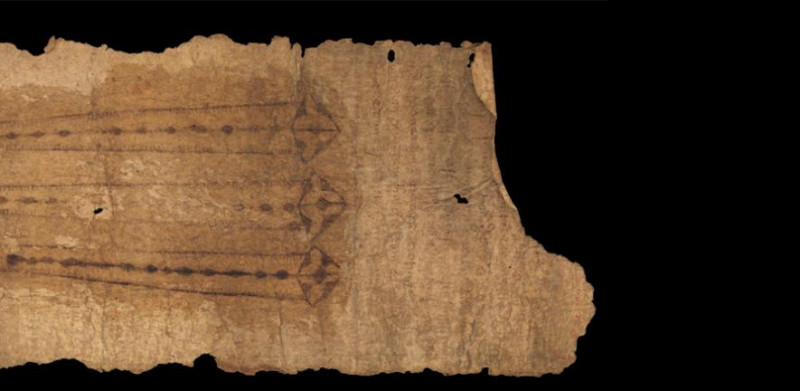
A 15th century "birthing girdle", inscribed with prayers and a well-thumbed crucifix image, was likely actively used in medieval childbirth, according to new research on one of the few such sashes not destroyed by time or religious revolutionaries.
With a delicate technique that uses the crumbs from plastic eraser rubbings, scientists were able to identify biological marks on the fragile sheepskin parchment.
They found traces of honey, milk, egg and cereals, as well as cervico-vaginal fluids "which indicated active use in childbirth", said lead author Sarah Fiddyment of Cambridge University's McDonald Institute for Archeological Research.
The study published last Wednesday said it "proved what was long suspected", that the girdle was not just a talisman to be worn during pregnancy, but was also a part of the ritual of labour and childbirth.
With little surviving first-hand evidence from medieval women themselves, the research shines a new light on women's health and obstetric care in a period when "accounts of childbirth were largely written by men", said co-author Matthew Collins, of the University of Copenhagen.
Ten centimetres wide and over three metres long, the girdle is covered on both sides with images and invocations that researchers believe were wrapped around a woman's body and placed strategically over her womb to imbue protection.
Its use "shows that women were using highly formulaic rituals that blended the numerical precision and incantation of magic with religious protection," the study said.
At this time childbirth was the leading cause of death for women and the study said the neonatal mortality rate for mother and child was thought to be somewhere between 30 and 60 percent.
With little that we would recognise as medicine, early midwives offered amulets, precious stones and plant-based remedies that had ingredients similar to those found on the girdle.
One recipe in Trotula, the 12th century manual on women's health, advised a mixture of "one scruple of opium poppy, one scruple of goose fat, four scruples each of wax and honey, one ounce of oil, the whites of two eggs, and the milk of a woman".
The study is the first to analyse proteins from a historic parchment document with the non-invasive eraser rubbing technique, which had previously been used to detect the animal source of parchment.
"The fact that we have been able to detect these specific additional non-human proteins further reinforces the evidence that this girdle was actively used in late pregnancy and childbirth, and also gives supporting evidence that these documented treatments were actually used," Fiddyment said in a press release from Cambridge.
'Clandestine' talisman?
Girdles -- made of silk, iron, parchment, or snake or deer skin -- were used particularly by wealthy women during pregnancy and one was even ordered for the wife of King Henry VII, the study said.
They were often leased out by the medieval Church, along with a host of other relics and talismans claiming to offer protection.
But this came to an end in the Reformation in the 16th century, with what would later come to be known as the Dissolution of the Monasteries between 1536 and roughly 1541.
"The raids were particularly vicious in targeting centres relating specifically to the veneration of female saints, much of which focused on childbearing and pregnancy," the study said.
Beyond the residue of birth, researchers have few other clues about the history of the girdle, including whether it was hidden and later used in secret.
"Given that this girdle was not destroyed by Reformers and given the heavy wear... it may be that this was a clandestine girdle used up until the early seventeenth century," the authors said. – ETX Studio, March 15, 2021