HOLY Week, or Passion Week, is the most solemn week, or as the name itself implies, the “holiest week” for Catholics and other mainstream Christian denominations like the Anglicans and Lutherans all over the world.
This year, Holy Week began last Sunday, on March 28, with the celebration of Palm Sunday. It will conclude with Easter Vigil on Saturday, and Easter Sunday the following day.
Two other epic events are also celebrated during Holy Week, that is, Holy Thursday and Good Friday. Holy Thursday, also known as Maundy Thursday, commemorates the Last Supper Jesus had with his disciples prior to his arrest and crucifixion on Good Friday (celebrated today).
Holy Week is the last week of the season of Lent, which is 40 days of fasting, praying, almsgiving, and abstinence from all that is delightful to the flesh.
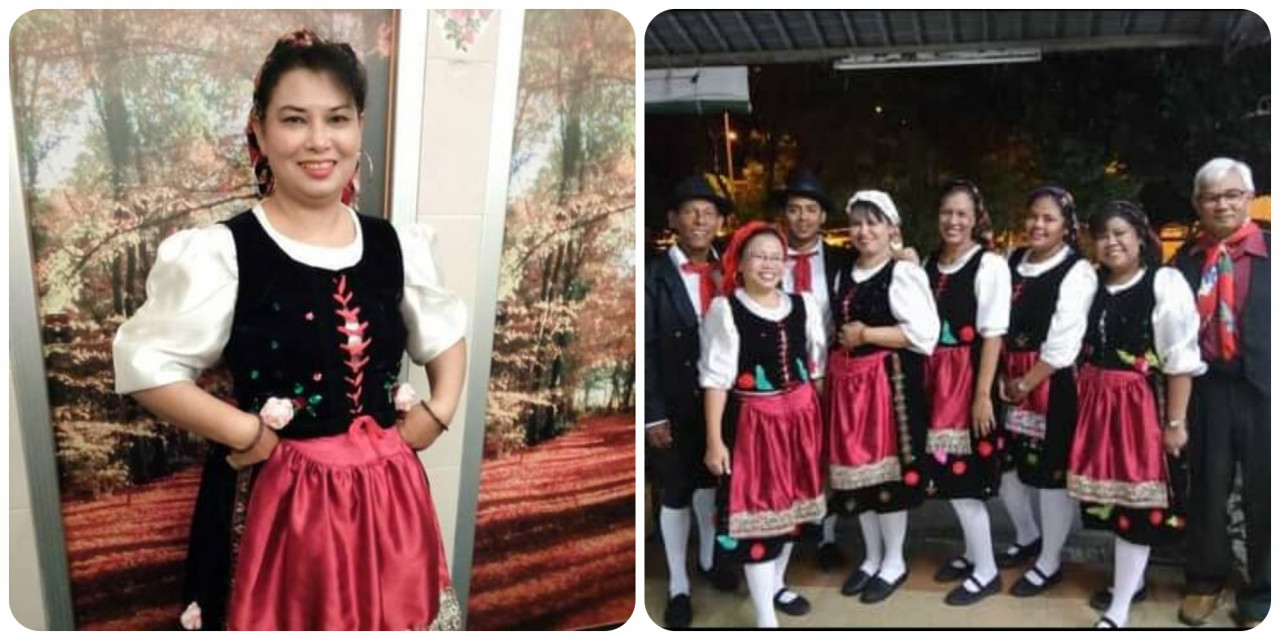
In Melaka, the Portuguese Eurasians celebrate Holy Week with great reverence, steeped in their in-cultured traditions and rituals, flaming candle-light processions, and poignant punctilios. These distinct Holy Week practices have over the decades grown to become an annual attraction to the Catholic faithful in the country and tourists alike.
Tourist brochures, too, list these “uniquely Melakan” Holy Week traditions in their monthly itinerary, causing busloads of people from as far as Singapore and Penang to overwhelm St Peter’s Church at Jalan Bendahara during the annual Holy Week.
Put paid by pandemic
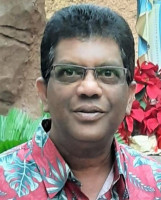
Retired government servant, Gerard Pereira, 66, is among the few remaining descendants of the first Portuguese conquerors of Melaka who invaded the ancient port city in 1511. Pereira lives at the iconic Portuguese Square with his wife and children.
He tells The Vibes: “Not only we, but the entire Catholic community of Malaysia and those from Singapore too are dearly missing the special way Holy Week is celebrated at St Peter’s in Melaka.
“Last year was the first time that our centuries-old special Holy Week celebrations failed to materialise due to the pandemic lockdown. We hoped the Covid-19 infections would have eased by Holy Week this year, but here we are, unable to celebrate our special rituals and traditions again. It means a lot to us to celebrate Holy Week as inspired by our forefathers.
“Usually during the last week of the Lent season, Melaka will be packed with visitors, and hotels here will register 100% occupancy with Catholics and tourists from outstation, who would come down with their families to participate in the Palm Sunday, Holy Thursday, Good Friday, Holy Saturday and finally, Easter Sunday events.
“Although Holy Week is itself sacred and auspicious, there will be an air of festivity as Easter draws closer. There is a feeling of fulfilment on the night of Holy Saturday when the new light of Easter is lit, and the ‘Gloria’ is sung with church bells tolling ceaselessly to hail the Resurrection of Jesus from the dead.”
According to Pereira, every Friday of Holy Week will see the residents of the Portuguese Square taking part in the Way of the Cross or Via Dolorosa. He explains that the Way of the Cross re-enacts Jesus’s walk up Calvary Hill bearing the wood of the cross on which he will be crucified and breathe his last.
There are 14 stop-points or stations along the Way of the Cross, each commemorating 14 important events that had taken place during Jesus’s actual forced march up Calvary Hill carrying his instrument of death.
“Unfortunately, we were not able to do this last year and this year according to the guidelines listed in the pandemic standard operating procedures,” Pereira laments.
.jpg)
‘Datuk pikul balak’
Sara Frederica Santa Maria, another descendant of the Portuguese conquerors, tells The Vibes that her community is very disheartened that they are not able to celebrate Holy Week in the way that they usually do.
“This is the second consecutive year that we are unable to put our efforts together to deeply express our sense of devotion to Holy Week in our special way,” says Sara, who lives with her Sabahan husband Sikim Gompongon and four sons.
According to Sara, some of the unique Holy Week traits are a combination of Portuguese as well as Catholic Peranakan influence. She says the Peranakan Catholics refer to the Way of the Cross in their colloquial terms as “Datuk Pikul Balak”. And they refer to Good Friday as “Datuk Mati”.
“On Palm Sunday, there will be two processions to re-enact the triumphant entry of Jesus into Jerusalem in the morning and another Way of the Cross-candlelight procession in the late evening,” says Sara.
“It may appear a little odd for the Way of the Cross to be held on Palm Sunday as it is usually held on Fridays, but it is a special devotional practice of the Augustinian missionaries that is still held to this day,” adds Sara.
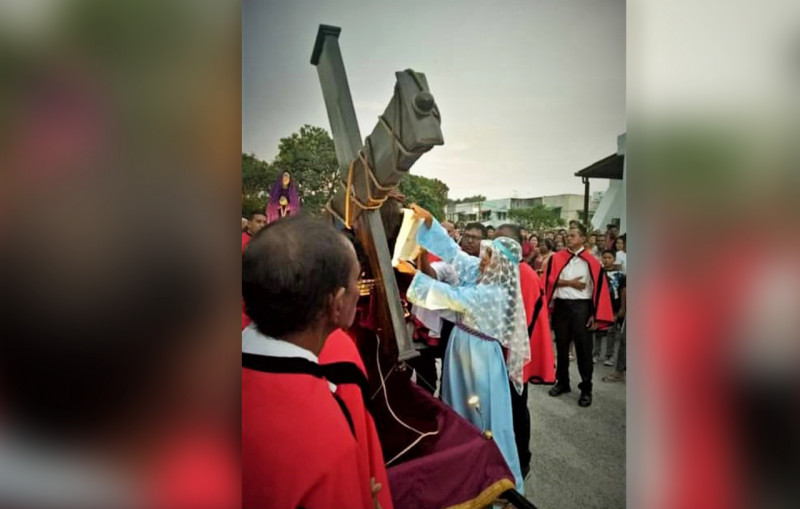
The procession begins after the celebration of the holy mass led by two members of the Irmaos de Igreja (Brothers of the Church). A wooden statue resembling Jesus carrying the cross and another wooden replica of his sorrowful mother are carried around St Peter’s Church, accompanied by people holding green palms and candles.
‘Veronica wipes the face of Jesus’
“It is here, where a moving scene ensues, when a young girl steps out from the crowd to wipe the face of Jesus with a veil, then unfolds it to show the imprint of Jesus’s face to the crowd.
“This is a re-enactment of the sixth station of the Way of the Cross, where the Gospels in their Passion story make reference to a young girl called Veronica who wipes the face of Jesus as he makes his way up Calvary,” Sara explains.
Pereira further explains that on Good Friday, another unique remembrance of Jesus’s crucifixion and death is expressed, where a life-sized statue of the lifeless body of Jesus is carried in procession on a wooden bier with three women acting as the “Tres Marias” (The Three Marys) follow alongside as a poignant dirge in Latin is sung.
According to Pereira, there are documents attesting that the unique Holy Week cultural traits at St Peter’s, one of the oldest Catholic churches in Malaysia, were introduced by the Augustinian missionaries when they first brought the seeds of the Gospel to the shores of Melaka.
Pereira also said the “Irmaos de Igreja” – a special “crack unit” referred to as the Brothers of the Church and dressed in their red mantle – are the custodians of the Holy Week celebrations since the 15th century.
“They too were introduced by the Augustinian missionaries to keep the Holy Week devotions intact till this day. They are believed to be the oldest Catholic society in Southeast Asia,” adds Pereira. – The Vibes, April 2, 2021