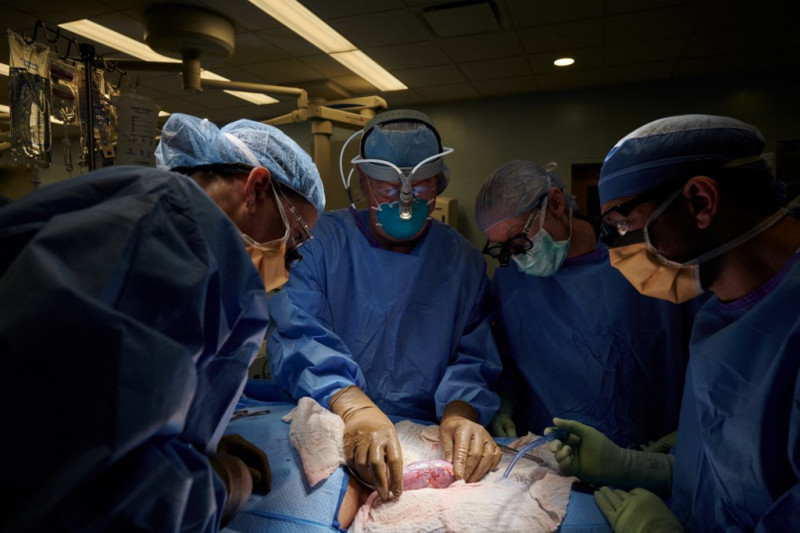
WASHINGTON – A US medical team has succeeded in temporarily attaching a pig's kidney to a person, a transplant breakthrough hailed as a "potential miracle" by the surgeon who led the procedure.
The surgery, carried out on September 25, involved a genetically modified donor animal and a brain dead patient on a ventilator whose family had given permission for the two-day experiment, for the sake of advancing science.
"It did what it's supposed to do, which is remove waste and make urine," Robert Montgomery, director of the transplant institute at New York University (NYU) Langone, told AFP in an interview.
Critically, the organ was able to reduce the level of the molecule creatinine, a key indicator of kidney health that was elevated in the patient before the transplant.
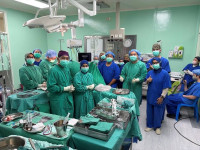
Montgomery carried out the surgery with several colleagues for around two hours.
They joined the kidney to blood vessels on the top of one of the patient's legs, so that they could observe it and take biopsy samples.
The patient had wanted to be an organ donor and their family was initially disappointed when told their loved one's organs were not suitable, said Montgomery.
But "they felt a sense of relief that this was another opportunity for donation," he said. The patient was taken off the ventilator and passed away following the 54-hour test.
'Important intermediate step'
Earlier research has shown that kidneys from pigs are viable in nonhuman primates for up to a year, but this was the first time it had been attempted with a human patient.
The donor pig belonged to a herd that had undergone a genetic editing procedure to knock out a gene that produces a particular sugar, which would otherwise have triggered a strong immune response and led to organ rejection.
The editing was performed by biotech firm Revivicor, a subsidiary of United Therapeutics.
"It is still a question what would happen three weeks from now, three months, three years," said Montgomery.
"The only way we're really going to be able to answer that is to move this into a living human trial. But I think this is a really important intermediate step, which tells us that at least initially, things are probably going to be okay."
He plans to submit the findings to a scientific journal in the next month, and says a clinical trial could take place in around a year or two.
The news was welcomed cautiously by outside experts, who nonetheless said they would like to see the peer-reviewed data before drawing firm conclusions.
"This news is a significant scientific achievement in the xenotransplantation field," Hynek Mergental, a surgeon at the University of Birmingham in Britain said in a statement.
If confirmed, "it would be a major step forward in the organ transplant field that might solve the critical shortage of donor organs," he added.
Organ shortage
The news comes amid a dire shortage of transplant organs.
According to official US data, nearly 107,000 Americans are awaiting an organ – 90,000 of whom need a kidney. Seventeen Americans die each day while waiting for an organ.
To meet demand, doctors have long been interested in so-called xenotransplantation, or cross-species organ donation, with experiments tracing back to the 17th century.
Early research focused on harvesting organs from primates – for example, a baboon heart was transplanted into a newborn known as "Baby Fae" in 1984, but she survived only 20 days.
Today, pig heart valves are widely used in humans, and pig skin is grafted on human burn victims.
Pigs make the ideal donors because of their size, their rapid growth and large litters, and the fact they are already raised as a food source, said Montgomery.
For Montgomery, the research has a personal dimension: he himself was on a waitlist for a heart transplant, which he finally received two years ago.
The technique could one day provide a "renewable source of organs," much like wind and solar provide sustainable energy, he said.
"I think people will see that and accept that, particularly the people who are waiting and desperate – they will see this as a potential miracle for them as we move this forward." – AFP, October 21, 2021