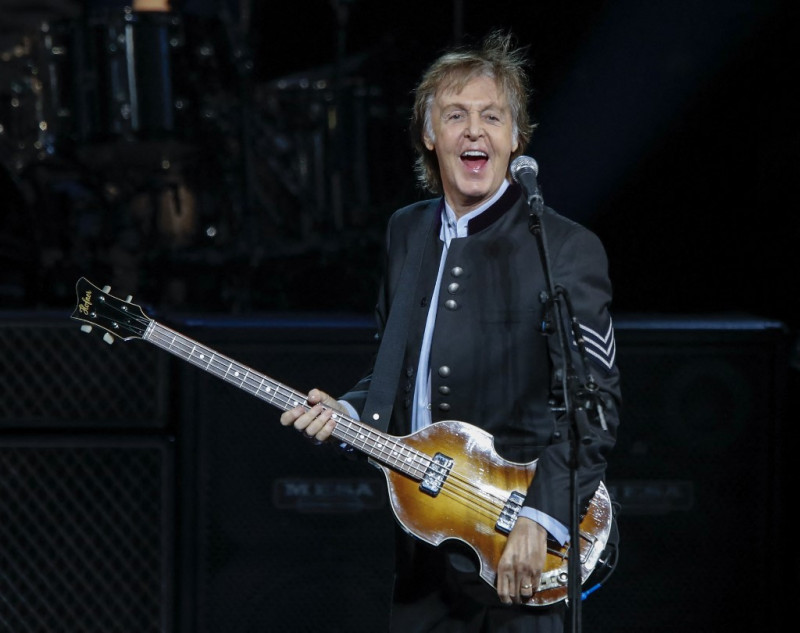

WHAT more is there to be said about Paul McCartney, who turns 80 years old today.
Generations of pop music fans have grown up listening to the music he created as a member of The Beatles (what more can be said about them), often working with John Lennon in an incredibly fruitful songwriting partnership in which they crafted some of the most enduring pop songs of all time.
By the time The Beatles broke up in 1970, after less than a decade, the band had produced a mind-boggling number of hits in such a small time frame, with Paul as its de facto leader after the unfortunate death of the band’s manager Brian Epstein and Lennon’s focus on his own music.
Late last year saw the release of the three-part and eight-hour-long documentary The Beatles: Get Back on Disney+ Hotstar. It’s not what you would call a tight and focused narrative, as it is mainly a rambling and discursive hangout film – but in the best way possible.
We see a band that is plainly on its last legs, easily distracted but held together by Paul as taskmaster. John, for his part, doesn’t really take the whole exercise seriously (and though it is not mentioned in the documentary, he and his paramour Yoko Ono were in the middle of their heroin phase).
George Harrison was aching to break free and be his own man. Ringo, well… Ringo was just chilling.
But together they could still crank out a hit single, it just took a bit more work.
Here’s a look back at five personal favourite Beatles’ tracks Paul put his stamp on from throughout their run of success.
Can’t Buy Me Love
Released in March 1964 as their sixth single, it was included in the Beatles’ third studio album A Hard Day’s Night – and was also featured in the film of the same name. Written by McCartney and credited to the Lennon-McCartney songwriting partnership, it would be the fourth highest-selling single in the UK in that decade.
This was during the first wave of Beatlemania hitting the US, so there was a need to get hit songs out to keep the momentum. Recorded in late January and late February 1964, it came out in mid-March.
Singing the vocals, McCartney – with the band still in their suits-wearing phase – had a surplus of charm, which helped him get the nickname ‘the cute Beatle’.
It’s not a terribly complicated song, being about how money can help with material possessions but can’t really help you get something you need, like love. Of course, that’s easy for someone at the beginning of their career.
He would later say "It should have been 'Can Buy Me Love'", after considering how much money and celebrity had given him.
Yesterday
Not to sound like a broken record, but what’s there to be said about this song, one of those most iconic ever written/sang/performed live, what have you. If we were to find an alien civilisation and wanted to send them a bunch of songs to understand us, Yesterday would be in the collection.
It was released on the album Help! in August 1965 and as a single in the US a month later, eventually reaching number one on the charts in the States.
While it is a Beatles track, it is undoubtedly Paul’s first solo performance, playing the melancholic ballad on a spare acoustic track with a backing string quartet. Its simplicity means it has been covered countless times over the decades by amateurs and professionals alike.
In 1999, a BBC Radio 2 poll voted Yesterday the best song of the 20th century, and in 2000 MTV and Rolling Stone magazine voted it as the Number 1 pop song of all time.
That might sound hyperbolic, but in terms of impact and legacy, it feels about right. The opening verse and the whole two-minute-long track ,are kind of perfection in their simplicity. A lament for melancholics everywhere.
Eleanor Rigby
A tale of loneliness and woe, wondering where all the lonely people go, as symbolised by the titular Eleanor Rigby.
In an article in The New Yorker from October of last year, McCartney said he was inspired by an elderly woman who lived alone whom he once befriended and would go shopping for. He would listen to her stories, saying, “just hearing her stories enriched my soul and influenced the songs I would later write.”
After writing the melody and the first verse, Paul presented it to his band mates who all pitched in different lyrics and musical choices. George “the 5th Beatle” Martin contributed a string section that helped move the song beyond pop music conventions of the time. This is part of the Beatles’ transition to their more experimental era.
Eleanor Rigby is also one of the few songs where Paul and John disagreed on the amount of credit each of them should have, with the latter sometimes saying he came up with most of the song.
Other people who were there for the creation of the song, say Paul deserved most of the credit. Perhaps this is just another testament to how good the song is on its own that the two songwriters wanted ownership over it.
Hey Jude
This is just one of those songs that is inescapable. If you’re a human adult somewhere on this planet (or in outer space), you’ve heard this song. You might not know what it’s about, or its lyrics (besides Na, na, na, na-na-na, na), but there’s something inedible about it.
Written by Paul to comfort John’s son Julian as his father was going through a divorce with his mum, the song is all about making the best out of a bad situation, which is as universal a human experience as there is. Things don’t always turn out the way we want them to, but we have to move on.
But the real power of Hey Jude comes from its coda, which takes up more than half the length of the song, which at 7 minutes and 11 seconds, is The Beatles' longest single. During live performances or even when it comes on at a bar or wherever, the coda is when the audience joins in and takes over.
There’s a real sense of community that comes from singing along together, which the simple lyrics help make happen. The rousing music helps end the song on an uplifting mood.
Personally, it also brings to mind an uncle named Jude who passed a few years ago. He played in a band and the last memory I have of him is Hey Jude being played during his funeral reception.
Let It Be
Let It Be was The Beatles’ final single before Paul left the band, seemingly wrapping a bow on one of the most successful runs in music history. Who knows if the band would have gotten back together if history had not gotten in the way, but the song was a fitting end to a tumultuous period.
Inspired by a dream Paul had where he reconnected with his mother, who had died about 10 years before, in which she calmed him by telling him to “let it be.” Having lost his mother when he was 14 years old, Paul saw the dream as a blessing.
Lennon was not a fan, saying in a 1980 interview with Playboy magazine: "That's Paul. What can you say? Nothing to do with the Beatles. It could've been Wings. I don't know what he's thinking when he writes Let It Be."
Extra track: Live and Let Die
Live and Let Die was written by McCartney with his wife Linda and performed by his post-Beatles group Wings, and was the first true rock song used to open a Bond film, which normally had ballads or orchestral numbers following the action-packed prologues.
The movie was also the first with Roger Moore in the role, so it was probably good to have another stylistic break from the Connery films.
The song has probably been overshadowed by Guns N’ Roses’ more explosive cover, but it’s a good showcase for Paul’s rock sensibilities when apart from The Beatles. – The Vibes, June 18, 2022