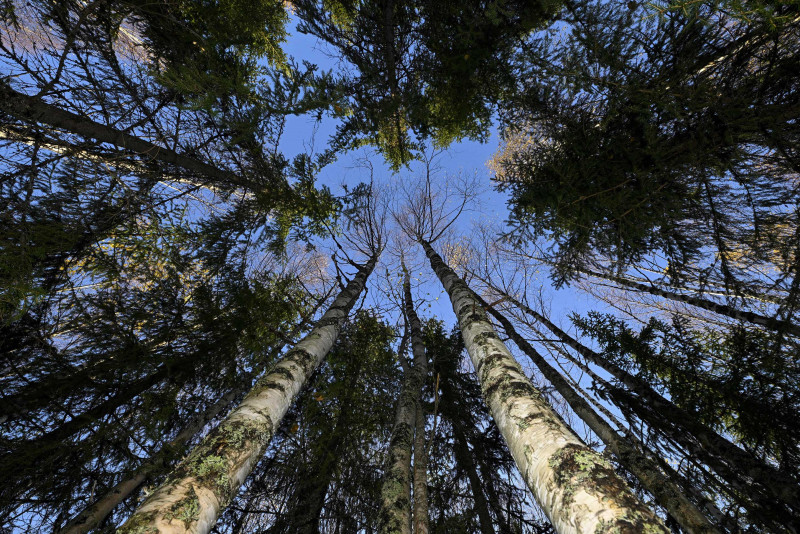
DEEP in the Finnish woods, the moss and blueberry shrubs hide a deadly threat to the boreal forests that are as important to the planet as the Amazon rainforest.
With chunks of their bark peeling off and needles falling from dying branches, more and more trees are being killed by the spruce bark beetle, which is venturing further and further north with climate change.
The tiny brown insects attack the Picea abies, one of Finland's most common tree species, and can cause massive damage to forests.
Burrowing through the bark to lay their eggs, the beetles eat their way around the spruce and kill it by stopping water and nutrients reaching the higher branches.
"The species has caused huge damage across Central and Eastern Europe, especially since 2018," Markus Melin, a scientist at the Natural Resources Institute Finland, told AFP.
With climate change, the risk of the beetle spreading is a "lot higher now", Melin added.
"We have to accept it and adapt to it. Things are changing fast up here."
While the threat is greatest in southern Finland, the sweltering summer of 2021 saw bark beetle damage "unusually high up north" in the Kainuu region of northern Finland.
'Nasty loop'
"It is well known that the spruce bark beetle is one of the species that benefit most from global warming," Melin said.
The beetles thrive on weakened trees. Hot summers mean there are more water-starved spruce, while warm winters mean there is no frozen ground to brace the trees against storms.
Warm weather also speeds up the life cycle of the beetles, meaning they can reproduce faster.
"Extreme warm summers benefit the bark beetle directly. They have less mortality, reproduction is faster," Melin said.
While the beetles normally go for weak trees, once their numbers reach a tipping point they can start attacking healthy ones.
"It becomes a nasty loop," Melin said.
If foresters do not react in time by removing weakened spruce, "suddenly there are so many beetles that they can attack healthy trees" further speeding the "cycle of destruction", Melin said. – AFP, December 12, 2022
.jpeg)