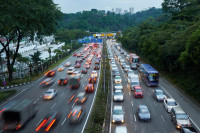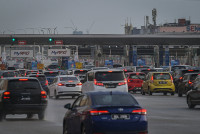
BEING stuck in traffic is stressful, wastes time and resources and ends up costing the world’s economies triillions of dollars a year. Jams happen daily and authorities have spent decades trying to fix the problem with little success.
Yet a solution may be literally under our feet. Ants.
There are an estimated 20 quadrillion ants on Earth. That’s more than the number of stars in the Milky Way (and possibly more than the number of stars in the entire observable universe). These ants – which can live in colonies that contain billions of individuals and can span thousands of kilometres – are nearly always moving yet somehow they never get stuck.
Like humans, ants have sophisticated transportation systems to ensure the efficient movement of individuals, resources and information.
Some ant species create systems using chemical signals called ‘pheromones’. If an ant finds an attractive food source, she returns to the nest dropping invisible droplets of pheromone behind her as she walks.
This is the basis of many ant transportation systems and enables ants to quickly gather workers to new food sources, allocate workers based on the quality of the food, and find the shortest path between points.
In the early 1990s, the trail-laying behaviour of ants inspired the incredibly successful ‘ant colony optimisation algorithm’ which is now used to tackle tough traffic problems such as determining the most efficient route for a fleet of delivery vehicles. Ants excel at managing traffic on their trails.
On human-built roads the average speed of cars decreases as the number of cars on the road increases: you simply can’t go fast when the road is crowded. Ants moving on their trails, however, do not slow down even when more ants join the trail.
How? In some cases, traffic congestion is prevented because ants switch from using a single trail when traffic is light, to using two trails when traffic is heavy. By dividing themselves across multiple routes, ants maintain traffic speeds and prevent congestion, effectively stopping traffic jams before they start.
Some ants also respond to increased traffic by leaving less pheromone, which decreases the attractiveness of a trail and may encourage ants to find alternate routes. Other ants appear to adjust their walking speed to avoid time-consuming collisions when ant trails become crowded.
Some ants manage traffic by travelling along their trails in small groups called ‘platoons’. Platooning is thought to increase the efficiency of ant trail systems by reducing the gaps between individuals. This concept is being investigated for self-driving cars as it reduces the need for sudden braking and helps prevent congestion.
It’s clear ants are masters at managing traffic on their trails but the billion-dollar question is whether we can apply what we learn from ants to our own traffic management systems.
There is one issue: humans are not ants.
Where ants on a trail share a common goal, human drivers are motivated by individual goals that may conflict with other road users. Ants communicate to one another through their trails systems, whereas communication between human drivers is limited.
However, as we move toward the adoption of self-driving vehicles, the opportunities for ants to inspire traffic technologies will increase. Self-driving cars can communicate with each other to find the best route and avoid congestion, similar to ants using chemical signals to communicate and navigate their trail systems.
Like ants in a colony, self-driving vehicles may be able to work together to minimise traffic times for everyone. In essence, our traffic systems may be becoming more ant like. And as our traffic systems continue to adapt, we would be wise to look to the animals whose traffic management prowess has been shaped by millions of years of evolution. – The Vibes, February 22, 2023
Tanya Latty is an associate professor at the University of Sydney. Her research focuses broadly on insect behaviour and ecology with particular interest in the intersections between entomology, agriculture and technology.
Published under Creative Commons and in partnership with 360info.org
_Putrajaya_-_AZIM_RAHMAN_2.jpeg)