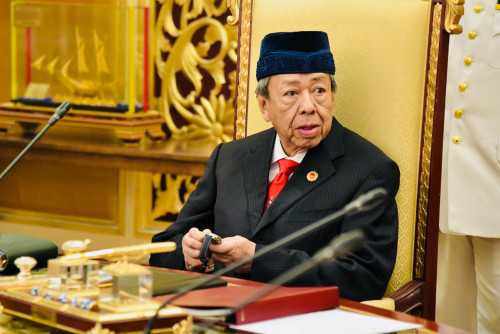
FORMER Sarawak education, science, and technological research (Mester) minister Michael Manyin has a damning assessment of the country’s education system.
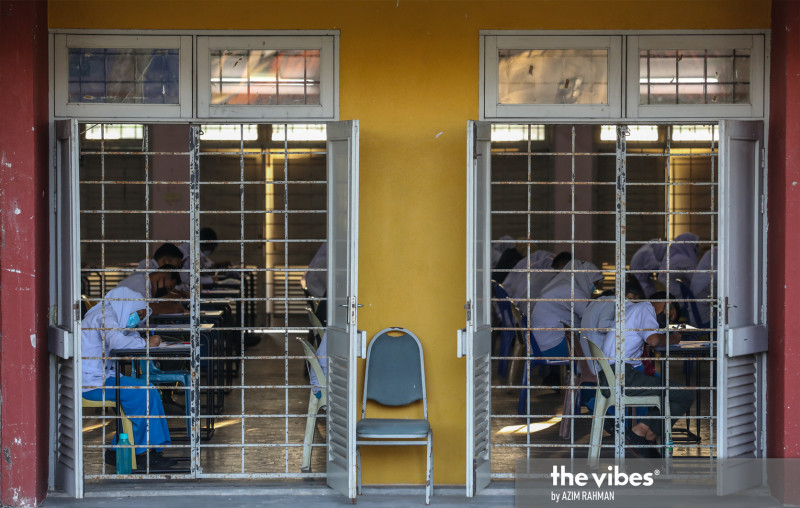
Manyin, who was Mester minister from 2017 to 2021, said in a recent Borneo states symposium titled “Realising the dreams and visions of the peoples of the Borneo states” that the fine performance of students in the Sijil Pelajaran Malaysia (SPM) examination “does not hide the fact that the quality of our education has dropped significantly”.
“Our worry stems from the inability of our students who scored straight As – 9, 10, 11 – in SPM can’t compete with their peers in Singapore, Hong Kong, China, Taiwan, Vietnam and even Brunei,” he said.
Apart from the growing number of parents, Manyin said this ongoing decline in the quality of Malaysian education has also been highlighted by many groups.
He pointed to the former vice chancellor of Universiti Kebangsaan Malaysia, Noor Azlan Ghazali, who questioned whether the 2022 SPM examination results reflected the actual quality of the nation’s education system, as an example.
Another yardstick he gave to gauge the quality of the Malaysian education standard is the Organisation for Economic Cooperation and Development’s (OECD) Programme for International Student Assessment.
In 2022, Malaysian students’ scores were lower than the OECD average of 438 in all three subjects – mathematics, science and reading.
The Malaysian students’ scores were 409 for mathematics, 416 for science and 338 for reading. Singapore was first in all three.
The result was Malaysia’s biggest drop since 2018.
Manyin said the disparity between SPM results and the actual quality of the education could be attributed to the assessment methods used.
There are two types of assessment methods that could be adopted, he said.
The norm-referenced and criterion-referenced assessment, which Malaysia has adopted.
The norm-referenced assessment (NRA) compares a student’s performance against the performance of his peers while the criterion-referenced assessment (CRA) compares a student’s knowledge and skills against a predetermined standard, cut score or other criterion.
“The NRA focuses on how students rank relative to one another, rather than absolute levels of achievement.”
He said the emphasis is on relative performance and determining where a student falls within a distribution of scores, indicating how a student’s performance compares to the performance of a referenced group.
The downside of the NRA is that it does not provide clear feedback to the students about their individual strengths and weaknesses in relation to a specific learning objective, he added.
In criterion-referenced tests, the performance of other students does not affect a student’s score.
This is a type of evaluation that measures a student’s performance against a set of predetermined criteria or standards.
It focuses on what the students know or cannot do without any reference to the performance of others.
Scores are typically based on the extent to which students demonstrate their mastery of the criteria.
Students are judged against absolute standards rather than compared to that of their peers.
While Manyin said CRA was good, there have been claims that the system was manipulated.
“They lower the benchmark.”
He said one reason he could think of for this manipulation is because the majority of the students are poor and not doing well.
He also said he was “told privately” that the threshold for students to get an “A” in Additional Maths was only 9%. The same applied to English.
“You should not lower the benchmark to as low as 9% to get an ‘A’.”
Even the World Bank Report 2023 titled “Bending bamboo shoots: Strengthening foundation skills” was damning on Malaysia’s education system.
Manyin said in the report, Malaysian students spend an average of 12.5 years in school but learn the equivalent of only 8.9 years.
To stem the decline, he said Malaysia should at least emulate Singapore’s policy on the recruitment of teachers.
“The recruitment process has to be enhanced to produce quality teachers and quality teachers to deliver quality teaching. Anything else is not really that important.”
Pointing to the Broken Chalk report to the United Nation Human Rights Council in 2023, Manyin said the report stated that 93% of those applying for a bachelor of education and 70% of those offered a place in the programme do not have the necessary qualifications.
The report said only 3% of offers were made to applicants considered high performers. – August 25, 2024.
Quality of Malaysia’s education sliding, says former Sarawak minister
Straight-A SPM achievers unable to compete with their overseas peers, says Michael Manyin.
Updated 2 years ago · Published on 25 Aug 2024 7:00AM