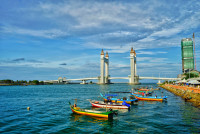
LANGKAWI - regarded as the nation's premier island vacation hub, is expected to reach its target of welcoming up to three million tourists this year.
With 2025 just over a week away, the glowing figures are encouraging, but the private sector continues to be troubled over the apparent lack of spillover effects, as many small and medium enterprises (SMEs) continue to struggle.
The spillover effect is often difficult to execute because to ensure it is effective, many factors must be combined to transform it into a possibility, said Eric R. Sinnaya.
The veteran travel practitioner said that attracting people to visit any destination, first requires a strong public-private partnership rather than organisations or individuals working in silos.
"A collective responsibility is needed. There needs to first be buy-in on what Langkawi should entail - a duty-free paradise, a beach gateway or sustainable tourism such as its Unesco certified geo (geology) - park status.
“The island should be marketed for its strengths rather than its past, as a duty-free destination solely, " he said.
The input from nongovernmental organisations such as the Friends of Langkawi Geo - Park (FLAG) or the Malaysian Nature Society (MNS) should also be weighed heavily when promoting and marketing tourism here, said Sinnaya.

Sinnaya, a pioneering inbound travel agent, is now forced to alternate his operations between the Klang Valley and the island resort due to a lacklustre arrival of foreigners.
"The official figures depict an encouraging arrival range, especially with direct flights coming in but somehow, the spillover is not felt at all levels, especially the grassroots."
Checks with a chicken rice seller to the operator of a nature park revealed that businesses have been dipping in the past year with some of them mulling over relocating.
To this, Sinnaya said that Langkawi needs to bring in tourists, who are willing to spend more and to promote its SMEs from cottage industries to gastronomy besides the attractions of the beaches, landmarks and culture as well as heritage attractions.
More can be done to unlock the potential of lure from the legends of Langkawi to the fact that the oldest rock formation in the country originated from the island, he said.
There is also an infrastructure issue, where villagers near Kisap continue to complain about the inconsistent water supply and the occasional flash flooding.
There are also allegations of cartel - systems taking place from how some enterprises operate to the much-mangled ferry services, which suffer from an acute shortage of trips, maintenance issues and escalating operating costs, not to mention low tides due to the shifting of waves and erosion, blamed on climate change.
Langkawi Businesses Association deputy president Datuk Issac Alexander said that tourists are coming but agreed that it is not felt all over the travel trade segment.
He said that to analyse closely, the perception that Langkawi is too pricey is not accurate if one compares an "apple to an apple" notion.
But what is needed to swell up arrivals until every segment of the hospitality industry can get a bigger slice of the market, is to boost arrivals and to make the transport costs cheaper as well as efficient, while diversifying the attractions here.
He suggested that more aid be given to the ferry operators to ensure they can upgrade their vessels and increase their trip frequencies while also allowing private charters to serve routes such as between Penang and Langkawi as well as other locations.

Alexander said that the civil aviation authorities should allow all airliners to fly flexible routes to further liberalise the air travel segment.
This will allow more airliners to use the Langkawi airspace and in turn, lower the fares.
"The age of indirect monopolies should end by allowing more competition."
Sinnaya's counterpart - Ahmad Pishol Isahak said that the authorities need to boost the population base from the present 80,000 to at least 180,000 within the next decade.
"We need to retain our talents and lure more investors to come over. Bring more people to reside here, to retire or to invest and to innovate the island."
He said that the authorities should look at setting up more educational institutions and retirement villages, especially when Malaysia becomes an aging nation by 2035. - December 22, 2024.