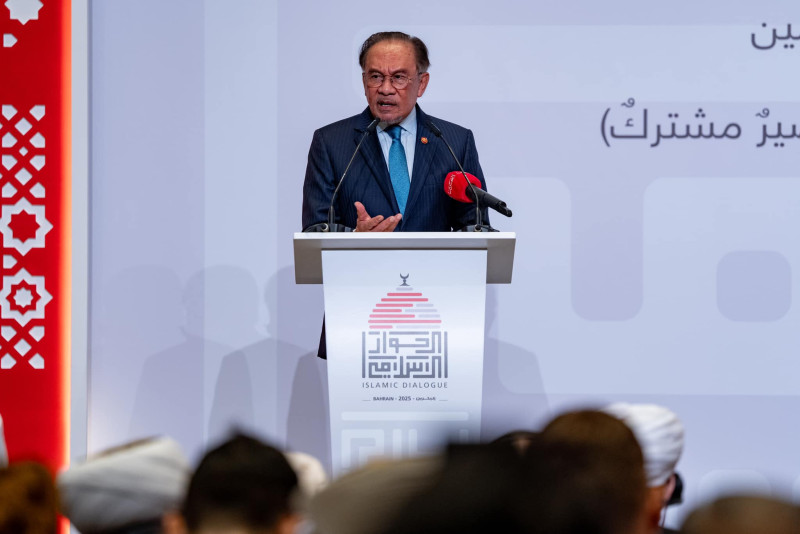
IN a highly significant address at the Intra-Islamic Dialogue Conference (IIDC), Prime Minister Datuk Seri Anwar Ibrahim was honoured as the sole head of state invited to speak and share his perspectives with Islamic scholars.
The conference served as a platform for urging unity in addressing sectarianism, while advocating for decisive action to support Palestine and Syria.
The leader stressed the destructive impact of sectarianism, describing it as a weapon that stirs tensions and divides communities.
He called for a shift away from sectarian divides to foster political cooperation, which is crucial to achieving the unity long desired by the Islamic world.
Expressing solidarity with the message of Al-Azhar Grand Imam Prof. Dr. Ahmed El-Tayyeb, Anwar reinforced the call for Islamic scholars and leaders to take the lead in promoting unity, rejecting religious fanaticism that is increasingly taking root within the community.
The speech underscored the urgent need for the Islamic world to demonstrate more than just rhetorical support for Palestine.
Instead, Anwar urged for concrete collective action—diplomatic efforts, continuous international advocacy, and economic backing.
He decried the ongoing massacres, illegal settlement expansions, and forced displacements of Palestinians, stressing that such actions demand more than just condemnation, but a resolute commitment to providing educational, healthcare, and infrastructural support, according to a post on his Facebook page.
The Prime Minister also highlighted Syria as a potential model for peace efforts, citing early signs of reconciliation and stability in the country that offer hope not just for Syrians but for the entire Muslim ummah.
He called on the Islamic world to take joint responsibility in building Syria's future, which would serve as an example of peacebuilding efforts for the region.
In a hopeful closing, he expressed his belief that through collective action, integrity, and unwavering commitment, the Muslim world could prove that they are indeed one united ummah, working toward a common purpose.
On a separate note, Anwar expressed optimism regarding the expansion of Malaysia’s tourism sector, revealing plans for direct flights between Bahrain and Malaysia.
The initiative aims to boost tourism exchanges between the two countries, coinciding with Malaysia’s efforts to enhance its economic and tourism sectors in preparation for the Visit Malaysia Year 2026.
The Prime Minister highlighted discussions with Gulf Air, noting that both Prince Crown Sheikh Salman Hamad al-Khalifa and the Bahraini government were keen to improve air connectivity between Malaysia and Bahrain, which could help increase tourism flows.
The idea of more frequent flights, including through Malaysia Airlines or other carriers, was also welcomed.
The Prime Minister also acknowledged the crucial role of the Malaysian diaspora abroad in promoting Malaysia as a travel destination, encouraging Malaysians living overseas to actively engage in campaigns to improve the country's image and attract more international tourists.
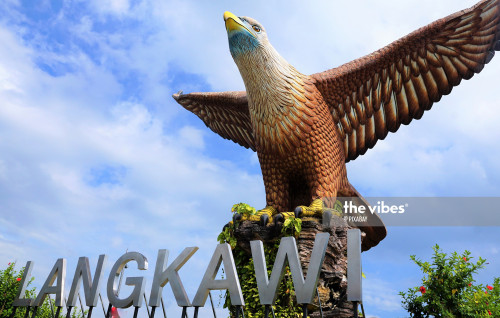
He pointed out that Malaysia is home to diverse and unique tourist destinations, ranging from Sabah and Sarawak to Johor, Penang, Terengganu, and Kelantan, each offering its own special attractions.
Through these efforts, the Prime Minister emphasized that Malaysia is positioning itself as an increasingly competitive and attractive destination for global tourists, with the broader goal of spurring economic growth alongside tourism development. – February 20, 2025