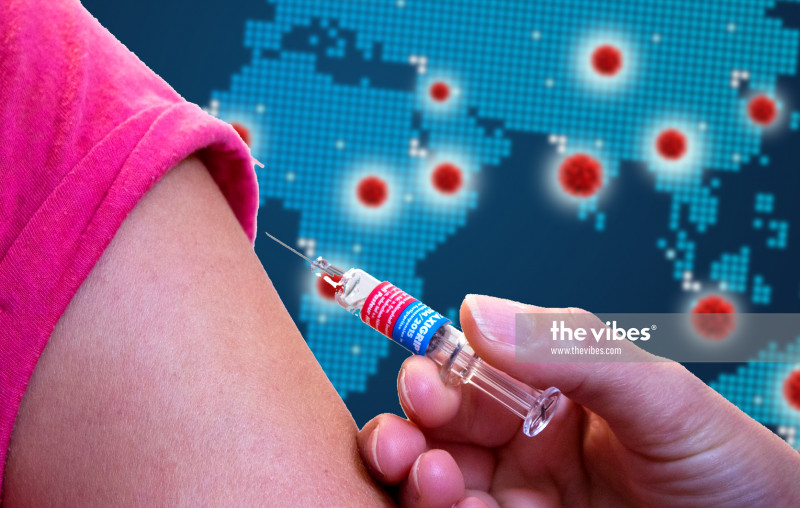

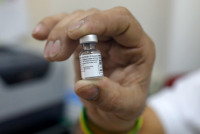
KUALA LUMPUR – As Malaysia waits on health authorities to ensure that the Covid-19 vaccine is safe for mass use, neighbouring Singapore has already received its first batch of the Pfizer/BioNTech jabs.
While Malaysia received Pfizer’s initial application only on December 15, Singapore’s Health Sciences Authority has approved the Pfizer/BioNTech Covid-19 vaccine for use in the republic on December 14.
Singapore plans to have all 5.7 million of its population immunised by the third quarter of next year, with the most vulnerable groups, such as health workers and the elderly, to be given priority.
Yesterday, Prime Minister Tan Sri Muhyiddin Yassin announced a deal with AstraZeneca, in addition to ones already inked with Pfizer/BioNTech and the Covax facility.
He said Malaysians may get the vaccine as early as February, adding that he will be among the first to get the jab in a bid to allay public concerns.
On the heels of Muhyiddin’s announcement, the Health Ministry yesterday posted an infographic on its official Twitter account on the National Pharmaceutical Regulatory Agency’s (NPRA) process to register any vaccine.
The ministry outlined the six steps needed for vaccinations to gain full approval.
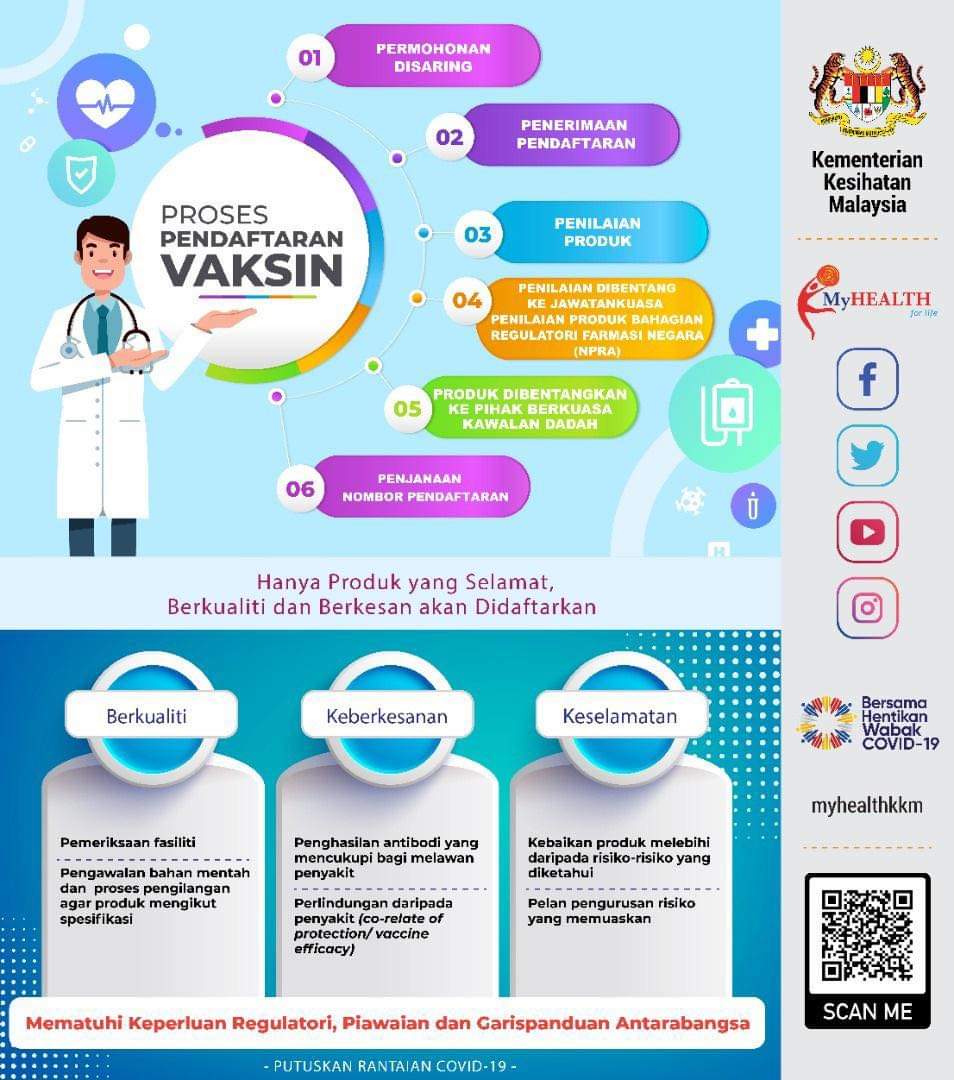
The process begins with the screening of the application by the vaccine maker, followed by the receipt of the application.
Then, the product is assessed, before it is brought to NPRA’s task force at the fourth stage of the application.
The product is then presented to the authorities tasked with drug control, before finally being given a registration number.
“Only products that are safe, of quality and effective will be registered,” the infographic said.
The ministry also described how three factors are considered in approving vaccines.
On Monday, Health director-general Tan Sri Dr Noor Hisham Abdullah said it may take between 90 and 120 days to register the Covid-19 vaccine produced by pharmaceutical giant Pfizer before it could be administered to Malaysians.
NPRA’s further correspondence with Pfizer will commence at the end of this month.
However, Dr Noor Hisham told The Vibes yesterday that the government may expedite the process for Covid-19 inoculations, adding that this will be done based on national interest, considering the danger and health risks posed by the coronavirus.
He said this in response to Muhyiddin’s announcement.
On quality, the ministry said, the NPRA will inspect the facilities involved, as well as monitor raw materials and manufacturing of the vaccines in accordance with submitted specifications.
It said the efficacy of the product is evaluated through the production of sufficient antibodies to combat the disease.
In terms of safety, it added that the product’s benefits must outweigh known risks, while the plan for its risk management must be satisfactory.
The ministry noted that the vaccine must also meet international regulations, standards and guidelines.
On December 7, it was reported that Indonesia had received 1.2 million doses of Covid-19 vaccine from China.
The Vibes has compiled the possible vaccine suppliers announced yesterday.
President Joko Widodo said they are expecting to receive another 1.8 million doses early next month.
Local media reported that Indonesia – through the Eijkman Institute for Molecular Biology, a body under the country’s Research and Technology Ministry – was working with China’s biopharmaceutical company Sinovac Biotech to conduct Covid-19 vaccine research.
Meanwhile, Thailand signed an advance agreement with AstraZeneca in late November to produce 26 million doses of the firm’s Covid-19 vaccine, covering 20% of its population.
Three days ago, its National Vaccine Institute told the Financial Times that it plans to vaccinate half of its population against Covid-19 next year, and as many as 70% by 2022, with other pending pharma deals. – The Vibes, December 23, 2020





_Datuk_Rusdi_Mohd_Isa._Facebook_pic..png)