THE nation is confronting one of its sharpest fresh-produce price surges in recent memory after relentless northeast monsoon rains destroyed crops, crippled transport routes and strained supply chains from the highlands to major wholesale markets.
New Streits Times cited today that prices of common vegetables have tripled in some areas, with growers and traders warning that shortages may persist well into early next year.
Cameron Highlands, the country’s principal vegetable-growing region, has been particularly hard hit. Weeks of unbroken rain have left farms waterlogged and slopes unstable.
Chai Kok Lim, chairman of the Cameron Highlands Vegetable Growers Association, said losses were severe.
“Leafy crops deteriorate quickly when waterlogged. We need better infrastructure so heavy rain does not disrupt growth,” said Chai, 61. “This is the highest surge in vegetable prices we’ve seen so far during the northeast monsoon.”
Floods across Thailand and Indonesia have further squeezed supplies, amplifying shortages at home. Grower Parveen Kumar Mohan said regional disruptions had pushed French beans from RM2.50 per kilogramme last month to RM14 today.
“Prices of greens are likely to stay high until next year,” he said.
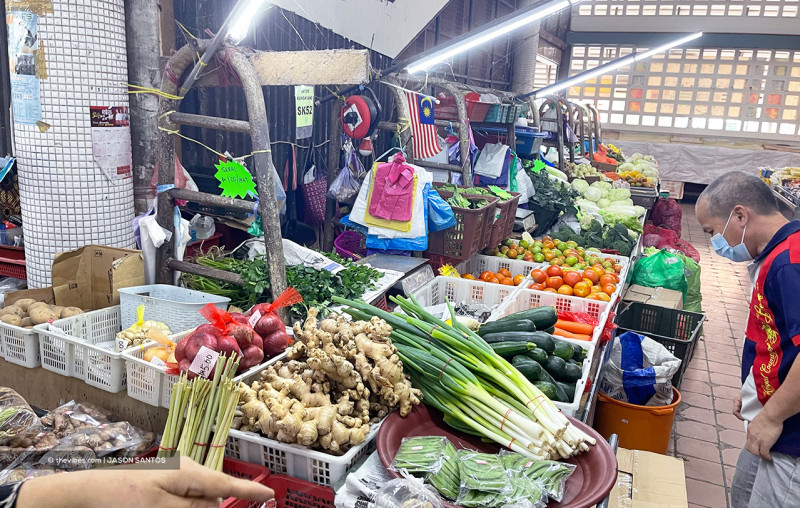
Across markets, the increases have been stark. Vegetables that once sold for RM1 to RM3 per kilogramme—such as choy sum, cucumbers, salad greens and iceberg lettuce—now fetch RM5 to RM10.
The prices of cabbage, mustard greens, tomatoes and chillies have also risen sharply. Farmers and traders nationwide report spikes of between 50 and 80 per cent, with Kuala Lumpur’s Selayang wholesale market reflecting the worst of the trend: spinach now sells for RM8 to RM9 per kilogramme, up from RM2 to RM3, and okra has nearly doubled to RM8 to RM9.
Transport bottlenecks caused by flooded roads have slowed distribution, delaying deliveries and pushing wholesale prices higher.
Restaurants, meanwhile, are bearing much of the strain, with operators reluctant to pass on the full brunt of increases to customers.
Malaysian Muslim Restaurant Operators Association (Presma) vice-president Syed Abthair Badrus Zahan said members’ margins were being eroded rapidly. “Customers rarely feel the impact because we cushion it,” he said.
“Two months ago, 1kg of mustard greens cost RM2.50 to RM3; now it is RM6 to RM7. We have faced price increases before, but never as steep as this.”
Presma, which represents 4,000 members running 12,000 outlets nationwide, has advised restaurateurs to minimise wastage by buying only one or two days’ worth of supplies and substituting with cheaper vegetables.
“Prices are very high, and if they remain this way, it will be difficult to make ends meet. We hope the rains end soon so that prices can stabilise,” Syed Abthair said.
In Kelantan, food operators describe the situation as unprecedented. Kota Baru restaurateur Aiman Yusri Mohd Yusof said mustard greens had jumped from RM5 to RM7–RM8 per kilogramme, while red chillies had soared from RM12–RM14 to RM25–RM30.
“The increase started about two to three weeks ago, when supply became limited due to the unpredictable weather and also floods,” he said.
He has reduced purchases of costlier vegetables, opting instead for cabbage, spinach and bean sprouts.
Another Kota Baru restaurant owner, who gave her name as Asma, said water spinach had surged from RM3–RM3.50 per kilogramme to about RM18. “The prices of some vegetables have climbed to unprecedented levels,” she said.
Consumer advocates warn that beyond weather, the crisis exposes serious structural weaknesses in Malaysia’s food system.
Federation of Malaysian Consumers Associations (Fomca) chief operating officer Nur Asyikin Aminuddin said the country remained dangerously unprepared for shocks to its food supply.
“Although weather conditions are the main short-term factor, this situation actually exposes a much bigger problem: Malaysia is not prepared for a food security crisis,” she said.
“Every time there is extreme weather, geopolitical tension, a pandemic or logistics disruption, the price of fresh food surges sharply, burdening the people, especially those in the lower-income groups.”
She noted that an estimated 20 to 40 per cent of agricultural output is lost due to poor post-harvest handling.
“When supply is damaged and quantity drops, prices rise. If the government is serious about addressing rising food prices, investment in post-harvest systems must be a priority. Fama should be strengthened as an intermediary,” she said, referring to the Federal Agricultural Marketing Authority.
Nur Asyikin urged policymakers to treat food security as a national priority.
“Rising vegetable prices are not only a cost-of-living issue; they also affect public health and household well-being.
“As climate change, global conflicts and pandemics increasingly disrupt global food supply chains, Malaysia must invest in post-harvest systems, modern food logistics and strengthen Fama as the intermediary between producers and consumers to stabilise fresh food prices,” she said. - December 10, 2025