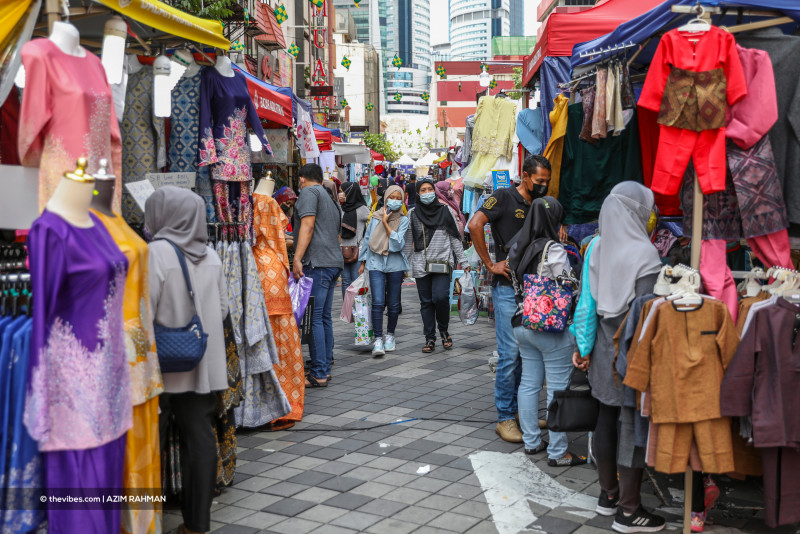
MANY Malaysian households may be economising on daily expenses, yet when Hari Raya Aidilfitri approaches, cutbacks often stop short of the festive table.
Across the country, families are tightening discretionary spending, postponing non-essential purchases and budgeting with greater care, while continuing to ringfence funds for clothing, food preparation, ‘balik kampung’ travel and ‘duit raya’.
Bernam cite cited on Monsay that the pattern reveals a distinctive characteristic of Malaysian consumer behaviour. Festive spending remains resilient not simply as a matter of consumption, but as an expression of cultural continuity, social obligation and household identity.
For many, ensuring that Aidilfitri is observed meaningfully is a commitment that transcends immediate financial strain.
Siti Sulaiman, a 38-year-old civil servant who preferred limited identification, said she has become more vigilant in managing expenditure but still prioritises her four children’s needs for the celebration.
“We cut down on eating out and shopping for ourselves, but for Raya, the children still come first. New clothes and balik kampung are things we try to ensure,” she told Bernama.
Hafiz Hambali, 29, who works in the private sector, has responded to tighter finances by saving earlier in the year to prepare for festive outlays.
“I manage other expenses and save gradually. Raya is still something we look forward to every year, so I set aside duit raya and prepare the basics, even if the celebration is simple,” he said.
For Nur Firdaus Abdul Rahim, another civil servant, kuih raya (Raya delicacies) remains non-negotiable. The cost-of-living may be rising, but the presence of festive biscuits in the family home is, she said, a matter of tradition.
“For me, kuih raya is a must during Hari Raya. Since young, we have been accustomed to having festive cookies at home — whether many or few, there must be some,” she said.
Firdaus moderates her overall spending by limiting new festive attire to a single outfit for the first day of celebrations and reusing existing garments thereafter.
Her annual allocation for kuih raya is typically capped at around RM500, reflecting the needs of her large family. While reducing purchases would be disappointing, she observed that even a modest selection is sufficient to preserve the festive spirit.
Economists argue that such behaviour cannot be understood solely through the prism of consumption statistics.
Dr Carmelo Ferlito, chief executive of the Centre for Market Education, said festive expenditure carries social and symbolic weight embedded in family ties, reciprocity and identity.
“Households are not simply buying food, clothes or decorations; they are reaffirming belonging. Even under cost-of-living pressures, they tend to reallocate priorities rather than abandon festive spending,” he told Bernama.
He noted that traditions and familial expectations shape decisions to host relatives, prepare elaborate meals and distribute duit raya, each imbued with emotional significance.
“In other words, economic action is future-oriented and meaning-driven.
“Even when households try to cut back, they tend to protect expenditures that sustain identity and relational capital, while reducing more anonymous or less meaningful consumption,” he added.
On whether the durability of festive spending signals economic strength or vulnerability, Ferlito suggested that both interpretations may apply.
“Stable festive spending may indicate confidence in future income prospects.
“However, we should not ignore the possibility of intertemporal substitution or short-term liquidity management — using savings, bonuses or even credit to smooth consumption during peak symbolic periods. In such cases, festive spending may coexist with underlying financial fragility,” he said.
Dr Mohd Afzanizam Abdul Rashid, chief economist at Bank Muamalat Malaysia Bhd, observed that households now enjoy greater flexibility in financing such expenditure, drawing on income, savings and a wider array of financial facilities.
This flexibility broadens funding options but does not remove risk, particularly where short-term credit is heavily relied upon.
Beyond traditional bank financing, consumers may turn to the flexible account of the Employees Provident Fund, buy-now-pay-later schemes and Ar Rahnu services, depending on their circumstances.
Mohd Afzanizam noted that private consumption growth stood at 5.3 per cent in the fourth quarter of 2025, below the long-term average of around six per cent, suggesting that households remain cautious even as festive spending typically strengthens during Ramadan and Hari Raya.
He added that credit utilisation tends to rise during this period, particularly in personal financing and vehicle purchases, often buoyed by promotional campaigns from financial institutions and dealers.
While acknowledging the resilience of festive consumption, he cautioned against overleveraging, especially where households draw financing from multiple sources.
Financial literacy and prudent management remain essential, he said, adding that Ramadan itself offers an opportunity to practise moderation and restraint.
Ferlito further observed that a marked decline in festive spending would signal weakening household confidence and expectations.
Festive consumption, he argued, is ordinarily “protected” because of its symbolic significance; any substantial retrenchment could indicate a shift from adaptive optimism to defensive financial behaviour.
In that sense, Hari Raya spending serves as more than a seasonal spike in retail activity.
It offers a revealing barometer of how Malaysian households interpret their present circumstances and future prospects, balancing celebration with caution in an increasingly uncertain economic climate. - February 23, 2026