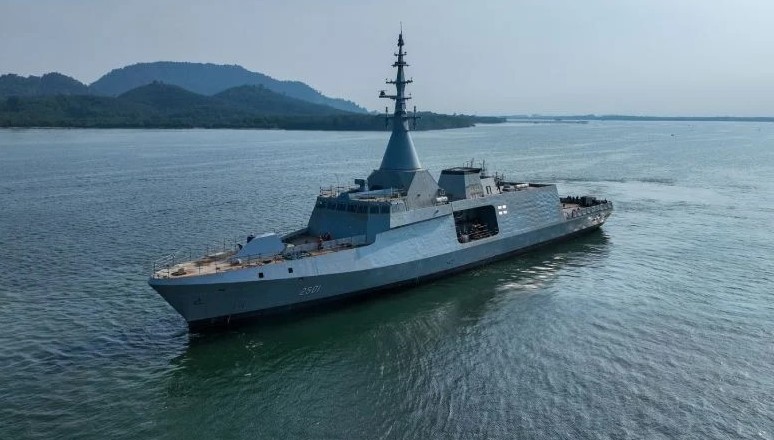
MALAYSIA has formally issued a notice of demand exceeding RM1 billion against a Norwegian defence company following the collapse of a key missile procurement deal linked to the Royal Malaysian Navy’s Littoral Combat Ship (LCS) programme.
Defence Minister Datuk Seri Mohamed Khaled Nordin said Putrajaya was seeking both direct and indirect compensation after Norway unilaterally revoked the export licence for the Naval Strike Missile (NSM) system intended for the country’s new generation warships.
The government had already paid €126 million, equivalent to approximately RM583 million and representing 95 per cent of the total contract value, before the export licence was withdrawn.
“Yesterday, we sent a notice to the Norwegian company. We are claiming both direct and indirect costs.
“The direct cost amounts to €126 million, which is the amount we already paid them,” he said after visiting the LCS construction project at the Royal Malaysian Navy Naval Shipyard in Lumut.
The NSM contract was originally signed in April 2018 with Norwegian defence manufacturer Kongsberg Defence & Aerospace to equip six Malaysian Littoral Combat Ships with advanced surface-to-surface missile capabilities.
Following the cancellation, Khaled confirmed that the Defence Ministry had instructed the Royal Malaysian Navy to urgently identify alternative missile systems compatible with the ships’ combat integration platform.
“Let that be with the Navy to identify the alternatives. We believe the best option is a system that is compatible and can be integrated with the combat system, from a country willing to transfer technology, and from a country we trust and believe is genuinely a partner.
“Sometimes they say they are friends when selling products, but once the purchase is made, they may not be as sincere. All these factors will be considered,” he said.
He acknowledged that Malaysia now faces limited options because the warships are already deep into the construction phase, making rapid replacement integration a major operational challenge.
“The key point now is that we are constrained and may have limited options because the ships are already being built. So we must find a replacement that can be implemented quickly,” he added.
Khaled stressed that only one of the LCS weapons systems had been affected by the Norwegian decision, while the remaining core combat systems remained intact.
“We are aware that these ships are equipped with four types of weapon systems, namely surface-to-surface, surface-to-air, anti-submarine warfare systems and electronic warfare systems.
“So, the other three weapon systems are not affected; only the NSM is affected. We still have the rest,” he said.
However, he cautioned that replacing the missile system would not be straightforward because the process involved extensive combat system integration, testing, operational certification and crew training.
“The impact is that the absence of this system cannot be replaced immediately because it involves integration with the ship’s combat system, followed by testing, training and other related processes.
“So this is among the areas that will be affected,” he said.
Despite the setback, the Defence Minister insisted that progress on all five LCS vessels currently under construction remained on schedule.
“As of April, the work progress for each vessel is satisfactory. LCS 1 is at 84 per cent; LCS 2 at 79 per cent; LCS 3 at 71 per cent; LCS 4 at 60 per cent, and LCS 5 at 49 per cent,” he said.
According to the latest delivery schedule, LCS 1 is expected to be delivered in December this year, followed by LCS 2 in August 2027, LCS 3 in December 2027, LCS 4 in August 2028 and LCS 5 in April 2029.
“Although the ships may be completed as scheduled, we may be without this system, the Naval Strike Missile. That is the only missing component,” Khaled said.
The dispute has intensified scrutiny over Malaysia’s long-delayed LCS programme, which has faced years of cost overruns, procurement controversies and repeated delays before construction progress resumed under tighter government oversight. - May 19, 2026










.jpg)