PARTI Islam Se-Malaysia (PAS) is preparing to test a broader political alignment strategy ahead of the Johor state election, signalling openness not only to political cooperation but also to the inclusion of non-governmental organisations and influential community figures in its electoral approach.
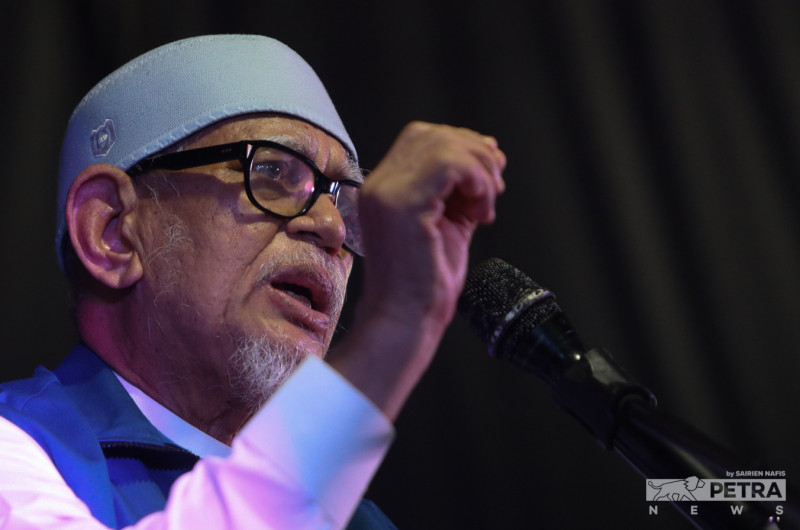
Party president Tan Sri Abdul Hadi Awang said the party’s central objective remains the consolidation of Malay-Muslim political leadership, while still acknowledging the multicultural nature of Malaysia’s electorate.
He said PAS would continue to evaluate its strategic direction, including seat negotiations, campaign arrangements and potential use of party branding, following a briefing by its Johor leadership next Monday.
“We are studying the matter. God willing, this Monday we will hear the briefing from PAS Johor. We will listen to it one by one first, then a decision will be made on how we proceed.
“We will contest. In principle we will contest, but it will be assessed in terms of our influence, our chances to campaign and candidates. Thank God we have many prominent figures who can be candidates in PAS today,” he said.
Hadi said final decisions had not yet been made regarding seat distribution in Johor, stressing that discussions were still ongoing and nothing had been concluded.
“Not finalised yet. Those are only views, not finalised yet,” he said.
He also said PAS would adopt a pragmatic approach in the Johor contest, acknowledging that the party would not necessarily contest every state seat if doing so did not reflect its electoral strength or chances of victory.
“It is not necessary (to contest all seats). We will look at suitability. But we may contest under (Perikatan Nasional) component, that will be reviewed further, where it is better for us to contest. We will look at our influence,” he said.
Hadi added that PAS was also broadening its political approach beyond formal party structures, including engagement with NGOs and influential figures within the Malay-Muslim community to strengthen its electoral position.
“Among them, we are involving not only Malay-Muslim parties, including Islamic NGOs and influential figures within the Muslim community. We take all of this into account.
“It will depend on suitability and influence. We must recognise that there are areas where we win by a very narrow margin, even as little as two votes. We will take into account influential figures,” he said.
The remarks come amid renewed discussion of informal cooperation among Malay-based political forces, with PAS previously expressing support for reviving a broader political alignment framework.
Earlier, PAS deputy president Datuk Seri Tuan Ibrahim Tuan Man had suggested reviving a “Muafakat Nasional 2.0” initiative to strengthen Malay-Muslim political unity ahead of upcoming state elections, arguing that recent political developments had opened space for a renewed political realignment.
Hadi also expressed confidence that PAS could expand its electoral strength in Negeri Sembilan, citing close-margin constituencies and previous victories as indicators of potential gains.
“God willing, we will contest in Negeri Sembilan. We have already won three seats and we expect to increase that because there are many constituencies with narrow majorities, around 1,000 votes,” he said.
His comments came shortly after the announcement of the dissolution of the Negeri Sembilan State Legislative Assembly, which paves the way for fresh state elections in the coming months.
Hadi added that PAS’s electoral strategy would also extend beyond Peninsular Malaysia, suggesting that developments could help strengthen broader Bumiputera political influence across Sabah and Sarawak as well.
Meanwhile, he said internal party matters involving disciplinary or leadership issues within Parti Pribumi Bersatu Malaysia (Bersatu) were being left entirely to the party’s central leadership.
“The State Liaison Committee and the ulama have made a decision. It is up to PAS central to decide when to announce the appropriate action. This matter will be discussed together on Monday,” he said.
As political parties begin positioning themselves ahead of a wave of anticipated state elections, PAS’s remarks underline a more flexible and multi-layered electoral strategy that blends formal coalition politics with informal community influence and broader socio-political engagement. - June 5, 2026