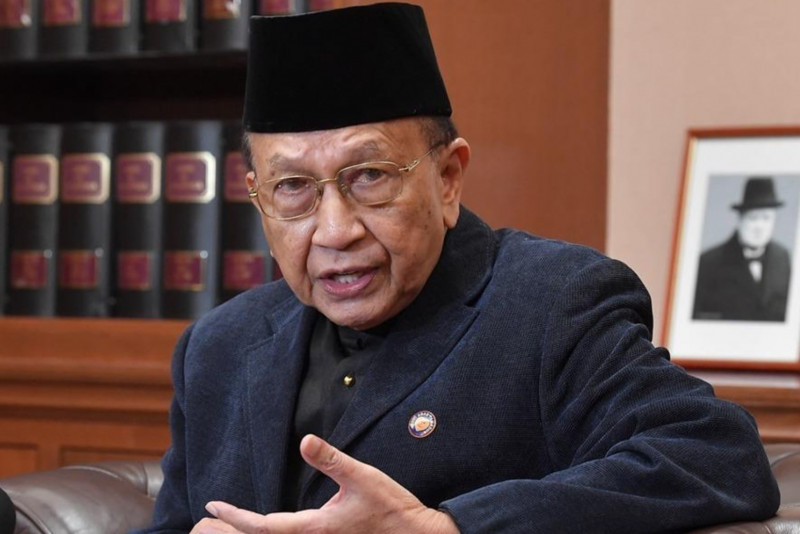
THE appointment of Tan Sri Rais Yatim as Penasihat dan Peguam Utama to Negeri Sembilan’s top adat leadership has raised serious questions about his claims of neutrality and independence.
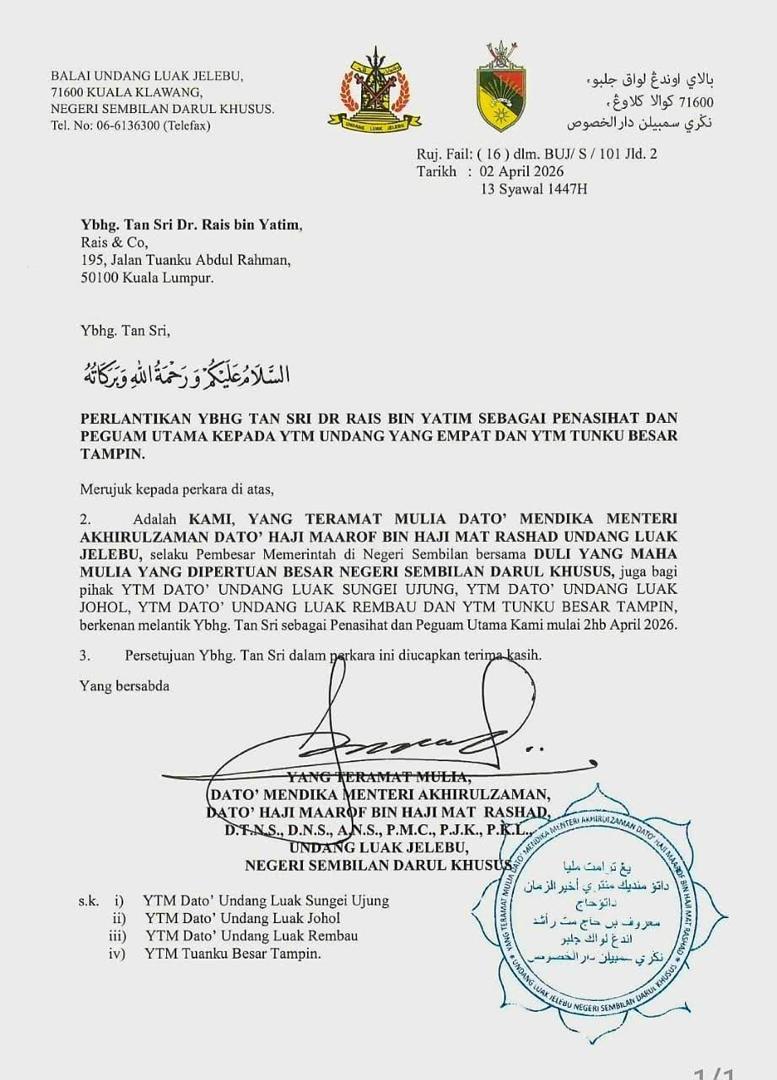
In an official letter, Yang Teramat Mulia Datuk Mendika Menteri Akhirulzaman Datuk Maarof Mat Rashad, Undang Luak Jelebu, on behalf of the Undang Yang Empat as well as the Tunku Besar Tampin, confirmed that Rais was formally appointed to the role effective April 2, 2026.
The appointment places Rais as chief legal adviser to the state’s highest adat authorities, including the Undang Luak Sungai Ujong, Johol, Rembau and Jelebu, as well as the Tunku Besar Tampin — effectively embedding him within the very power structure he is now publicly commenting on.
This revelation complicates Rais’s repeated assertions that he is merely acting as an independent expert on adat and constitutional matters.
In reality, his involvement appears far deeper.
Sources and documents (being circulated to the media) indicate that Rais had already been engaged as legal counsel to these parties from the early stages of the dispute, well before his formal appointment was publicly known.
His role, therefore, was not observational or academic — it was participatory.
That distinction matters.
Legal advisers are, by definition, advocates for their clients’ positions. They are not neutral arbiters.
By continuing to frame himself as an independent authority while being contractually and professionally tied to one side, Rais risks blurring the line between expert opinion and legal strategy.
The question now is not whether Rais has views on adat — but how those views were shaped, and in whose interest, they are being advanced.
Insiders argue that presenting himself as detached while actively serving as counsel undermines public trust, particularly in a sensitive constitutional and royal matter where legitimacy hinges on perceived impartiality.
“How independent can an ‘expert’ be when he has been acting as their lawyer from the very beginning?” one insider noted.
The issue is not Rais’s qualifications, which are widely acknowledged, but the transparency of his role.
If his involvement was always that of a legal representative, then portraying himself as a neutral commentator risks misleading the public — and potentially influencing opinion under false pretences.
As scrutiny intensifies, one key question remains unanswered: just how involved was Rais Yatim behind the scenes, long before this appointment was made official? – June 12, 2026