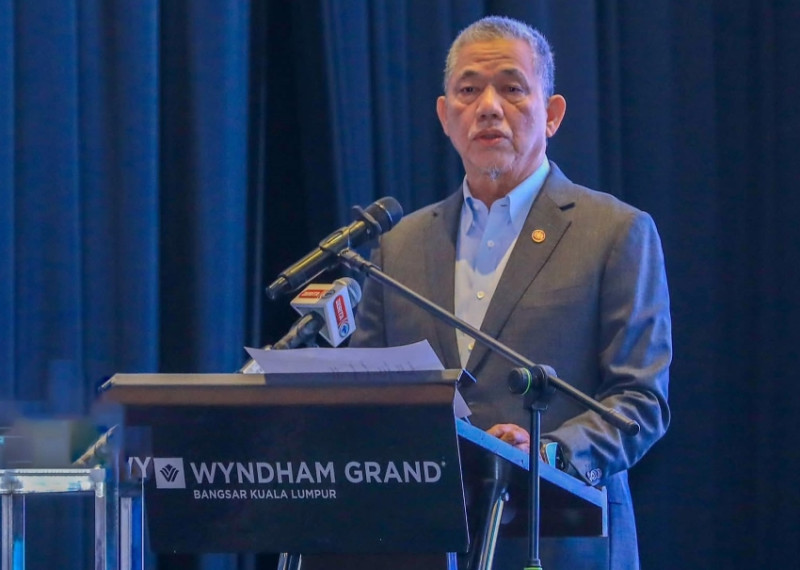
THE Government has set out an ambitious vision to become a leading Southeast Asian digital economy hub, linking the rapid rise of artificial intelligence and data-driven industries to the country’s energy transition agenda, infrastructure expansion and governance reforms, a senior minister said.
Deputy Prime Minister II Datuk Seri Fadillah Yusof said the success of the AI revolution would ultimately depend not only on technological adoption, but on how effectively governments manage trust, talent and infrastructure to ensure inclusive and sustainable growth.
“As we gather at the World Digital Economy and Technology Summit (WDET) 2026 under the theme ‘Unleashing the Potential of AI and Digital Technology: The Southeast Asia Inflection Point,’ our conversation extends far beyond algorithms, data and digital infrastructure. At its heart, it is a conversation about trust,” Fadillah said.
“The rise of artificial intelligence presents one of the defining opportunities of our generation. Yet the true measure of our success will not be determined by how rapidly we deploy technology, but by how wisely we govern it, how inclusively we share its benefits, and how faithfully we ensure that innovation serves the common good,” Fadillah, who also serves as Minister of Energy Transition and Water Transformation, said.
He warned that Southeast Asian economies now face a decisive choice between shaping the digital transition or being shaped by it, adding that competitiveness in the coming decades would hinge on trust in governance systems, development of skilled talent and locally relevant technology ecosystems.
“Those pillars are trust, talent and technology,” he added, stressing that regional ambition must now be matched with execution.
Fadillah said Malaysia had already positioned itself as a major destination for digital investment, with more than RM140 billion in data centre and cloud computing commitments approved since 2021, and one of the fastest-growing data centre markets in the region.
However, he cautioned that capital inflows alone would not sustain a digital economy without reliable energy and water infrastructure.
“A hyperscale AI-focused data centre can consume as much electricity annually as 100,000 households,” he said, adding that rising demand was already placing pressure on national grids and water systems.
He said Malaysia was confronting these constraints directly, describing infrastructure as the central bottleneck to digital expansion rather than a lack of ambition.
In a notable reference to Johor’s investment strategy, he said the state had begun adopting a more selective approach to data centre approvals, reflecting the need to balance growth with resource sustainability.
Malaysia’s energy transition framework, he said, was already in motion through the National Energy Transition Roadmap and the PETRA Strategic Plan 2026–2030, which outlines 119 programmes and 133 targets focused on grid modernisation, digitalisation and energy resilience.
He also highlighted Tenaga Nasional Berhad’s RM43 billion investment programme between 2025 and 2027 to upgrade the national grid, including the integration of artificial intelligence in grid management systems.
Among recent developments, he cited the commissioning of the Santong Battery Energy Storage System in Terengganu, with 100 megawatts of capacity and 400 megawatt-hours of storage, as a key step towards supporting large-scale renewable integration.
Malaysia, he added, has now surpassed 13.3 gigawatts of installed renewable energy capacity, with solar power leading growth, while a 1,000-megawatt solar project is being developed to support the Johor–Singapore Special Economic Zone.
Water infrastructure is also being expanded, with reclaimed water production currently at 48.5 million litres per day and a target of 118 million litres per day by 2030 for industrial use, alongside work towards a national water reclamation policy.
“These investments are ultimately about creating opportunities, enabling innovation, improving productivity and ensuring that future generations inherit a stronger nation than the one we inherited,” he said.
Fadillah said Malaysia was positioning itself not merely as a market for investment, but as a strategic partner in building resilient and sustainable regional digital infrastructure, calling on private sector stakeholders to co-invest in energy systems, technology transfer and long-term capacity building.
“Malaysia’s message is straightforward. We are not simply offering a market. We are offering a partnership,” he said.
He also urged greater focus on emerging governance issues such as sovereign artificial intelligence, agentic systems and digital inclusion, warning that these would determine whether technological progress leads to shared prosperity or widening inequality.
“The AI transition is therefore not merely a technological transformation. It is a test of leadership,” he said, adding that energy and artificial intelligence were now structurally linked, with AI both increasing power demand and enabling more efficient energy systems.
He said Malaysia had already laid the groundwork for a dual-track strategy covering both energy transition and digital economy development, and stressed the importance of decisive execution.
“What remains is our collective commitment to execute with urgency, discipline and purpose,” he said.
Fadillah added the AI era would ultimately be judged not by technological advancement alone, but by whether it delivered a more inclusive, sustainable and humane future.
“If we succeed, this moment will not be remembered simply as the age when artificial intelligence transformed our economies. It will be remembered as the moment when we chose to harness innovation responsibly,” he said. - June 25, 2026