THERE was a time when "due process" was the hill the human rights movement was prepared to die on.
It was not a slogan. It was not a political convenience. It was the one principle that separated justice from vengeance.
You defended it for your enemies.
You defended it for people you disliked.
You defended it precisely because principles mean nothing if they only apply to those we already agree with.
This week, over 140 Palestinian civil society organisations — coordinated by the Palestinian Human Rights Organisations Council, including Al-Haq, Al Mezan and the Palestinian Centre for Human Rights — reminded the world of that forgotten truth.
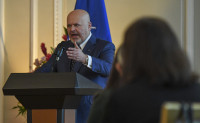
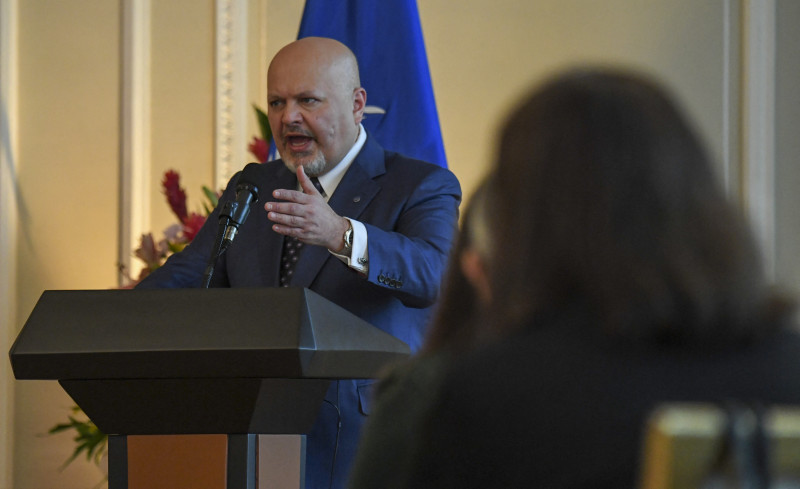
In a statement published on 18 July, six days before ICC member states vote in New York on whether to remove Chief Prosecutor Karim Khan, they said the plainest thing imaginable: the Court investigating war crimes across the globe cannot itself operate outside the rule of law.
Read that again.
The organisations were not asking anyone to ignore allegations. They explicitly said they take no position on the validity of the claims against Khan or his defence. They were asking the International Criminal Court to obey its own rules.
That should never have been controversial.
Yet somehow it has become exactly that.
The evidence says one thing. The politician said another
Here is what actually happened, and it is worse than a procedural squabble.
In May 2024, the ICC's Independent Oversight Mechanism was notified of misconduct allegations against Khan.
Rather than proceed under the Rome Statute's own Article 112 process, the Assembly of States Parties outsourced the investigation to the UN Office of Internal Oversight Services — a body whose disciplinary standard of proof is "clear and convincing evidence," meaning the allegations are "highly probable."
The ICC's own disciplinary framework, governed by the International Labour Organisation Administrative Tribunal, requires proof beyond a reasonable doubt. Two different bars, for the same set of facts.
_1.jpeg)
OIOS spent eighteen months on the inquiry and produced a 150-page report built on 5,000 pages of evidence.
The UN Office of Internal Investigations did not make any findings of fact against Khan that were adverse to him.
But there was a further stage: to assess whether that report actually met the Court's own legal threshold, the ASP appointed three of the most senior judicial figures available: Paul Lemmens, former judge at the European Court of Human Rights; Seymour Panton, retired president of Jamaica's Court of Appeal; and Leona Theron, a judge of South Africa's Constitutional Court.
They spent three months producing an 85-page legal assessment.
Their unanimous conclusion: the investigation had surfaced two entirely conflicting accounts, much of the material was hearsay, and the factual disputes were so unresolved that any legal characterisation was "almost destined for fruitlessness."
They considered the evidence collected and the UN report and unanimously found it did not establish misconduct or abuse of authority on Khan’s part. Zero finding of misconduct.
Then, less than four weeks later, a political body overruled them.
A theory nobody made
On 8 June 2026, the ASP Bureau — eighteen member states plus a president and two vice-presidents, voting by qualified majority — sidestepped the judges' findings entirely.
By a vote of 15 in favour, 4 against and 2 abstaining, it concluded that Khan had committed "serious misconduct" on the theory that he had "engaged in a sexual relationship" with the complainant and that, given the power imbalance, such a relationship "could never be appropriate."
There is one problem. Neither Khan nor the complainant has ever claimed the contact was a consensual relationship.
The Bureau built its findings on a characterisation neither party made, while failing to establish the non-consensual conduct that was actually alleged.
It suspended him from duty immediately.
A body of diplomats, without the independence, impartiality or legal expertise of the judges it overruled, and without anything like the time the judges spent examining the record, reached the opposite conclusion.
The African Bar Association warned that "any departure by a political body from the reasoned conclusions of experienced judges could undermine the institutional credibility of the Court."
The President of the Paris Bar, representing 37,000 lawyers, wrote directly to the ASP president raising the same alarm.
Then the Bureau moved the goalposts again. The Rome Statute framework was supposed to require a two-step vote at the Assembly: first, a two-thirds majority to establish serious misconduct, then a separate absolute-majority vote to remove the Prosecutor.
The Bureau collapsed that into a single vote, cutting the threshold from two-thirds down to a bare absolute majority — dismantling, in one procedural stroke, the check that made removal hard to achieve.
That vote happens on 24 July, at UN headquarters in New York.
This is impossible to separate from the wider war
The ICC finds itself under unprecedented political pressure over its investigations relating to Palestine. That is not speculation.
In November 2025, Israel filed a formal request to disqualify Khan from the arrest-warrant proceedings against Prime Minister Netanyahu and former Defence Minister Yoav Gallant, leaning heavily on media leaks of the very disciplinary process now under scrutiny.
Khan is already under US sanctions imposed by Executive Order 14203, specifically over those warrants.
On 13 July, days before the Palestinian NGOs' statement, the US Secretary of State announced what his own department called a "sweeping campaign to dismantle the threat posed by the International Criminal Court to U.S. sovereignty."
None of that proves conspiracy.
It proves something equally important: the integrity of the Court has never mattered more, and the timing of a politically engineered removal — arriving weeks after Israel asked for Khan's disqualification, and days after Washington declared war on the institution itself — should trouble anyone who cares about the rule of law, regardless of what they believe happened between two individuals.
When the institution is under that degree of pressure, adherence to due process is not a procedural technicality.
It is the institution's shield. Once people lose confidence that the rules apply equally inside the Court, why should they trust the Court when it tells nations to respect those same rules?
That is the question the 140 organisations are really asking. And it deserves an answer.
The easiest thing in the world is to defend due process when it protects someone everyone likes.
The real test comes when it protects someone accused of something serious, someone many have already judged.
That is why due process exists. Not to frustrate justice. To preserve it.
History is littered with institutions that abandoned principle because they believed the circumstances were exceptional.
Every one of them thought they were serving a higher cause. Everyone of them believed the rules could wait. The rules rarely recover.
The irony here is impossible to ignore. The ICC was created to insist that no government is above the law.
It cannot now afford to create the impression — through a rushed rule change, a lowered threshold, and a political body overruling three of the most credentialed judges it could find — that its own internal processes are negotiable when political pressure becomes uncomfortable.
Justice is not measured by how fiercely it pursues the accused. It is measured by how faithfully it follows its own rules while doing so.
That is why this debate is no longer simply about Karim Khan
Tomorrow it will be someone else. The names will change. The principle must not.
The 140 organisations — including Palestinian NGOs themselves sanctioned by Trump — have issued a warning that extends far beyond one prosecutor or one controversy.
If due process becomes conditional — if it depends on who is accused, what case they are handling, or how politically inconvenient they have become — then the ICC risks trading away the moral authority its entire existence depends on.
Institutions are rarely destroyed in a single dramatic moment. More often, they are hollowed out one compromise at a time.
One exception. One shortcut. One vote was rewritten mid-process to guarantee the outcome. Until eventually the exception becomes the rule.
Perhaps the greatest danger facing the International Criminal Court is not criticism from governments, nor sanctions, nor political attacks.
It is forgetting why the world created it in the first place — not to deliver convenient justice, but to deliver principled justice.
Even when that is unpopular. Especially when it is unpopular.
Because the moment due process becomes optional, justice itself becomes negotiable. And if that happens on 24 July, the ICC will not have failed Karim Khan.
It will have failed the very idea that no one — not states, not armies, not presidents, and not prosecutors — is entitled to justice without law. – July 20, 2026