
FOR years, DAP has struggled to shake off the perception that it is anti-Malay and anti-Islam.
The party has repeatedly rejected the label, insisting that it is neither hostile to Islam nor opposed to Malay interests.
Many within DAP, particularly its Malay leaders, have worked hard to change that perception.
They have gone into communities, engaged voters and tried to convince Malays that the party deserves to be judged on its policies rather than the accusations levelled against it by political opponents.
But such efforts count for little when one of its own MPs appears to have so little understanding of the sensitivities surrounding an issue involving Islam.
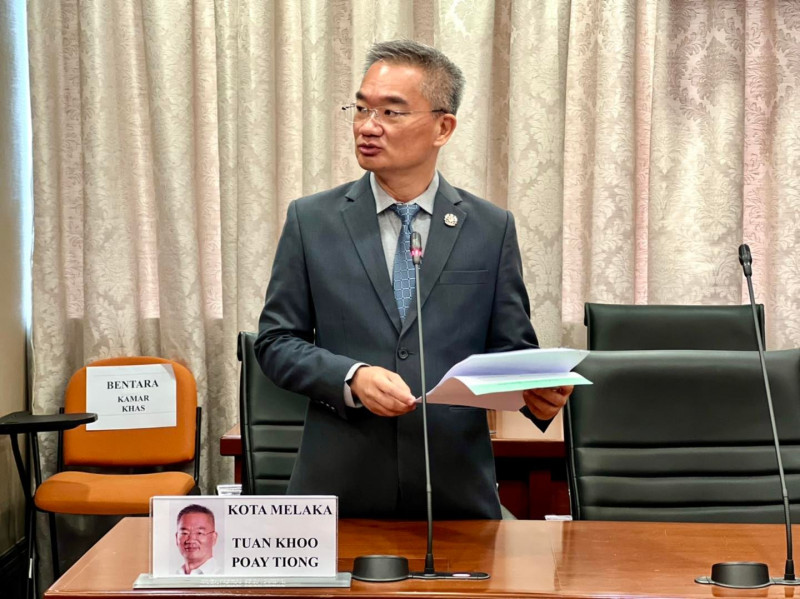
Kota Melaka MP Khoo Poay Tiong’s remarks over Kuala Terengganu’s Friday prayer business closure policy have done little to help his party.
In fact, they have handed its critics another opportunity to portray DAP as a party that does not understand or respect the place of Islam in this country.
The issue is not whether Khoo has the right to question a local authority’s policy. He does.
Elected representatives should scrutinise regulations, question their implementation and speak up when businesses or members of the public are unfairly affected.
But before making a public issue out of something so sensitive, he should at least have understood the policy and its background.
The directive was not introduced overnight by the present Terengganu administration. It dates back to a state executive council decision in 2014.
MBKT had also clarified that non-Muslim-owned food premises could operate as usual, subject to provisions involving Muslim employees and the relevant exemptions.
If Khoo’s concern was the enforcement of the directive, he could have focused on that.
There was no need to turn it into a wider political argument without first establishing the facts.
His subsequent clarification that he was questioning enforcement rather than Friday prayers does not erase the damage caused by his initial remarks.
More telling was the reaction from within his own party.
Thirteen Muslim DAP grassroots members reportedly criticised him, saying he should have understood the local circumstances before making public statements.
That should tell DAP something.
These are the very people who have to do the difficult work of building trust among Malay voters.
They know how much effort it takes to persuade a community that remains sceptical of the party.
also know how quickly that confidence can be lost.
So what exactly does DAP expect its Malay leaders to do when their own colleagues make statements that reinforce the very image they have spent years trying to correct?
The party wants greater acceptance among Malays.
It wants to appeal to fence-sitters who reject racial supremacy and hardline conservative politics.
But those voters are not automatically going to embrace DAP simply because they disagree with the politics of Malay supremacy.
They also want a party that understands their concerns, respects their religion and knows how to conduct itself in a multiracial country.
That is not an unreasonable expectation.
DAP must understand that being multiracial is not simply about having representatives from different ethnic backgrounds.
It also means having the political maturity to understand communities beyond one’s own experience.
Its Malay leaders cannot be expected to keep reassuring voters that DAP respects Islam while other representatives make statements that undermine those assurances.
Khoo is entitled to question the policy. But being an MP comes with responsibilities. It requires more than having an opinion. It requires knowing the facts, understanding the context and thinking through the consequences before speaking.
DAP’s national leadership should also take a hard look at this episode.
The party cannot keep blaming its political opponents for the anti-Malay and anti-Islam narrative when some of its own representatives repeatedly give that narrative a new lease of life.
Not every criticism of a government policy is an attack on Islam.
Equally, not every issue involving Islamic practices should be approached without an understanding of the sensitivities involved.
If DAP genuinely wants to win Malay confidence, it must demand better judgement from its own MPs.
Its leaders should not have to spend their time repairing damage caused by colleagues who fail to think before making politically loaded remarks.
The party has spent years asking Malays to look beyond the label attached to it.
But it cannot expect voters to keep doing so when its own representatives make that task increasingly difficult.
At some point, DAP needs to stop asking why Malays are reluctant to trust it and start asking who within its own ranks keeps giving them reasons not to. – November 21, 2026