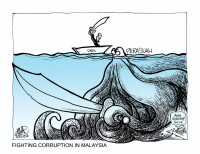

KUALA LUMPUR – The perception that the Malaysian Anti-Corruption Commission (MACC) is being used as a political weapon has raised concerns among several non-governmental organisations (NGOs), who have called for the anti-graft body to have more autonomy in its operations.
Speaking with The Vibes, Centre to Combat Cronyism and Corruption (C4) executive director Cynthia Gabriel said the centre has been advocating for MACC’s true independence since the days of its former chief Tan Sri Abu Kassim Mohamed and the 1Malaysia Development Bhd fiasco.
“The fact is that the chief is appointed by the king at the advice of the prime minister, hence making the prime minister his direct boss.
“This is a serious impediment and obstacle to MACC’s true independence.”
She said C4 had, during the Pakatan Harapan administration, advocated two main objectives.
“The first is for the chief’s security of tenure to be beefed up and lifted to that of a judge. This will allow him or her to better carry out their work without fear or favour.
“The second is for MACC’s budget and finance to be transferred to the purview of the Parliament, and not under the Prime Minister’s Department, as is currently the case.”
Gabriel said Prime Minister Tan Sri Muhyiddin Yassin’s administration must answer if it has abused MACC by having it slam the brakes on recent investigations, which saw RM77 million in bank accounts frozen and several aides arrested.
“If Malaysia is to progress and Muhyiddin to lend credence to his constant anti-corruption claims, then he must answer this to all Malaysians: what happened to ongoing investigations targeting a former minister?”

The Institute for Democracy and Economic Affairs said it supports MACC in its call for politicians to report party-hopping bribes.
Its democracy and governance unit manager Aira Azhari said the act of switching parties should not be punished as Article 10 of the federal constitution guarantees Malaysians the freedom of association – which comprises the right to engage or participate in political parties or any association – and this must be respected.
“It is important to acknowledge that not all individuals who switch parties do so for the wrong reasons. Legitimate disagreement with party leadership is a normal process in a functioning democracy.
“What should be punished, however, is the act of bribery as a form of enticement to lure politicians into leaving their parties. This is a serious offence under Section 21 of the MACC Act 2009, and must be thoroughly investigated.
“If this practice is normalised and goes unpunished, it will become a norm for politicians to switch sides for personal monetary gain.”

Their comments follow former PKR vice-president Datuk Xavier Jayakumar’s departure from the party to support Perikatan Nasional as an independent amid an MACC investigation that saw several of his aides detained for investigation.
The probe is related to Xavier’s previous tenure as water, land and natural resources minister.
Earlier this month, the PH presidential council had slammed PN’s tactic of using enforcement agencies to intimidate opposition lawmakers into defecting.
It said it is aware of actions made by certain agencies – including MACC, the Inland Revenue Board and police – against opposition lawmakers, as well as their officers and family members.
These “actions” are to pressure opposition MPs into pledging support for Muhyiddin, who has yet to prove he has the majority in Parliament, it added.
MACC has denied allegations that it is being used as a “political weapon”, emphasising that it is an independent investigative agency that always ensures its actions are done according to the law and without political leanings.
It said the claims are unfounded and irresponsible, and may tarnish its reputation and create a negative perception of the commission. – The Vibes, March 18, 2021