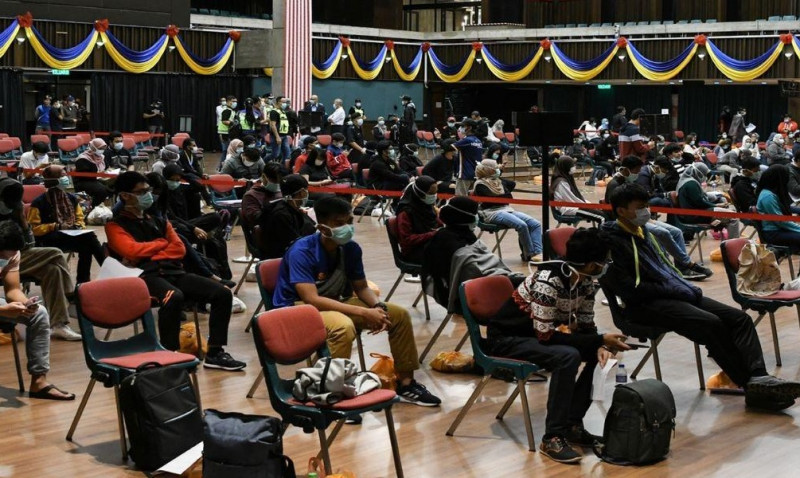

KUALA LUMPUR – 70% of the nation’s current job seekers comprise youths, according to the "Quarterly Labor Market Perspectives - Modest Labor Market Recovery" report for Q4 2020.
The report, published by the EIS-UPMCS Centre for Future Labour Market Studies, said those between 18 and 30 years old struggled to secure jobs this year largely due to being mostly new entrants who lacked work experience.
The report noted that this was coupled with the slow vacancy rate in the fourth quarter of 2020 caused by the adverse impact of movement restriction measures brought upon by the Covid-19 pandemic, making the job market more competitive.
“Furthermore, current crisis mitigating measures focus more on retaining workers and the likely bias toward rehiring experienced workers in the recovery phase, benefitting previously employed workers,” said the report.
However, those who will not benefit from the recovery are young workers, new graduates, and school leavers, who will be entering a “slackened” labour market.
“In light of tenuous growth in employment, young Malaysians are more vulnerable to job uncertainties and this will most likely increase the number of youth unemployment,” it added.
The Human Resources Ministry projected an improved labour market this year but stressed that specific intervention was needed as the unemployment rate for 2021 was expected to hover between 4.2% and 4.3%.
In a statement released together with the report, Human Resources Minister Datuk Seri M. Saravanan said several issues continue to constrain the country’s labour market.
They include challenges prospective workers face gaining employment, job qualification mismatches, increase in informal employment, as well as slower wage growth.
“The ministry will continue to monitor the labour market situation from time to time,” said Saravanan.
“At the same time, appropriate interventions to stimulate recovery and drive labour market efficiency will continue to be given attention by the government.”
The report noted that the surplus of jobseekers is due to limited vacancies as the gap between job seekers and vacancies had widened from a factor of 3.3 in Q3-2020 to 3.6 in Q4-2020.
It said the job market shows that the number of job seekers increased by 6.7% from 593.9 thousand in Q3-2020 to 633.7 thousand in Q4-2020.
In contrast, vacancies available reduced by -1.9% from 179.3 thousand to 175.9 thousand, said the report.
It said the job market in 2020 was characterised by a trapezoid shape, reflecting unequal growth in active unemployed numbers and vacancies.
“The ‘trapezoid’ shape trend calls for serious attention as it indicates that the number of job seekers will keep growing in the labour market. If not properly addressed, this structural issue will prolong,” said the report.
It said this is different from the pre-crisis period of 2019, in which the gaps between jobseekers and vacancies were stable at a factor of 1.8.
The report however added that there would be stronger demand for non-professional manager, executives, and technician jobs this year.
Comparing the current economic turmoil to the one faced in the nineties, the report said the economic contraction induced by the Asian financial crisis was more severe than that of the Covid-19 pandemic.
It said the financial crisis in 1997 turned a strong expansion of 7.3% in 1997 into a deep contraction of -7.4% in 1998, while the Covid-19 pandemic adversely affected economic growth in Malaysia with a -5.6% contraction in 2020.
“The Covid-19 pandemic disrupted the labour market harder than the 1997 financial crisis. Although the economic growth during the pandemic is less severe than the Asian financial crisis, it has had a profound impact on the labour market.”
It said Malaysia was able to maintain an unemployment rate of 3.2% during the Asian financial crisis, but the pandemic resulted in thousands of people losing their jobs and income, increasing the unemployment rate to 4.5% in 2020.
“Implementation of movement restrictions as a preventive measure to control the outbreak of infection has its economic costs.
“The restriction measures have caused massive disruptions to both the supply and demand sides of the economic system,” the report noted.
"On the supply side, the sudden operation halt of non-essential businesses disrupted the supply chain and production output, which in turn, affected the demand for labour.
“Firms could not afford to pay wages and were forced to retrench their workers." said the report. – The Vibes, April 5, 2021