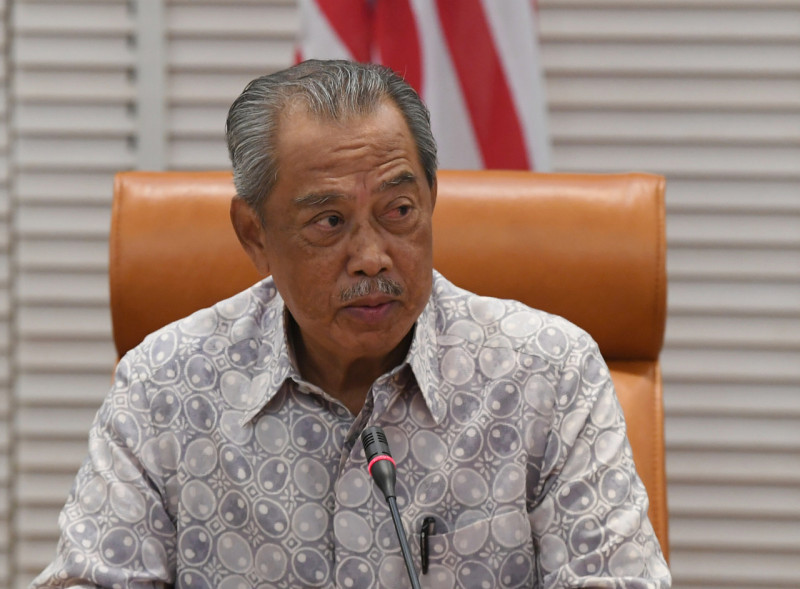

KUALA LUMPUR – The popularity wave that Prime Minister Tan Sri Muhyiddin Yassin has been enjoying is now turning against him after gaffes during his Covid-19 address on Tuesday. The Perikatan Nasional (PN) administration has been riding high after winning the Sabah election with its allies as well as its handling of the pandemic in March.
However, Muhyiddin and his government have since been on the receiving end of public criticism over their failure to take necessary measures to curb the spread of Covid-19 following the Sabah polls last month.
He also drew the ire of social media users over his national address via Facebook Live after the country registered a record high of 691 new Covid-19 cases, including the death of a one-year-old toddler.
He was criticised for saying there were no double standards in enforcing mandatory quarantine as well as ending his speech with a light remark that he would start using the rotan (cane) if Malaysians continued to defy health SOPs.
Immediately, Malaysians took to social media with #MuhyiddinOut, calling for his resignation. The hashtag has been trending on Twitter since.
This has raised questions over the prime minister’s popularity, with observers divided as to whether such gaffes would create a groundswell of discontent.
Universiti Malaysia Sabah (UMS) academician Associate Professor Lee Kuok Tiung said it is only expected that Muhyiddin’s popularity will plunge following recent developments, particularly as Malaysians grow increasingly concerned by the spike in Covid-19 cases.
“We have to accept that most Malaysians are now in a stressful situation, and we know that Covid-19 is a serious matter,” he told The Vibes.
“So when anyone trivialises a sensitive issue like this, the public will not take it lightly,” he said, referring to Muhyiddin’s national address.
Lee said the PN government’s approval rating is similarly expected to fall, with many Malaysians feeling as if not enough is being done to tackle current economic issues.
“The people still feel as though the government is not doing everything it could to address bread-and-butter issues. With the loan moratorium ending last month, sentiments will only get worse,” he said.
To regain the trust of the public, Lee said it is a must for Muhyiddin and PN to promptly tackle the economic and health issue, and to get Covid-19 figures back under control.
Universiti Utara Malaysia’s Prof Mohd Azizuddin Mohd Sani said there is bound to be criticism if the public feels that their livelihood will continue to be affected by the pandemic.
The situation is made worse with cybertroopers painting a negative image of Muhyiddin on social media, Azizuddin said.
“As far as popularity goes, there will always be ups and downs. For instance, when the economy is not doing well, you can expect the rakyat to start questioning the government’s efforts.
“So it (criticism) is normal, especially when issues like Covid-19 get worse,” he said, adding that the ongoing bickering among PN parties would not do the coalition any good.
Independent pollster Merdeka Centre director Ibrahim Suffian, however, said Muhyiddin’s popularity should not be judged based solely on the views of social media users.
He said the negative sentiments against Muhyiddin, while sizeable, may only be reflective of a more critical, urban crowd and does not necessarily represent the majority of Malaysians.
Ibrahim said up to October 1, Muhyiddin’s popularity remains to be in a “very positive territory”, especially after the Sabah polls.
Merdeka Centre had, last month, said the approval rating for Muhyiddin was at 69%, based on a survey it conducted.
“In my view, the negative sentiments expressed by netizens over the last few days should be balanced with the rest of Malaysia.
“Until nationwide data becomes available, I would be cautious to generalise negative sentiments,” he said. – The Vibes, October 8, 2020






.jpeg)