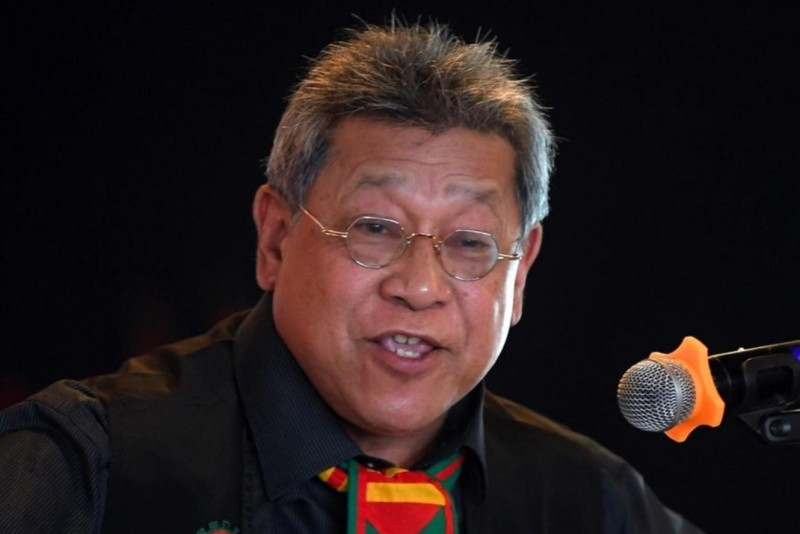
KOTA KINABALU – Former Dewan Rakyat speaker Tan Sri Pandikar Amin Mulia has sent a stern message to Putrajaya – pull up your socks or we are pulling out.
Pandikar, a household name in Malaysian politics said the East Malaysian states will turn their backs on the Malaysian government if their interests and claims are not met.
“Putrajaya should resolve matters like the Malaysia Agreement 1963 or end the cabotage policy,” he said.
The Malaysian cabotage policy, which affects Sabah and Sarawak, emphasises that only vessels registered in Malaysia are allowed to load and unload cargo in the ports of Malaysia.
The whole idea behind this policy is that Port Klang is to be the container hub port in Malaysia.
“My view is that the federal government must focus on calls from the Sabah and Sarawak governments.
“My concern is if the federal leaders do not do this, there will be some kind of reaction... if the attitudes and the minds of federal leaders do not change.
“I can guarantee you in 15 years, Sabah and Sarawak may no longer be part of the Malaysian Government.
“Please, don’t take my advice lightly or trivialise it,” he said this after a meeting with members of Brunei, Indonesia, Malaysian and Philippines East Asean Growth Area (BIMP-EAGA).
Pandikar who has been appointed as the BIMP-EAGA special envoy for Sabah advised Putrajaya to stop formulating policies that will hurt the people and economy of Sabah and Sarawak.
“Putrajaya must be serious over East Malaysia’s concerns,” he said.
BIMP-EAGA challenge
Pandikar also took a swipe at the state civil service as the reason for the stunted progress of the BIMP-EAGA over the last 27 years.
He said it was largely due to sluggishness in the state civil service, as well as the treatment given by top officers in the Sabah civil service to the council which has led to a less progressive BIMP-EAGA.
Launched in 1994, the BIMP-EAGA was established to tap into the economic potentials of the four nations, the Philippines, Malaysia, Indonesia and Brunei, which are the world’s most resource-rich areas in Southeast Asia.
The BIMP-EAGA initiative boosts growth in trade, investments, and tourism through new intra-region shipping routes and air links as well as power interconnection projects.
Other key areas of cooperation include agribusiness, tourism, the environment, and socio-cultural education.
“The highest in the state civil service is the state secretary and he is supposed to put an effort into this.
“Unlike Sarawak which appointed the state secretary to chair their BIMP-EAGA council, it is the deputy state secretary who has been named as the chairman for the council in Sabah.
“So what does this tell you? The deputy does not have quick access to the chief minister.
“Instead the officer will check with the state secretary first before all the council matters can be brought to the chief minister’s attention,” he said.
Pandikar also said the councils are under-equipped and are left behind, saying they now stand to lose out on potential businesses arising from the relocation of the Indonesian capital city in Jakarta, to East Kalimantan.
Earlier, Pandikar said underutilisation of the Kudat jetty remains one of the problems faced by the council, despite RM7 million being spent on upgrades. – The Vibes, April 5, 2021