
GEORGE TOWN – While hotel and resort operators along Batu Ferringhi are worried about the worsening beach erosion, Penang Infrastructure and Transport exco Zairil Khir Johari believes it is not as bad as it looks.
Zairil said the erosion is an isolated incident and occurs only in the Rasa Sayang area and not along the entire coast.
“For your information, Rasa Sayang does not have a coastline at high tide; it only has a beach area at low tide.
“In fact, the hotel built a structure on the beach bank in the area of their land lot up to the seafront.
“The structure is also a burden on the cliff and is one of the factors contributing to erosion of the coastal cliff.
“My office received a complaint from Rasa Sayang regarding this issue on February 8.

“After discussing with the technical agencies, a site visit was conducted on February 18 with the Penang Irrigation and Drainage Department (DID), District and Eastern Land Office Sea and Penang Island City Council.
“During the visit, the estimated length of the erosion was approximately 300m, with a cliff height within 2m.
“In other words, the area affected by erosion is only 0.3km of the total 2.7km of Batu Ferringgi beach,” Zairil said in a statement recently.
Uprooting trees, destroying amenities
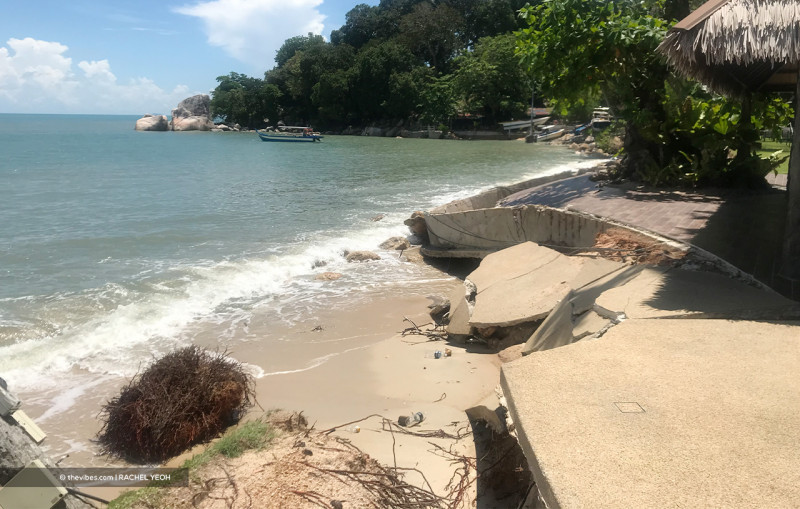
His response comes in the wake of several reports, including by a resort, about the escalating erosion since January this year, causing some structures to collapse.
Some said the erosion has also caused the uprooting of some 50 trees due to the removal of sediment along the coastline.
The beachfront is also lashed by waves during high tide, leaving only a narrow foreshore during low tide.
.jpg)
Hotels with amenities by the beach have been forced to relocate their essentials as it poses a threat to patrons.
Coastal conservation researcher Chee Su Yin told The Vibes that the beach erosion in the northern regions of Penang has been happening for years, including at the Centre of Marine and Coastal Studies (Cemacs) in Teluk Aling.
“The rocks that are now seen on the beach used to be covered by sand.
“Properties will be the next to be affected, followed by human life.
“This erosion will also affect the tourism industry adversely as there will be loss of beach, landscape, quality and deteriorating infrastructure that might include roads and power lines.
“The sand goes into the sea. So, you can expect increased sedimentation in the water, which is bad for the growth of aquatic plants, which clogs fish gills, among others,” she said.
Nature-based solutions?
To determine the cause of the erosion, a bathymetric study that includes modelling and oceanography has to be undertaken.
Some believe the main causes are due to activities such as land reclamation, the building of islands, rise in sea levels, increase in storm frequency and intensity due to climate change.
“It is natural for erosion and accretion to happen as these are natural cycles.

“However, because of all the stressors mentioned, it has accelerated and worsened the condition.
“Normally, people would build seawalls to stop the erosion, but recently, governments all over the world are shifting to nature-based solutions; harnessing the power of nature as solutions to these challenges,” she said, suggesting this would be a better solution than building artificial walls.
Senior research officer at Sahabat Alam Sekitar Mageswari Sangaralingam told The Vibes that it is the government’s responsibility to investigate the cause of the erosion and undertake mitigation measures.
“We need an update on the latest condition of our beaches in all of Penang.
“Where and how critical is the coastal erosion and where is the accretion happening? Are reclamation projects contributing to coastal erosion?” – The Vibes, April 28, 2021




.jpeg)









.jpeg)