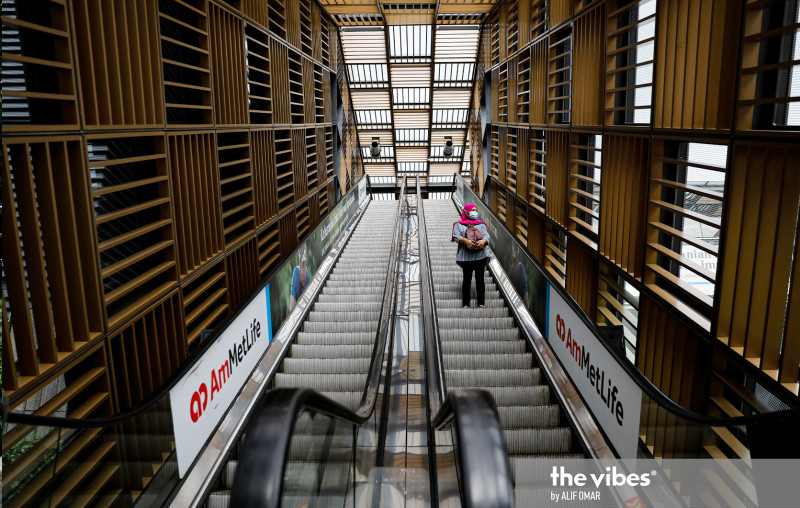

KUALA LUMPUR – The federal government’s knee-jerk reactions to increasing pandemic infection numbers, and its ensuing conflicting instructions, are causing what can only be described as pandemonium in the retail industry.
Thanks to the Hotspot Identification for Dynamic Engagement (HIDE) system, the sector is set to see another hitch in its recovery, as premises listed in the system must shut for three days.
Malaysia Shopping Malls Association president Tan Sri Teo Chiang Kok said the association believes the government’s “impromptu” decisions regarding shopping mall operations are not based on facts or science, adding that the sudden closures have needlessly disrupted businesses.
During the first and second movement control orders, foot traffic at the centres dropped to between 10% and 15% of normal levels, he added, saying that there is a direct correlation between foot traffic and business turnover.
Teo said some 20% of tenants have already shut shop, with many more struggling to recover or simply survive.
Existing standard operating procedures have already been a barrier to recovery, he told The Vibes.
For example, he said, the physical distancing rule has reduced shopping mall capacities by 60%, which is below profitability, with them merely mitigating losses while generating cash flow.
The industry currently employs some 452,000 workers, he added, but “already there is an increasing number of lay-offs and salary cuts”.
._Credit_See_Hoy_Chan_Group.jpg)
Teo said the association does not understand the desperation behind the government’s decisions, adding that safety measures will be more effective and less damaging if businesses had a one- or two-day notice, as well as properly planned consultations and standard operating procedures (SOPs).
“Shopping mall operations are akin to a big oil tanker, it takes time to change course, not ‘serta-merta’ (immediately). This is especially so when the directives are ambiguous and change by the hour.”
Yesterday, Senior Minister Datuk Seri Ismail Sabri Yaakob said premises listed in HIDE are identified as potential at-risk locations in the transmission of Covid-19 infection, and will be ordered to close for three days immediately, in an effort to tighten SOPs amid the worsening Covid-19 situation.
This despite Science, Technology and Innovation Minister Khairy Jamaluddin earlier saying it will not be necessary.
Yesterday, HIDE listed 152 locations at risk of becoming Covid-19 hotspots over a seven-day period, with the majority of them in Kuala Lumpur and Selangor. Most are malls, markets and stores.
However, based on Health Ministry data from February 22 to April 2, only 4.78% of Covid-19 infections are from shopping premises.
Factories are the largest contributor with 48.06%, followed by community spread (12.55%) and construction sites (11.56%).
Incomplete data
Teo said misinformation makes the negative impact on shopping malls worse, especially when the people are fed such inaccurate information.
“Decisions are made based on inaccurate and incomplete data-mining and computer-modelling data. This is a classic case of ‘garbage in-garbage out’.
“Shopping malls have been adhering to SOPs, and recording movements of staff and shoppers using the MySejahtera app.”
He said the centres have provided more comprehensive data of staff and shopper movements compared with other businesses, leading to result distortions due a lack of reliable data.
“Unfortunately, crucial decisions like directing sudden closures of businesses are based on faulty data and simulation modelling.
“(Because of this) The retail industry and shopping malls not only face massive losses, but the public has also been misled to believe that such centres are unsafe. This misperception (causes) a massive damage, which may take months to restore.”
On the closure of Bangsar Village II – which is listed in HIDE, but not its annexe Bangsar Village I – Teo said the order has led to “illogical” and “incomprehensible” situations.
“If this precarious recovery process is further interrupted, many more businesses will fail as they have already exhausted whatever reserves they have, and are at the edge of possible collapse.” – The Vibes, May 9, 2021