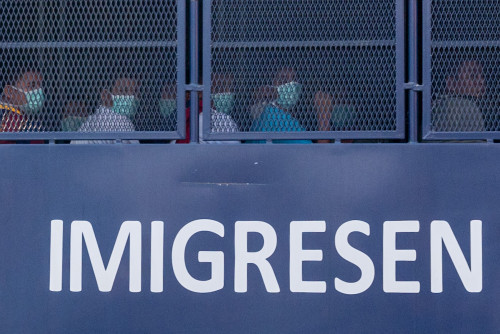
SANDAKAN – Barter trade, which brought in millions of ringgit for Malaysia in waters off Sabah, is no longer the business it used to be, as it now rarely involves the exchange of goods but normal export and import of wares.
Trading between Sabah and the nearby regions of Indonesia and Philippines started in the late 1940s, but was only officially named “barter trade” in 1993. Traders from the three countries would cross the sea borders with ships to exchange goods.
However, over the years, instead of exchanging goods, the trade has become conventional, where a party would pay money for its purchase. Sabah also now sells more than it buys from these countries.
This is further supported by the free-trade policy in Malaysia, which runs counter to the barter trade policy in Indonesia and Philippines limiting a person’s purchase to RM600 worth of goods per trade, with anything more subject to tax.
Wong Thart Sin, the Tawau chairman for the Brunei Darussalam-Indonesia-Malaysia-Philippines East Asean Growth Area’s (BIMP-EAGA) Malaysia Business Council, said that the different policies among the countries pose a challenge to traders.
“That is why we don’t see Malaysian ships going to Indonesia and Philippines for these trades,” he said.
“We are able to sell as much as we want, so they come and buy what they want.”
He said that the shipping companies in the other two countries manage to settle any issues related to the “barter trade policies” in their respective countries on their own, but Malaysian ships are not so lucky there.
“We don’t want to risk getting our goods and ships seized there,” he told The Vibes in an interview recently.

In Sabah, only ports in three districts are allowed to conduct border trade. These are in Kudat, Sandakan and Tawau. Only Tawau trades with both Indonesia and the Philippines, while the ports in the other two districts ship only to the Philippines, which is closer.
Wong, who has more than 30 years of experience in barter trade, said that Indonesia and the Philippines would purchase goods like onions, rice, sugar, high-end branded cosmetics and processed food.
The islands in these two countries, mostly located in the Sulu Sea and Celebes Sea, buy from Sabah, which is closer to them than their own capital cities.
“Trading houses in their capital cities have been dominated by bigger brands like Nestle. So, by the time these goods reach their islands, they become too expensive. That is why they can get the same goods from Sabah for half the price,” he said.
Sabah would, in turn, buy lower-end goods like cosmetics and other daily essentials from them.
Trading sector taken over by foreigners
Wong, who is also a national advisory committee member of the Associated Chinese Chambers of Commerce and Industry of Malaysia (ACCCIM), said that another challenge faced by the traders is that the Filipinos and Indonesians are starting to take over the business by placing their relatives in Sabah to get supplies.
“Back in Berjaya’s time (Parti Bersatu Rakyat Jelata Sabah, which ruled Sabah in the 1970s and 1980s), the trade was booming in Sabah because there was a policy that disallowed foreigners from staying in Sabah for long (periods).
“Those who entered Sabah for trading activities must be guaranteed by a Sabah trading company at the Immigration Department. So, we would have to keep track and ensure that they leave within a period or be fined by the government.
Right now, the trading business is difficult for the locals. Their own people would run the smaller scale trades, while the big trades are dominated by cartels, leaving little opportunities for local SMEs.”
“This policy was so effective as it was very strict, leaving no chance for foreigners to illegally stay in Sabah or for them to take over the business.
“Right now, the trading business is difficult for the locals. Their own people would run the smaller scale trades, while the big trades are dominated by cartels, leaving little opportunities for local SMEs (small and medium enterprises),” he said.
Wong said due to an unfavourable government delivery system and the fact that major traded items like sugar and rice are now controlled by foreign cartels, Sabah now does not earn much from barter trade.
“I estimate Sabah earns only about RM6 million per year from Sabah Port Sdn Bhd warehousing charges and local shipping charges, shipping agents and forwarding agents’ services charges, as well as licence-holders earning licence fees,” he said.
Wong’s estimation is far lower than past recorded incomes, said to be about RM148 million (to Indonesia) and RM20 million (to Phillipines) in export value from 2011 to 2015.
Meanwhile, Datuk Seri Loo Yap Kiang, the Sandakan chairman for the BIMP-EAGA Business Council Malaysia, said that he welcomes the Gabungan Rakyat Sabah (GRS) government’s decision to allow barter trade in March this year to resume operations, after it was banned to curb the spread of Covid-19 in October last year.
He said traders in Sandakan have faced difficulty as they must pay rent to Sabah Port for space to store their goods, which are unable to be shipped to the Philippines.
“Right now, I think that the traders are only covering their losses. We are still not earning. We hope that this decision will stay, and the trade will not be banned again in the future,” he said. – The Vibes, May 16, 2021