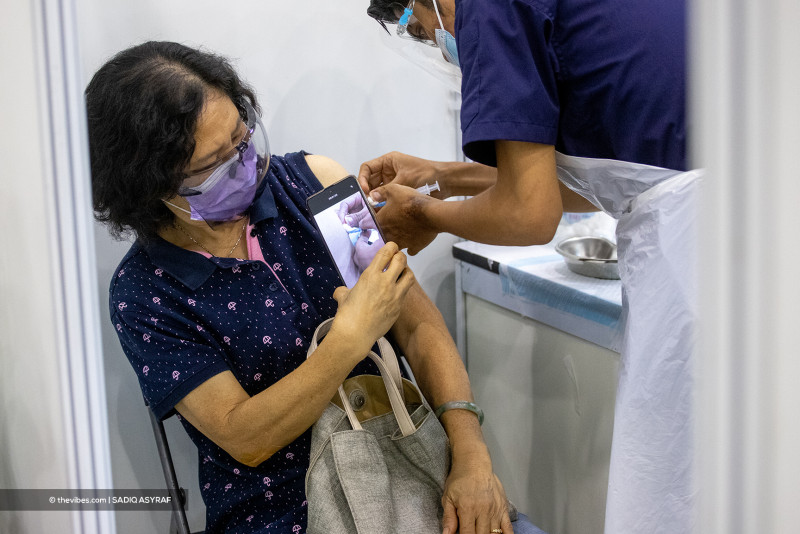

KUALA LUMPUR – Health experts have weighed in on the viability of using a different Covid-19 vaccine as the second dose or booster shot to resolve the issue of supply shortage in the country.
This comes as the Covid-19 Vaccine Supply Access Guarantee Special Committee (JKJAV) explores data on the feasibility of giving an individual who has received one dose of the AstraZeneca vaccine, the Pfizer jab as the second shot.
If this is approved, Malaysia will join countries, such as Bahrain, Canada, China, the United Kingdom, the United States, South Korea, the United Arab Emirates and Spain, that are considering or have adopted this method.
Several medical studies are being conducted to test the efficacy of switching Covid-19 vaccine brands in various countries amid delays in distribution by pharmaceutical companies, reported Reuters late last month.
Speaking to The Vibes, Universiti Putra Malaysia medical epidemiologist Assoc Prof Dr Malina Osman said “mix-and-match” vaccinations are an option that health authorities and the government can examine to ramp up the National Covid-19 Immunisation Programme.
She noted that 40% of the population has to receive both doses before a decline in infections can be seen.
The latest published scientific evidence documents preliminary findings that this method leads to much higher levels of antibodies produced, she said.
“This will overcome issues related to unexpected inadequate or fluctuating supplies of various vaccines.
“In my opinion, based on current findings, our country can consider this approach. (This way,) we can attain herd immunity.”
National vaccination drive coordinating minister Khairy Jamaluddin has said using a combination of vaccine brands can improve protection against Covid-19 variants.
Speaking at a webinar hosted by the Oxford and Cambridge Society of Malaysia, he said Institute of Clinical Research director Dr P. Kalaiarasu has presented a paper on the method to JKJAV.
We have real-world data that we received from Germany on heterologous vaccinations using AstraZeneca for the first dose and Pfizer for the second, which have shown to boost neutralising antibodies and be more effective against variants.
“We are watching this very closely. We don’t want to make a quick decision on this before getting more data.”

Better immune response
In late May, science news site Nature.com reported that researchers in Spain found that people given both the AstraZeneca and Pfizer jabs have a better immune response to the coronavirus, based on trials involving more than 600 people.
The trials are similar to those conducted around the same time in the UK, whose findings on immune responses have yet to be published. Researchers in Germany, meanwhile, recently found improved immune responses in 26 individuals who received the two vaccine brands.
The mix-and-match method is not limited to the vaccines produced by AstraZeneca and Pfizer, and can also see the use of jabs by other pharmaceutical firms.
On Tuesday, Health Director-General Tan Sri Dr Noor Hisham Abdullah announced that the Drug Control Authority has approved the Covid-19 vaccines by Johnson & Johnson and CanSino for emergency use.
He said the agency has also given the nod for the Pfizer jab to be used on children aged 12 and above under the national immunisation programme.
Both the Johnson & Johnson and CanSino vaccines are single-dose jabs and have received Emergency Use Listing approval from the World Health Organisation (WHO), while the Pfizer, Sinovac and AstraZeneca jabs currently used in Malaysia are a two-dose regimen.
WHO experts have said this option to fast-track immunisation is feasible and can simplify vaccination efforts, based on preliminary studies in Spain, the UK and Germany.
Chinese broadcaster CGTN recently quoted Alejandro Cravioto, the WHO chair of strategic management, as saying using AstraZeneca and Pfizer for the first and second doses, respectively, can be done “without any problems in the sense of efficacy”.
It also reported that mixing and matching AstraZeneca and Pfizer shots showed an efficacy rate of 97% after the second dose. However, information on the results of combining other vaccine brands remains limited.
Katherine O’Brien, director of WHO’s Immunisation, Vaccines and Biologicals Department, said there are currently 15 vaccine types being used in different countries.
Although they work differently – based on inactivated flu viruses or mRNA technology – all of them stimulate the immune system to develop antibodies against Covid-19.
“So, just on the basic principles of how vaccines work, we do think that the mix-and-match regimens are going to work,” said O’Brien.
“But, it is important that we actually get data on the degree to which your immune system does respond to a second dose that’s not of the same vaccine as the first.”

Not yet enough evidence
A Malaysian public health expert, who declined to be named, said the matter of safety when it comes to using different vaccine brands will “not be such an issue”, as the jabs administered in Malaysia must first get the green light from the Health Ministry.
“Either way, they (vaccines) function similarly, although the technology to develop them may be different. In the end, it’s all about building up antibodies against Covid-19,” he told The Vibes.
However, he said, while mixing vaccines, such as AstraZeneca and Pfizer, has shown promising results, including recipients exhibiting higher levels of immunity, the method’s long-term efficacy has yet to be observed.
Furthermore, there could be complications in the future, when international borders open up. For example, the US might only accept travellers who have received the Pfizer or Moderna jab, while the UK could approve entry only for those who got the AstraZeneca jab.”
Putrajaya should not rush into mixing and matching vaccines, and should base its decision on further scientific findings, he said.
Dr Sanjay Rampal, a specialist on public health medicine and professor of epidemiology at Universiti Malaya’s Social and Preventive Medicine Department, said there is not enough evidence to influence policy changes at the moment, “unless there is a chronic imbalance in vaccine supply”.
“The vaccines have been tested using specific protocols. As such, most of the published evidence is from single-vaccine protocols.
“The results of the mix-and-match approach are still in their preliminary stages, and from relatively small-sized trials.”
In periods of vaccine shortage, he said, an option would be to space out the interval between two doses of the same vaccine by up to three months.
“However, increasing the period between doses will result in a longer period of attenuated efficacy between the first dose and two weeks after the second dose.
“The goals of vaccination should be clear. Is it to prevent infection, or severe manifestations of the disease? The current aim is to reduce disease severity and mortality.”
Daily Covid-19 cases will lose their significance in a post-vaccinated community, and only cases with complications will be admitted for treatment, he said, adding that occupancy at intensive care units serves as a more important marker for how the standard operating procedures should be calibrated.
We must all be patient when it comes to the implementation of the National Covid-19 Immunisation Programme. Rome was not built in a day. We should have a more realistic expectation of its completion.
“While we wait for the immunisation programme to be completed, prevention is better than cure. It is important to ensure that preventive public health services at the district level can cope with their caseloads efficiently.” – The Vibes, June 18, 2021