
KUALA LUMPUR – China befriended Malaysia in 1974 – notably four years before it opened its doors to Western powers – and yet, almost 50 years later, bilateral ties remain complex.
An ongoing dispute is over Beijing’s claim to a large part of the South China Sea, which has raised the ire of not just Malaysia, but also regional neighbours Vietnam, Brunei, the Philippines and Taiwan.
Chinese vessels have repeatedly encroached on Malaysian waters – 89 times in the three years since 2016.
In April, a survey ship breached the country’s exclusive economic zone in East Malaysia, making it the second non-cruise vessel to have done so since 2012.
And shortly before Chinese Foreign Minister Wang Yi’s visit to Malaysia last Monday, six Chinese fishing boats and their crew were detained on suspicion of trespassing on Malaysia’s maritime territory.
Beijing has urged Putrajaya to investigate the matter fairly.
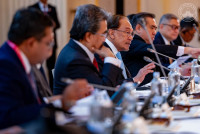
In a joint statement on Tuesday, Wang and his Malaysian counterpart, Datuk Seri Hishammuddin Hussein, said the two countries have underscored the importance of not complicating disputes in the South China Sea.
They also spoke about a speedy conclusion of the South China Sea Code of Conduct (CoC), but progress has been painfully slow.
“I don’t think the CoC will be concluded by 2021,” said geopolitical expert Azmi Hassan.
The code was first mooted in 2002, but it was only two years ago that China and Asean nations agreed to a single draft negotiating text for the document and a deadline of next year.
Despite China’s passive-aggressive behaviour in the row and Malaysia’s seemingly conciliatory tone, Azmi believes Putrajaya has been playing its cards right.
“Taking into account the West Capella incident, Putrajaya hinted to Beijing that we have the US to rely on if Beijing insists on bullying us. We can play hard with them, but we do it by the book.
“In the CoC negotiations, we demanded that UNCLOS (United Nations Convention on the Law of the Sea) is adhered to, which was contrary to China’s wishes, but Wang has said Beijing is willing to take the middle ground on the issue.”
Ngeow Chow Bing of Universiti Malaya’s Institute of China Studies agrees with Azmi on Malaysia’s approach to the South China Sea spat.
“Malaysia has taken the necessary steps to assert its claims and interests in the South China Sea while being moderate and not too vocal. That has been the policy posture since the 1990s across different administrations.”

The need for Malaysia to maintain a soft balance is clear.
China has been Malaysia’s largest foreign direct investment contributor since 2016 and is involved in several of the country’s high-profile projects, such as Forest City, East Coast Rail Link, Malaysia-China Kuantan Industrial Park and Melaka Gateway.
During Wang’s visit, China agreed to make Malaysia a priority recipient of the former’s Covid-19 vaccine and buy 1.7 million tonnes of Malaysian palm oil until 2023.
The palm oil purchase is a much-needed assurance given the US’ ban on FGV Holdings Bhd following an investigation into allegations that the company has been using forced labour.
Despite the maritime tensions, Ngeow is of the view that incursions by Chinese fishing vessels are isolated incidents that will not harm bilateral ties.
“The diplomatic history is one thing; the territorial and maritime dispute is another matter.
“There are territorial and maritime disputes with Singapore, Indonesia, Thailand, Vietnam and the Philippines, but that doesn’t mean Malaysia will cut diplomatic ties with these countries.”
He said freedom of navigation technically allows fishing boats to “trespass” on Malaysian waters, and many foreign vessels do so.
“So, are Chinese fishing vessels trespassing or doing other activities not permitted by the Malaysian government? We don’t know yet.
“But, this incident will have very little impact,” he said, referring to the latest case.
“The weight of the joint statement (by Wang and Hishammuddin) will not be reduced because of this incident.” – The Vibes, October 19, 2020