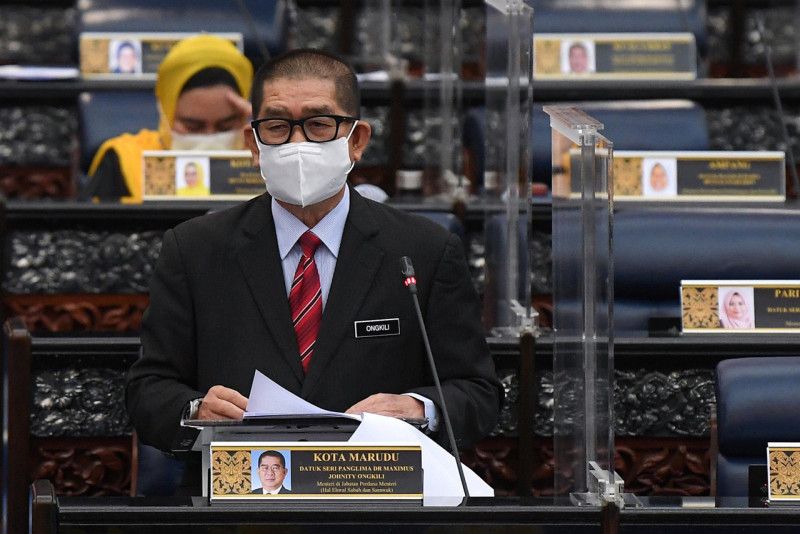

KUALA LUMPUR – The past 11 Malaysia Plans may have failed Sabah and Sarawak, but this time, the 12th Malaysia Plan (12MP) will bridge the development gap between East and West Malaysia, said Minister in the Prime Minister’s Department (Sabah and Sarawak Affairs) Datuk Seri Maximus Ongkili.
He said as one of the old-timers in the august house, he believes that in the last 11 Malaysia plans, despite its many achievements, the federal government sometimes shied from admitting that Sabah and Sarawak deserve special attention.
“Although Sabah and Sarawak are rich in culture and natural resources, the planning and budgeting agencies of both states need special attention to realise its development goals and thorough follow-throughs.
“The habit of taking things for granted, loose planning and absence of goal-setting in development planning is over.
“The federal government is (now) committed to bridging the development gap between East and West Malaysia as evidently, the 12MP is the first Malaysia Plan with a special chapter for the socio-economy of Sabah and Sarawak,” he said in his winding-up speech on the 12MP in Parliament today.
Ongkili said the government is committed to overcoming any obstacles, delays and backlogs concerning development plans for Sabah and Sarawak.
The focus will be on basic infrastructure, such as roads, water and electricity supply, education, multimedia and digital technology, as well as health, which sets the bar between developed and under-developed states in the country, he added.
“I believe that, under the 12MP, with views and input from members of the august house in terms of realising wholesome and inclusive policy planning and budget management, (these policies) should be realised, and not remain just academic.
“We must make it a reality that development planning be translated to the improvement of the livelihood of rural people, especially in Sabah and Sarawak. Development planning should never be listed as an academic fantasy of testing theory and empirics.
“It must concrete to the real and tangible improvement of the economic status of rural people, elimination of poverty, creation of employment, reduction of income inequalities and achievement of real prosperity.
“This should be the real content of the Shared Prosperity Vision 2030,” he said.
Ongkili added that, after 58 years as a federation, the word “inclusive” in development plans is still far from being reached.
As the minister overseeing East Malaysian affairs, he said he will not back down from sharing their grouses and stressed that a lot of effort is needed at the national level for Sabah and Sarawak, seeing that the two states have been funding development in Peninsular Malaysia.
The Kota Marudu MP then voiced his appreciation and thanks to Putrajaya’s awareness that Malaysia as a whole will be more prosperous if the development gap between Peninsular Malaysia and East Malaysia is narrowed, or “better still, repealed”.
“There is no reason to allow the development and progress gap between Sabah and Sarawak, on one end, and Peninsular Malaysia, on the other.
“This is the responsibility of all (MPs) in this august house: to ensure that Malaysia stays strong, developed and prosperous.”
He said further strengthening Malaysia is not just about protecting, honouring and guaranteeing the rights and interests of Sabahans and Sarawakians, as enshrined in the Malaysia Agreement 1963 (MA63), but also to ensure that development and prosperity of the people in both states are equal to that of Peninsular Malaysia.
“This is what we want to preserve because former prime minister Tunku Abdul Rahman reiterated many times when ‘proposing’ to Sabah and Sarawak to form the Federation of Malaysia, that, in his words: ‘Trust me, I will develop you better than the British.’… so, let’s pursue these words as part of the essence of MA63 promises.” – The Vibes, October 7, 2021