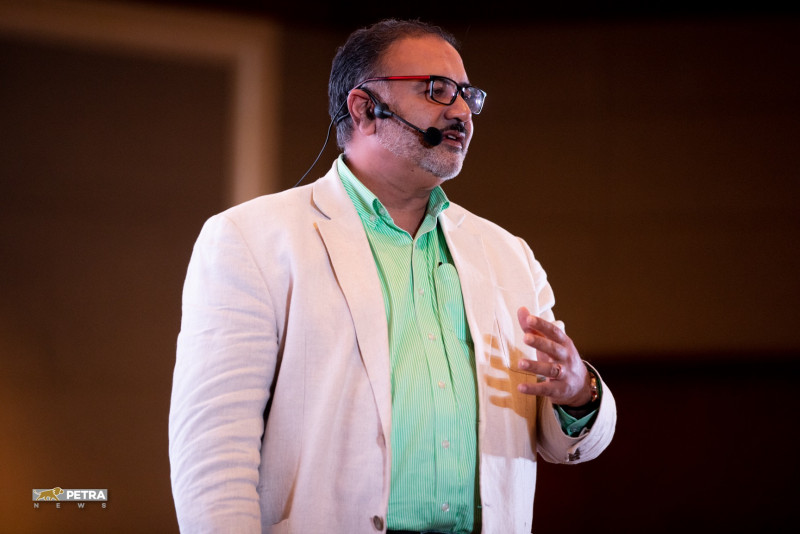

KUALA LUMPUR – Action speaks louder than words, but not when it comes to issues on global warming and how nations can be more sustainable.
PETRA Group chairman and chief executive Datuk (Dr) Vinod Sekhar said economic integration must happen first to provide education and solutions, and develop economic leaders before sustainability can be effectively championed.
He highlighted that there is no point in fighting climate change, if humanity issues such as poverty and malnutrition are not dealt with.
“You cannot just save the planet, and not save the people along with it. It has to be done together holistically – so, poverty eradication and education is one of the key elements to fight climate change,” he told attendees of the plenary titled “Sustainable Asian Growth” during the Horasis Asia Meeting 2021 today.
“There also needs to be economic integration – without it, we are not going to deal with climate change. If Malaysia takes up the position to fight climate change and neighbouring countries like Thailand, Indonesia, and the Philippines do not, then it takes us nowhere. We cannot do it on our own.”
However, he said for this integration to happen, countries must strive against divergence of socio-economic issues that are prevalent.
Hence, Vinod believes that more businesses in the region, both big and small, should be involved in the conversation about climate change.
“Politicians cannot be effective leaders in this fight as they can change every five years. Following that, policies change as politicians and governments change. The agenda of one government may be different from another,” he said.
He also said if businesses and industries that make up the community buy in and are fully integrated into the process towards sustainability, it will result in long-term change.
“We need to face the challenge that there is a lack of education, and poverty.
“When you go to the people that need convincing in the community and tell them what is needed from them to fight climate change, they would not be concerned because their priority is on having enough money to feed their family tomorrow or send their children to school.
“Therefore, education is the basis that will enable them to understand that climate change is impacting their world. It is impacting their jobs, it is impacting the economy, and the way they live their life. But that comes with education in that community – we need to deal with that issue head on,” he said.
Vinod also spoke about the poverty eradication model in Malaysia under the Smallholders Scheme with the Federal Land Development Authority and Rubber Industry Smallholders Development Authority.
He said this is where parcels of rubber plantation were given to families so they could tap and sell them to a processing company, which lifted many lives and created education opportunities for communities that didn’t have schools.
Using the same model to aid climate change, he said vanilla plantations are the way forward in Malaysia as the income generated from working on one acre of vanilla is equivalent to 50 acres (20.2ha)-60 acres of palm oil.
“This allows farmers to make the income that they need, while addressing the issue of Malaysia being completely reliant on palm oil and plantations of that size that take away rainforests.”
Vinod said this innovative approach to the community toward climate change, is a must.
“Closing down a specific industry for sustainability without also finding a solution for the community dependent on that industry, will not be effective – especially when too many livelihoods depend on that industry.” – The Vibes, November 26, 2021





.jpg)