
KOTA KINABALU – The year 2021 wraps up with some good news for Sabahans, after the Dewan Rakyat passed constitutional amendments on December 14 giving greater recognition to the Malaysia Agreement 1963 (MA63).
Sabah and Sarawak had been downgraded to mere states in the constitutional amendment made in 1976, and the amendment this year is another step forward in restoring the states’ original status as equal partners in the federation of Malaysia.
More importantly, the changes to the federal constitution will also see a redefinition of “federation of Malaysia” to give recognition to MA63.
Sabah has also been given the authority to issue deep-sea fishing licences, as a result of a decision made during the MA63 Special Council meeting on October 18.
Covid-19 in Sabah
Overall, the state had its Covid-19 situation under control,after it registered the highest daily Covid-19 cases at 3,376 on August 24. The state recorded an average of 120 new Covid-19 daily cases in the past week, and has recorded 2,773 Covid-19 deaths as of December 27.
However, there was the dine-in fiasco in Sabah at the end of June. On June 28, Sabah Chief Minister Datuk Seri Hajiji Md Noor announced that dining in was allowed in Sabah, contradicting the standard operating procedures issued by the National Security Council.
However, on the very next day when food premises opened for dine-ins, health authorities and local government officials here warned that only takeaways are allowed.
On the same day, the then senior minister for security Datuk Seri Ismail Sabri Yaakob chided Sabah for going against an existing federal directive, which had caused state opposition leaders to slam Hajiji, saying his decision was seen as weak by those in federal power.
Sabah only moved to the second phase of the National Recovery Plan (NRP) on July 10, but the Gabungan Rakyat Sabah (GRS) government ignored the national directive that only states in the third phase of NRP are allowed dine-ins, and proceeded with its dine-in green light.
The federal government did not move to stop the state’s decision after the fiasco, and Sabahans continued to enjoy dining outside.
Sabah moved on to the third phase of NRP on October 18, and the fourth phase on November 8.
Sadly, the deadly virus has taken the lives of some of the most prominent figures in Sabah, including former Sabah deputy chief minister Datuk Seri Lajim Ukin (August 29), former Sabah governor Tun Sakaran Dandai (August 30), and senator Datuk Guandee Kohoi (October 26).
While the National Immunisation Programme began on February 24, Sabah initially had problems with the slow vaccination supply from the federal government as it seemed to have prioritised states with higher daily Covid-19 cases at the time, such as Putrajaya and Kuala Lumpur.
The situation became worrying when cases started to increase in Sabah in July, which forced the opposition and ruling camps to plead with the federal government to speed up vaccine shipments to Sabah, as the state had the lowest vaccination rate in the country.
A total of 75.81% (2.09 million people) adults in Sabah have completed their vaccinations as of December 28.
Natural disasters
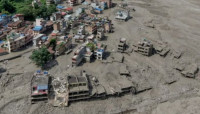
This year was no exception for flood and landslides in Sabah. In fact, it has been one of the worst years as many areas, such as Kota Belud, were flooded in September, the first time in 40 years, arguably due to the Pan Borneo Highway and other ongoing projects.
Sabah Deputy Chief Minister Datuk Seri Bung Moktar Radin said there was no denying that the Pan Borneo Highway has contributed to flooding in some areas in Sabah, but floods in Sabah were also mainly due to indiscriminate dumping, which has been blamed as one of the causes of rampant flash floods in Sabah’s west coast.
The year started with landslides and floods in early January with almost 1,000 flood victims evacuated by January 14.
Meanwhile, a chasm was reported at Kinabalu Park and about 1,000 villagers from 10 villages in Pitas were disconnected from the main road when two bridges collapsed due to flooding.
Floods hit Sabah’s west coast again in September, and two victims died in a landslide, identified as Salmaah Hamid, 25, and 5-year-old Rosatima Asbirin in Penampang.
The districts most affected by floods in September were Beaufort, Sipitang, Penampang, Papar, Kota Belud, Tuaran, and Kota Kinabalu.
African swine fever
After over 30 wild boars mysteriously wound up dead in the interior regions of Kinabatangan, Sugut, and Paitan in eastern Sabah in early February, the Sabah Veterinary Services Department linked the deaths to the deadly African swine fever (ASF).
It led to the department to declare Pitas as the first district with an ASF outbreak on February 23, resulting in Sarawak banning the import of pigs, pork, and pork products from Sabah.
As a result, some 2,000 pigs and 1,000 wild bearded pigs in Pitas were culled to curb the spread of ASF in Pitas.
As of October 21, 10 districts in Sabah have been seen ASF outbreaks, including Pitas, Kota Marudu, Beluran, Telupid, Tongod, Kinabatangan, and Sandakan, and the latest being Papar, Kota Kinabalu, and Tenom.
However, the virus is not a zoonotic disease, which means it does not spread to humans.
Post-Unduk Ngadau fiasco
After a Kadazan-Polish beauty representing the Api-Api constituency, Maya Hejnowska, was crowned the winner of the Unduk Ngadau Kaamatan 2021, the contest became the hot topic when then Sabah STAR member Philip Among was linked to a sexual harassment case involving a contestant.
Philip, who was the Unduk Ngadau technical chief, was detained by police on June 3 and remanded for four days. He then claimed trial on June 10 to five counts of sexual assault.
Even his lawyer, Marcel Jude Joseph, found himself in hot soup after his court submission described the Unduk Ngadau as an “exotic cattle show” and “auction show”.
Joseph’s case, however, was settled with a “sogit” (compensation) of seven buffaloes, one for every indigenous group that had filed the summons against him, including the Kadazan and Dusun Cultural Association.
Controversial carbon trade deal – Nature Conservation Agreement
In early November, Sabah was shocked to find an article published on conservation website Mongabay reporting that leaders in Sabah had signed the Nature Conservation Agreement (NCA) on October 30, which calls for the marketing of carbon and other ecosystem services to companies looking, for example, to buy credits to offset Sabah’s emissions.
The report also claimed that the deal would grant 30% of the profits to Australian and Singaporean companies, and that the agreement involving more than two million hectares of forest was signed without participation from the indigenous communities.
This sparked the anger of environmental and civil groups, as well as opposition members, against the Sabah government, which seemed to have signed the agreement with Singapore-based Hoch Standard Pte Ltd in secret.
Sabah Deputy Chief Minister Datuk Seri Jeffrey Kitingan assured that any of the NCA’s shortcomings would be rectified in its fine-tuning and that the deal was authorised by Hajiji himself.
Sabah opposition leader Datuk Seri Mohd Shafie Apdal had pushed for the government to be transparent about the deal, saying that it is a matter of public interest and involves the authority of the state, as land is a state matter.
The NCA became a hot topic during the debate session at the state assembly in early December, which ended with Hajiji assuring representatives that the deal still has a long way to go before its terms and conditions with Hoch Standard Pte Ltd can be finalised. – The Vibes, December 31, 2021