
SANDAKAN – Villagers in Kg Sg Daling Luboh Mile 12 here had been living in fear as the village’s jetty is often used as a landing point for illegal immigrants from the Philippines.
However, the presence of the Eastern Sabah Security Command (Esscom) tasked with guarding entry points used by such migrants has made them feel safer.
Esscm is the main enforcement authority to oversee the vast high-security territory in the eastern half of Sabah referred to as the Eastern Sabah Security Zone (Esszone).
The Sg Daling jetty is only about nine miles from Taganak Island and Bakungan Island in the Philippines – a mere 30- to 45-minute boat ride away.
Its village chief, Jafaruddin Nurudin, said that there are 114 houses and 684 villagers here.
“The illegal immigrants use our jetty as a port to conduct smuggling activities through this jetty. They are smuggling cigarettes, turtle eggs, petrol and other illegal foreigners to Sandakan.
“However, we must prepare for the worst. We do not want the Tanduo intrusion to happen here. We must protect our people,” he said, referring to the violent incursion by armed Filipino intruders at Lahad Datu in 2013.

He said that the villagers have been reporting the frequent arrival of illegal immigrants at the nearest police station which is about half an hour away by car.
“But Esscom coming here has saved us. We hope that their patrols here will continue even after the pandemic ends,” he said.
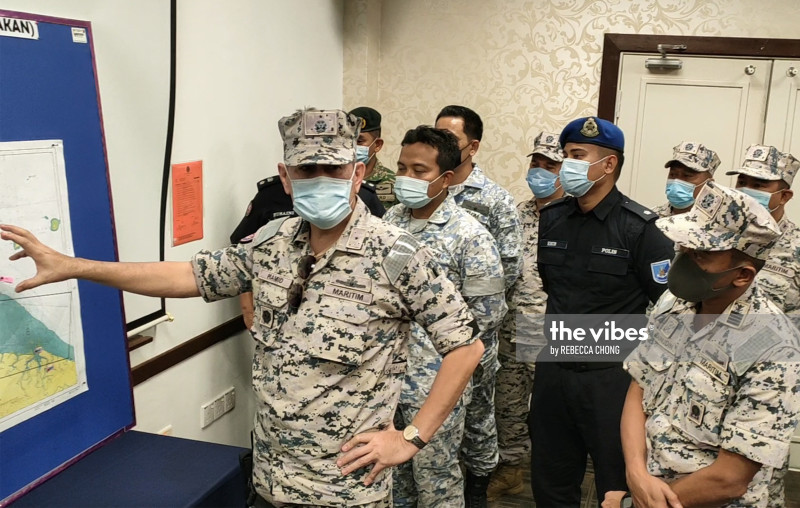
The OpsCegah PATI operation (OCP) is designed for Esscom to coordinate security forces to stop the entry of illegal immigrants to the eastern coast of Sabah, and to avoid the spread of Covid-19 from Indonesia and Philippines.
The security forces consist mainly of the maritime enforcement agency, navy, armed forces and the police together with its marine force, The operation is divided into maritime and land.
Among the key individuals overseeing the coordination are Maritime operation chief of staff Admiral Hamid Mohd Amin and Esscom land operation chief of staff SAC M. Chandrasehkaran.
Chandrasehkaran said that the OCP has been very effective as there is a drastic reduction in the number of illegals entering the country.

He said that this is proven by intelligence data, as well as radar detection that showed a reduction in contacts of interest, such as the entrances used by boats.
“The illegal immigrants do not dare to encroach as they are aware of the presence of security forces at all the ten entry points into Sandakan. There have been no encroachments by illegal immigrants since Esscom launched its operation in Sandakan a month ago,” he said.
There are 34 villages with about 11,000 people along the 71km coastline of the Sandakan district, and 70 entry points or hotspots on Sabah's eastern coast.
One difficulty is that there are local villagers who have been helping the illegal immigrants to land here.
“Esscom has been actively engaging with village folks to turn them from illegal immigrants helpers to Esscom helpers. We want them to provide information and help us instead,” he said.
Challenged by intrusions at sea from nearby islands
The close proximity between several points along the coast and some islands in southern Philippines does not help matters.
For example, the sea border between Sandakan and the Philippines is only about 25.74km away from Sandakan town.
The maritime OCP was launched here on June 12, and now has 10 boats, five vessels, one surveillance radar and one drone.
Admiral Hamid said that Esscom forces recently chased away 134 illegal immigrants on seven boats that had entered Sabah’s waters here.
They had also ordered four boats that attempted to cross the border into Malaysia illegally to turn back to the Philippines.
However, Hamid said that Esscom faces greater challenges in Semporna further east as there are many islands located near the border there.
He said one island known as Sebatik, off Tawau, is located right on the border, and is thus divided between Malaysia and Philippines.
Currently, due to the full capacity of detention centres in the state, the OCP only stops the illegal immigrants from entering Sabah, instead of arresting and deporting them.
With the closure of the Philippine border, illegal immigrants cannot be sent back. The last time they were returned was in September when 215 Filipino migrants were put on a vessel at Sandakan Port and brought back to their country. – The Vibes, November 8, 2020



















.jpeg)