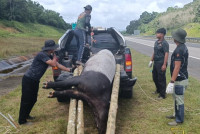
KUALA LUMPUR – The rapid decline of the Malayan tapir – categorised as an endangered animal – due to many of them being hit by vehicles on the road is worsening every year and becoming a major concern.
Wildlife and National Parks Department (Perhilitan) director-general Datuk Abdul Kadir Abu Hashim said statistics today show that the number of tapir animals that are still present in Peninsular Malaysia is estimated to be fewer than 1,500.
By only numbering about 1,100 to 1,500, the situation makes it the only tapir species in Asia that is now categorised as endangered.
“Most of the population exists in protected areas in the forest,” he said when contacted by Getaran, The Vibes’ Malay-language sister portal.
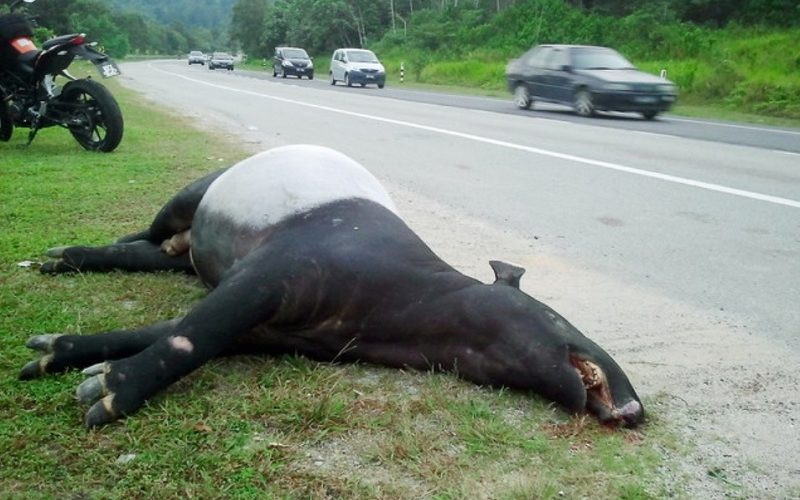
Kadir said in the last year alone, 24 Malayan tapirs were reported to have been killed as a result of being hit on the road.
He said during the period 2015 to 2020, a total of 92 Malayan tapirs died due to similar incidents in Johor, Kelantan, Melaka, Negri Sembilan, Pahang, Selangor and Terengganu.
Apart from wildlife crime, other issues such as wildlife conflicts with humans and deaths due to road accidents (roadkill) are now major problems that are still difficult to fully resolve,” he said.
He said the rise in Malayan tapir deaths due to road accidents is worrying, despite the government providing viaduct facilities.
He explained that the wildlife-crossing warning signs that are installed, especially in areas with high potential for accidents involving the animals, have been ineffective in curbing the incidents.
According to Kadir, the Energy and Natural Resources Ministry, which is responsible for protecting endangered animal species, is committed to implementing various efforts, including intensifying the conservation of Malayan tapirs on an “in-situ” and “ex-situ” basis to ensure the survival of the species.
“Biodiversity protection and enforcement initiatives such as the Khazanah Integrated Operations programme and the Veterans of the Armed Forces-Orang Asli activities have also been also implemented.
“The main thrust of these programmes are to conduct patrols and enforce existing laws to prevent habitat encroachment and illegal wildlife hunting.
“Perhilitan also implements ex-situ management to breed tapirs located at the Wildlife Conservation Centre in Sg Dusun, Selangor,” he said.
‘Avoid carving roads through wildlife habitats’
Non-governmental organisations Malaysia Nature Society (MNS) and Seratu Aatai have called on the government to look into the proposed alternatives to create a balance between economic development and preserving wildlife habitat.
They pointed out that while we enjoy new highways and railways, we are also splitting the homes of wildlife animals such as elephants and tapirs into fragments, shrinking the size of their habitat.
MNS’ I.S. Shanmugaraj Subramaniam pointed out: “The tapir has poor eyesight, so when they are flashed with a vehicle headlight, they often stay static and don’t move. With their black and white colours, they often become victims of roadkill.”
In October 2020, Meenakshi Raman, president of Sahabat Alam Malaysia, had warned that construction of roads through wildlife habitats resulting in fragmented forests should be a serious concern for the country, as it opens more roads that dissect age-old wildlife travel routes.
She said in order to reduce roadkill, the authorities have come up with eco-bridges or viaducts, underpasses and overpasses to enable wildlife to move from one fragmented forest to another.
“But the question remains as to how effective these facilities are for the purpose of safe wildlife crossings,” she said.
“Wildlife crossings may help to lessen the impact of roadkill, but it is not the panacea to foil the ill-effects of roads on wildlife and should not justify the building of roads into wildlife habitats.”
Meenakshi stressed that the first option is to avoid road cutting through wildlife habitats.
“Nothing will completely eradicate animal deaths. But highway authorities should make people aware of the enormity of roadkill tragedies that should be incorporated into driver education courses,” she said. – The Vibes, May 29, 2022