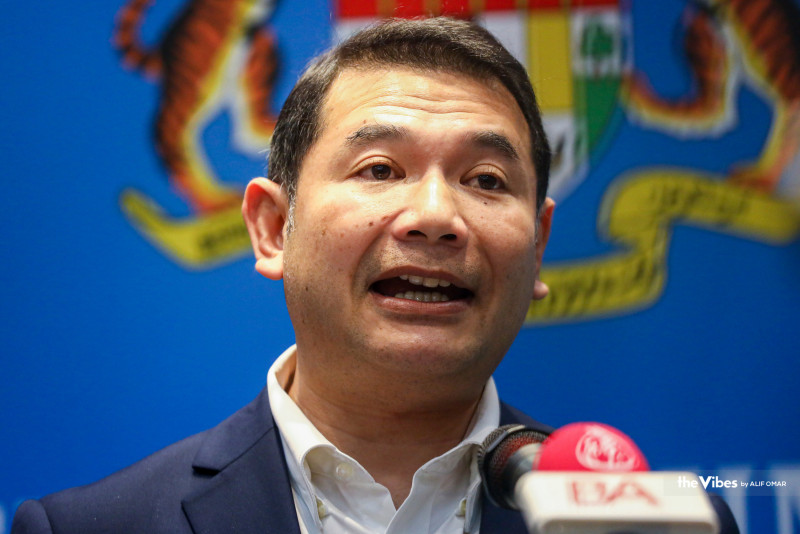
KUALA LUMPUR – Malaysia’s pace of policy changes will pick up in the second half (H2) of the year to further push the nation’s economic reforms, said Economy Minister Rafizi Ramli.
He said the country will launch a new industrial master plan in August and a revision of its five-year plan in September.
“We are phasing everything out to build up towards the budget announcement in November. “There will be more clarity on a month-to-month basis, because (what) we want to avoid is going ‘big bang’ with a list of things that we intend to do and then disappointing everyone six months down the line with the pace of implementation.
“So, balancing what we intend to do with how we do it, I think, is key to providing sustainability,” he said in an interview at the Qatar Economic Forum, powered by Bloomberg.
He said the government has done a major subsidy reform in the last six months and is looking at good timing to ensure successful end results so that Malaysia is able to achieve a high-income nation status.
“Society is grappling with inflation and disparity in wages, and that’s the focus that has been taken by this government...that the structural reforms go in chunk size, month-after-month, so it will provide a strong foundation. We hope the result will speak for itself,” he added.
Hence, he reckons that this two-year period is crucial for the government to roll out its economic structural reforms.
Rafizi said the government is also focusing on the energy transition with Malaysia set to launch a regional renewable energy exchange market that will facilitate and accelerate cross-border trade.
“We will develop organically for our market first so we can build the capacity before we take a bold step to lead the way towards a regional energy exchange.
“In the region, we will have to scale up our capacity by 11 times in the next 20 years, and for that to happen, we have to invest US$150 billion (RM693.8 billion) in infrastructure to allow an energy transition,” he said.
The nation is also seeking potential in building the renewable digital semiconductor sector and diversifying into other components.
At present, Malaysia contributes about 30% of the assembly, testing and packaging of chips, he said.
“We are looking at some fabrication, given the presence of the world’s big-name semiconductors in Malaysia.
“People talk about generative artificial intelligence, and a consequence of that is definitely a demand for better and faster chips in the future,” he added.
Rafizi said Malaysia is also scaling up and is keen to replicate Penang’s success in developing its semiconductor sector in another region.
“There are various activities and investments that can be spread across the country, and we are looking at, for example, the central region, for more high-end research and development data centres…in the south, (we will) focus not just on traditional oil and gas and new fuels but also renewables,” he noted. – Bernama, May 26, 2023