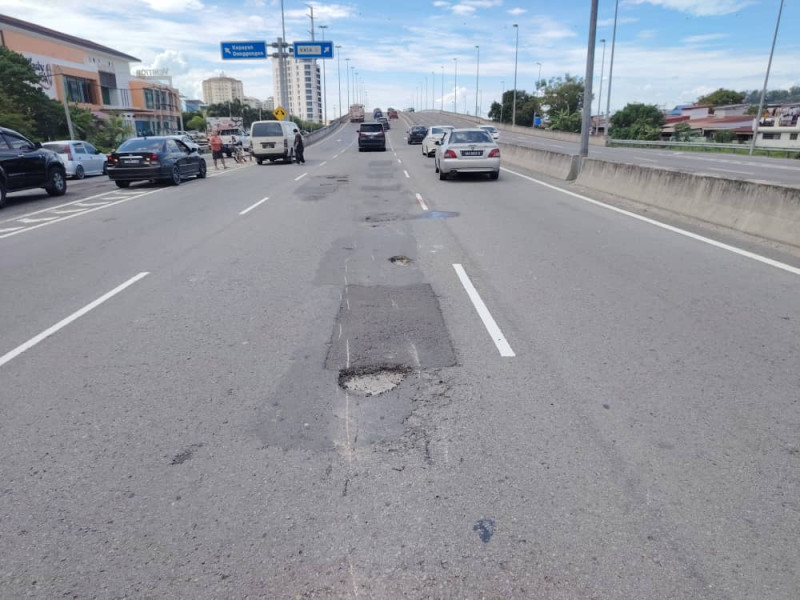

POTHOLES on Sabah’s roads are no longer just an inconvenience—they’re a fatal hazard.
The recent death of a motorcyclist in Lido after hitting a pothole has brought public frustrations to a boiling point.
For years, complaints about Sabah’s crumbling infrastructure have gone unanswered.
Drivers have suffered burst tires, damaged suspensions, and near-accidents, while rural communities have resorted to symbolic protests, including planting banana trees in potholes.
Yet, these warnings were met with indifference—until now.
“We Deserve Better”
Social media activist Kratos Ragnarok has become a voice for frustrated Sabahans. Following the Lido tragedy, he took matters into his own hands, marking potholes with white paint to warn road users.
“Recently, a tragic incident occurred that claimed the life of an innocent person. May his soul Rest In Peace!” Kratos wrote in a Facebook post that quickly went viral.
“Since the district and municipal councillors from GRS and Pakatan Harapan in Sabah are not doing their job and are failing to pressure the Public Works Department (JKR), the white-marked potholes are meant to help drivers and motorcyclists avoid them until the authorities repair all potholes.”
The white markings have sparked debate. Some see them as a grassroots safety measure; others label them as graffiti. But for many Sabahans, these markings are a desperate plea for action in the face of prolonged neglect.
A Budget That Falls Short
Road repairs and maintenance in Sabah are not new concerns.
The state’s Budget 2025 allocated RM424.53 million for road construction and upgrades in urban, rural, and small-town areas.
While the figure appears significant, it pales in comparison to the actual needs.
Last year, Deputy Chief Minister III and Public Works Minister Datuk Shahelmey Yahya revealed that Sabah required RM1.8 billion for road repairs—nearly double the combined federal and state allocations of RM1 billion.
This funding shortfall is one of many issues that have left Sabah’s roads in disrepair.
Concessionaires, responsible for maintaining road infrastructure, have also come under fire.
Questions about their accountability remain unanswered, adding to the public’s growing dissatisfaction.
Why Now?
The Lido tragedy has sparked widespread outrage, but it also raises uncomfortable questions.
Why did it take a death for urban residents to speak out, when rural communities have been vocal for years?
Protests like planting banana trees in potholes along Jalan Sandakan-Lahad Datu have drawn attention to the problem, yet the government’s response has been largely reactive.
Urban areas, meanwhile, seemed resigned to the state of their roads—until this latest incident.
A Call for Accountability
This tragedy should serve as a wake-up call.
Potholes are not just a symptom of bad infrastructure; they reflect systemic issues in governance, funding, and accountability. Sabahans are now demanding answers.
The white paint encircling potholes across the state is more than a warning—it’s a symbol of the community’s frustration and resilience.
The question now is whether this moment will push the government to act decisively or whether it will fade into yet another missed opportunity for change.
For Sabahans, the message is clear: it’s no longer enough to wait.
Action is overdue, and lives depend on it. - February 7, 2025.