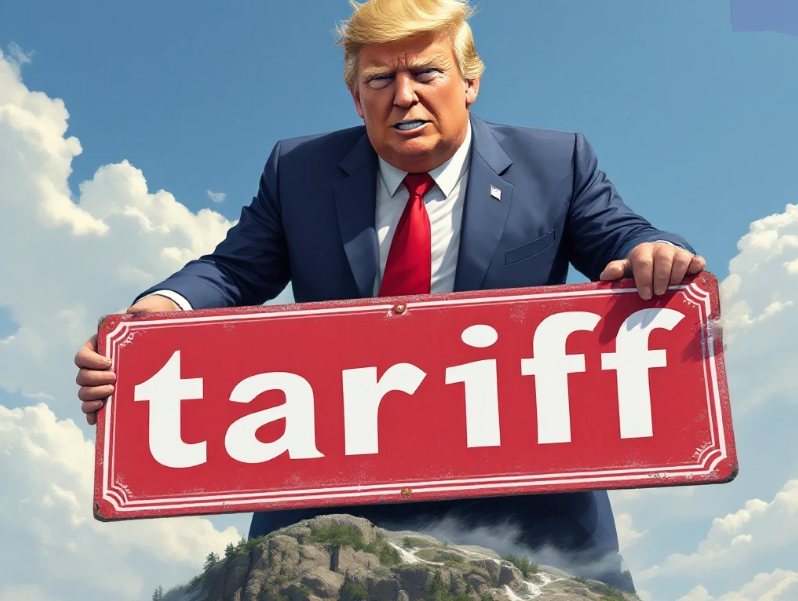
DESPITE the chaos of immigration crackdowns at home, a swelling domestic agenda, and now the spectre of war in the Middle East, Donald Trump’s White House has remained ruthlessly focused on one front: the global trade war.
Five months into his final term, the former reality-TV-star-turned-president is fast approaching a reckoning—one that could reshape the trajectory of global commerce, and with it, the fate of Southeast Asia’s export-driven economies.
The deadline? July 9.
Trump promised to replace sweeping multilateral trade pacts with “better” bilateral deals.
So far, he’s sealed just two: one with the UK and another with China—out of more than 100 ongoing negotiations.
The rest hang in limbo, snarled by the chaos of policy whiplash and a president now increasingly consumed by a military escalation with Iran that threatens to spiral beyond containment.
The High Stakes Summit That Wasn’t
At the G7 summit in Canada this past week, the world’s top economies were poised to finally hammer out a few of these elusive trade deals.
Central bankers and world leaders alike were hoping that a handful of headline agreements would steady shaky markets and dispel the looming threat of recession.
But just as the negotiations entered the critical phase, Trump abruptly exited the summit—jetting off to address the Iran-Israel flashpoint, leaving behind his trade team and a host of disoriented allies.
It was a diplomatic mic drop with global consequences. Leaders who had scrambled for sideline pull-asides and bilateral meetings with the president—who had shaped the summit schedule around his availability—were suddenly left holding incomplete drafts and frayed nerves.
Canadian officials had even floated a bold backroom swap: increased defence spending in exchange for steel and aluminium tariff relief.
It went nowhere. Japan’s Prime Minister Shigeru Ishiba was hoping to finalise a long-anticipated agreement.
That didn’t happen either. EU leaders were stonewalled. And Trump, mid-flight aboard Air Force One, offered a blunt assessment of the situation:
“They’re either going to make a good deal, or they’ll just pay whatever we say they have to pay.”
The Fallout Hits Southeast Asia
Trump’s aggressive posture is more than just an American spectacle—it’s setting off economic tremors across ASEAN. Southeast Asia has positioned itself as the world’s alternate workshop, especially as global firms seek to diversify out of China. Malaysia’s E&E sector, Vietnam’s textiles, and Indonesia’s automotive parts suppliers have all benefited from this geopolitical shift.
But now, the tariff pause is ending. And Trump’s message is clear: bend or break.
US Commerce Secretary Howard Lutnick insists more deals are “in the hopper,” with 18 partners in advanced stages. But the track record doesn’t inspire confidence. Deadlines have come and gone. Promises of “deal after deal” remain unfulfilled.
Meanwhile, Southeast Asian trade ministers are quietly recalibrating. The risk isn’t just direct tariffs—it’s second-order effects.
If US consumers get squeezed by inflation or if global growth slows, demand for ASEAN’s goods could collapse like a house of cards.
Worse, if the US imposes unilateral duties on countries it perceives as trade “free riders,” the region could find itself in Washington’s crosshairs despite having little say in the larger US-China calculus.
Fed Sounds the Alarm
Federal Reserve Chair Jerome Powell offered a measured warning this week: the tariffs are already biting. Electronics prices are creeping up. Goods inflation is accelerating.
And by summer’s end, the delayed effects of import taxes will have worked their way into retail pricing across the US—and possibly the world.
“Many companies expect to pass all or some of the cost to the next person in the chain—and ultimately, the consumer,” Powell said.
The Fed’s updated projections are sobering. Slower GDP. Higher unemployment. And an inflation curve that bends upward at a time when global liquidity is already tightening.
Powell did acknowledge that reducing Chinese tariffs from 145% to 30% offered temporary relief—but if the broader reciprocal tariff pause expires in July without deals in place, those numbers could swing back up with devastating speed.
ASEAN’s Delicate Dance
Here in Southeast Asia, the geopolitical balancing act is becoming increasingly untenable. On one hand, nations like Malaysia, Thailand, and Vietnam see opportunity in the US-China divorce—a chance to court American investors, absorb relocated supply chains, and grow regional GDP.
But the courtship comes at a price. Playing too close to Washington risks angering Beijing.
Sitting on the fence may draw Trump’s ire. And for smaller nations already navigating the complexities of Belt and Road loans, climate shocks, and demographic pressure, the room to manoeuvre is shrinking fast.
Even Singapore—neutral, nimble, and well-respected—is finding itself walking a tightrope.
With Trump declaring that nations must “open their markets or face tariffs,” the logic of trade diplomacy has given way to something more brutal: protectionist extortion dressed up as nationalism.
.jpg)
Trump’s Leverage, The World’s Gamble
With less than a month to go, Trump holds the cards—and he knows it. “We’re making a lot of money,” he said nonchalantly to reporters’ mid-flight, referring to the tariff revenue flowing into U.S. coffers.
But it’s a dangerous game. The question now isn’t whether Trump will get some deals done. It’s whether his brinkmanship will blow up what remains of the post-war global trading system.
For Southeast Asia, the next few weeks will be crucial. If deals start dropping into place, the region could see renewed investment flows, tariff relief, and a more predictable trade landscape.
If not, we may be staring down a summer of volatility, protectionism, and strategic recalibration.
The clock is ticking. And from Putrajaya to Phnom Penh, from Hanoi to Jakarta, policymakers are watching with growing unease—because in this global chess match, it’s not just kings and queens at stake.
It’s pawns too. - June 19, 2025
Abbi Kanthasamy is an entrepreneur with a passion for photography and travel.