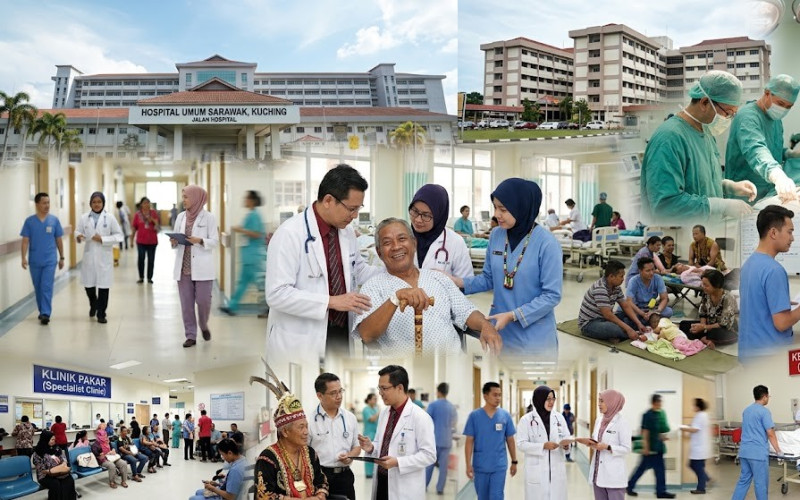
SARAWAK can build more hospitals, but if it cannot attract and retain enough healthcare workers to run them, the state’s healthcare capacity will remain limited no matter how much infrastructure is added.
The clearest warning came in 2025, when the Ministry of Health offered permanent placements in Sarawak to 764 contract medical officers. By November, only 432, or 57 percent, had reported for duty, while 332 had either not reported or declined their placements.
The principal of management and socio-economic consulting firm, 27 Advisory opined that this is not simply a question of recruiting more doctors. It is a question of whether Malaysia can persuade skilled professionals to work, and remain, in the places where they are most needed.
A December 2025 written reply by the Health Minister to the Dewan Negara identified staff willingness to accept postings, particularly in rural and remote parts of Sarawak, as one of the ministry’s main challenges.
The same problem is evident beyond healthcare. The Ministry of Education has also faced difficulties filling postings in Sarawak, suggesting that the underlying challenge is broader than the management of medical placements alone.
For patients, an unfilled post is not an administrative statistic. It can mean fewer staffed beds, fewer clinics, longer waits and reduced access to specialist services.
The scale of the gap is already significant.
“As of May 2026, Sarawak had approximately one doctor for every 590 people, compared with one for every 406 nationally. By June, 5,844 approved healthcare positions in the state remained vacant.
“Those figures matter because Sarawak is simultaneously preparing for greater healthcare demand from an ageing population.” 27 Advisory said.
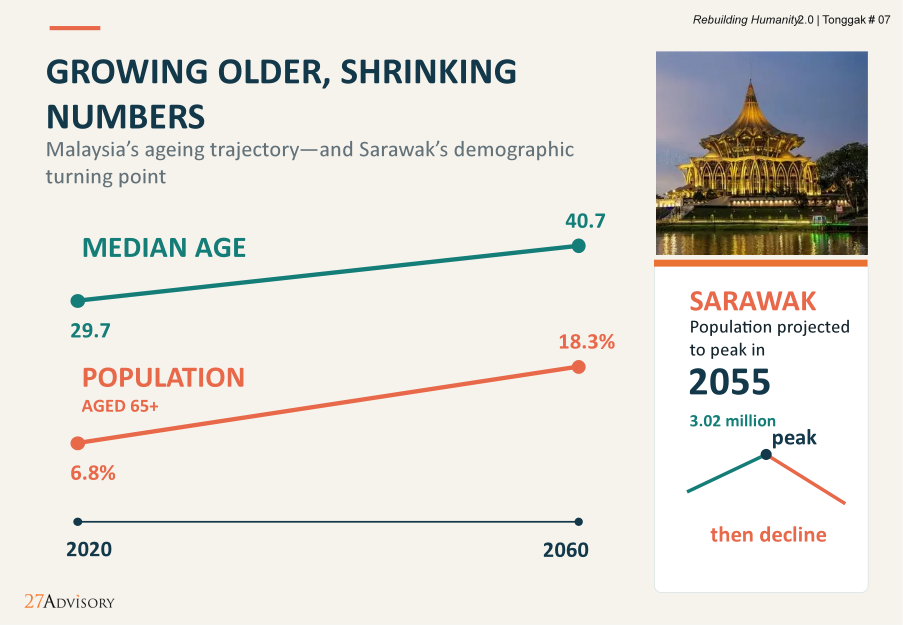
The national share of people aged 65 and above is projected to rise from 6.8 percent in 2020 to 18.3 percent by 2060. Sarawak already qualifies as an ageing state, with more than 7 percent of its population aged 65 and above in 2024 and 2025.
An older population means growing demand not only for acute hospital treatment, but also for specialist, rehabilitation, psychiatric, residential and community-based care. That makes workforce planning inseparable from infrastructure planning.
Sarawak is already moving ahead with major healthcare investments. Hospital Petra Jaya is expected to begin operating in phases following its handover, while a new block at Hospital Sibu and a planned 76-bed hospital in Lundu are at earlier stages. The Sarawak Cancer Centre is also being developed.
The state estimated in May 2025 that RM17.26 billion would be needed to upgrade and redevelop its healthcare facilities, including RM9.25 billion for hospitals and RM8.01 billion for clinics.
But that is the cost of infrastructure. It does not answer the more important question of who will staff it. Hospital utilisation figures also illustrate why simply counting beds can be misleading.
Sarawak General Hospital recorded an occupancy rate of 88.54 percent in 2024, while several smaller district hospitals operated below 50 percent. A lower occupancy rate at some facilities does not necessarily mean excess capacity if staffing shortages prevent services or beds from operating at their intended level.
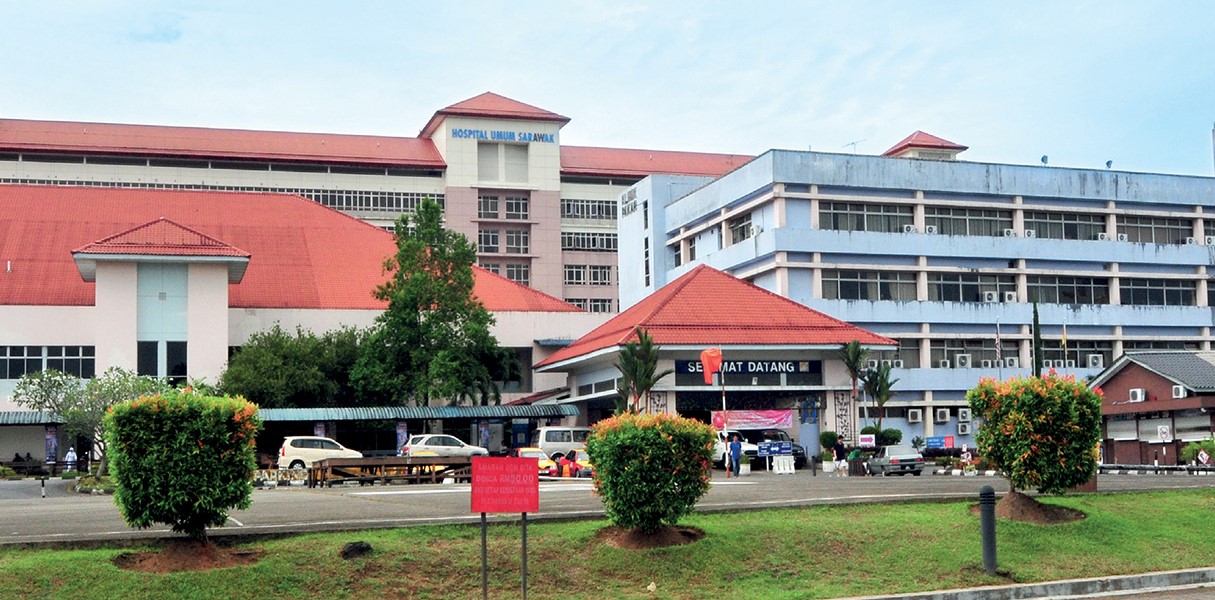
The state’s healthcare system also carries significant long-term care responsibilities. Hospital Sentosa, which provides psychiatric, rehabilitation and forensic services, recorded an average length of stay of 154.64 days in 2024.
As Sarawak ages, those services are likely to become more important, increasing the need for a workforce capable of delivering care across the full spectrum rather than concentrating only on acute hospital services.
The Government has taken steps to make Sarawak postings more attractive.
Medical and dental specialists posted to Sabah, Sarawak and Labuan receive monthly incentives ranging from RM500 to RM2,500, while postings to Sarawak’s interior carry a separate location allowance of RM500 to RM1,500.
Eligible doctors accepting permanent placements can also receive full relocation support, while the Health Ministry has been given direct control over the allocation of its approved posts.
But the reporting figures suggest that incentives alone are not enough.
The Regional Incentive Allowance itself remains part of the debate. Under the Public Service Remuneration System, management and professional officers appointed from December 2024 receive a fixed RM360 monthly allowance for service in Sabah, Sarawak and Labuan, while earlier appointees retain their previous rate.
The Malaysian Medical Association and Malaysian Dental Association have called for the progressive allowance to be restored, with the MMA estimating an annual cost of about RM4.2 million.
The decline in reporting rates, however, began before the latest allowance revision. That suggests the Government should avoid treating the problem as a single-pay-policy issue.
The more durable solution is to build a workforce pipeline specifically designed for Sarawak.
Yayasan Sarawak already funds 40 medical scholarships annually for eligible Sarawakian students pursuing medicine at Universiti Malaysia Sarawak. That provides a foundation for a locally rooted strategy.
The next step could be to recruit more students from underserved districts, provide extensive rural clinical exposure and link scholarships to guaranteed placements, housing, career progression and specialist training opportunities.
International examples reinforce the value of this approach.
Thailand’s rural medical track recruits students from rural backgrounds and trains them through provincial hospitals. Some 78.2 percent of its graduates remained in the public health service, compared with 52.5 percent from the conventional track.
Japan’s Jichi Medical University combines tuition support with a structured service commitment in graduates’ home prefectures. Even after completing the obligation, 69.8 percent remained in their home prefectures for at least another six years.
27 Advisory said the lesson is straightforward: retention is more effective when professionals have a reason to build their careers in the communities they serve.
Sarawak therefore needs to change how it defines healthcare capacity.
Every major hospital or clinic project should have a workforce plan alongside its construction plan, with recruitment beginning well before the facility opens.
That plan should cover staffing requirements, housing, rural rotations, specialist training, career progression and relief arrangements so existing personnel are not left carrying vacancies indefinitely.
The Government should also publish measures that show whether infrastructure is translating into actual care: staffed beds rather than simply installed beds, filled posts against approved establishment, the duration of specialist vacancies, actual clinic operating hours, placement acceptance rates and retention after 12 and 36 months.
These are the figures that ultimately matter to patients. A hospital can be completed on schedule, fully equipped and officially open, yet still fail to deliver its intended capacity if there are not enough people to operate it. For Sarawak, the priority should therefore be clear.
Build the hospitals, but build the workforce at the same time.
Because healthcare capacity is not measured by how much concrete and steel is installed. It is measured by how much care patients can actually receive. - September 5, 2026