



MALAYSIA’S slowing population growth is set to put greater pressure on the country to raise incomes and productivity, as businesses can no longer rely as heavily on an expanding workforce and consumer base to drive growth.
An analysis by the founder of 27 Group, Girish Mavath Ramachandran, reveals that the demographic shift is already becoming more visible, with live births falling from 521,136 in 2015 to 414,918 in 2024, while the total fertility rate declined from 2.0 to about 1.6 over the same period, below the replacement level of 2.1.
For Malaysians, the issue is not simply that there will be fewer people in the future, but whether the economy can continue improving household purchasing power and creating well-paid jobs as population growth slows.
Malaysia’s median monthly household income rose 53% from RM4,585 in 2014 to RM7,017 in 2024. After adjusting for inflation, real median household income still increased by about 27%, equivalent to an average annual real increase of roughly 2.4%.
This means the challenge is not that real household incomes have failed to grow, but that future income growth will need to be sustained and strengthened as demographic expansion becomes a weaker source of economic momentum.
The objective will increasingly have to be to generate more economic value and higher incomes per person, rather than depend on a larger number of households, workers and consumers.
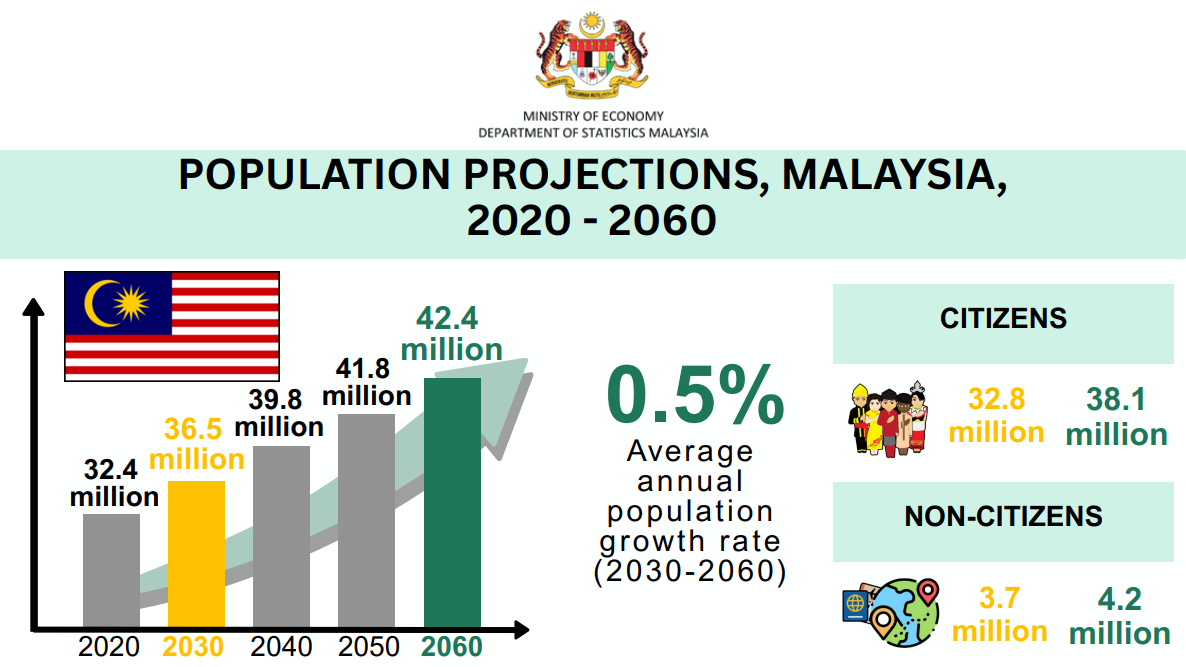
For businesses, slower growth in the workforce and consumer population could make it harder to expand revenue simply by selling to a larger domestic market. Companies will have to increase productivity, move into higher-value activities and improve the skills of their employees to sustain wage growth and competitiveness.
The 13th Malaysia Plan targets average labour-productivity growth of 3.6% annually between 2026 and 2030, putting productivity at the centre of efforts to raise incomes while maintaining economic competitiveness.
Higher productivity can create greater room for businesses to pay better wages without relying solely on higher prices or sacrificing competitiveness.
The demographic shift is also changing the demands on Malaysia’s education system. While the number of primary pupils has begun to decline, higher education enrolment has continued to rise, increasing the importance of ensuring that graduates possess skills aligned with higher-value economic activities.
Artificial intelligence could form part of that transition, but simply purchasing AI software will not automatically raise productivity.
Businesses will need to redesign processes, retrain employees and deploy AI in ways that allow workers to produce more valuable output. Schools and universities will similarly need to equip students to evaluate, apply and govern AI rather than simply use it to generate answers.
At the same time, Malaysia faces a growing need to manage labour supply strategically, including through skills development and targeted migration, as the working-age population gradually faces greater demographic constraints.
The broader economic test is therefore becoming clearer: with population growth slowing, Malaysia will have to generate more income and economic value from each worker and each household.
For households, that ultimately means ensuring that gains in productivity translate into higher real incomes, better-quality jobs and improved living standards rather than simply higher nominal wages.
A smaller or slower-growing population does not necessarily mean a weaker economy. But it does mean Malaysia will have less demographic growth to lean on — making productivity, skills, investment and the quality of jobs increasingly important to the country’s economic future. - September 19, 2026

.jpg)






_director_Datuk_M._Kumar.jpg)

