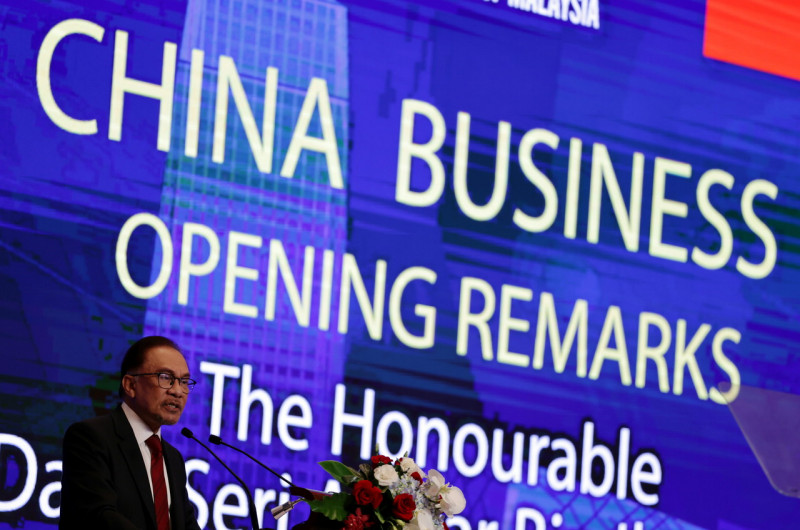
AT the end of March, Malaysian Prime Minister Datuk Seri Anwar Ibrahim led a delegation to visit China.
In addition to attending the Boao Forum for Asia and facilitating a meeting between top leaders of the two countries, the visit also witnessed the signing of 19 memoranda of understanding (MoUs) with a total investment value of RM170 billion between Malaysian and Chinese companies.
This has created a huge response in the private and business sectors in Malaysia.
The largest investment comes from China’s Rongsheng Petrochemical Holdings, which will invest RM80 billion to build a petrochemical park in Pengerang, Malaysia.
Another investment comes from Geely, with an initial investment of RM2 billion in the Automotive High-Tech Valley in Tg Malim, which will gradually increase to RM23 billion in the future.
If both investments are realised, they will only account for about half of the total amount in the MoUs. Therefore, there are another 17 investments that are pending and require monitoring and follow up in various fields.
After Anwar’s visit to China, the cabinet decided to establish a special committee to follow up on execution work, which will be supervised by the Investment, Trade, and Industry Ministry on the Malaysian side and Premier Li Qiang on the Chinese side.
This “civilian supervision by government officials” initiative strengthens the confidence of companies in both countries (especially China) to invest in each other and is a correct decision.
RM170 billion is undoubtedly a huge number, but is a large amount of foreign investment the panacea for promoting Malaysia’s economy?
In the early stages of national development, the intensity of foreign investment overwhelmed everything, and as long as it came, it was good regardless of what it was.
In the past, this foreign-investment-oriented policy, even hampered by the heavy price paid for Tun Dr Mahathir Mohamad’s misallocated heavy-industrialisation programmes, the remaining premiums still allowed our country to develop by industrialisation and even join the ranks of the middle-income league.
However, it would be like seeking fish on a tree if Malaysia continues to rely on the same strategies to industrialise and develop its economy.
Referring to the economic complexity index, it can be observed that our country’s index has gradually slowed down in recent years and has been surpassed by neighbouring countries such as Thailand, while also being approached by the Philippines and Vietnam.
The economic complexity index can be considered a reference for capital quality, indicating that the foreign investments attracted by Malaysia in the past have been lacking in terms of technology transfer, value creation, and improving human capital quality.
According to the Asean Labour Productivity Regional Report, Malaysia ranked third in labour productivity among Asean countries from 1971 to 2018 (3.18%), trailing only Singapore (annual average of 3.25%) and Thailand (annual average of 3.44%).
Malaysia’s labour productivity has significantly slowed down since 2000, and is currently lagging behind other Asean countries (excluding Brunei). This is a cause for concern.
The slowdown of labour productivity means that the value created by each employee is limited, and so is their potential for wage increases. The low investment in automation and mechanisation in Malaysia is a major reason for this.
In 2019, Malaysia’s investment in machinery accounted for only 12%, compared to Thailand (20%) and Vietnam (14%). In the long run, low investment in automation and mechanisation will limit the country’s productive capacity and hinder Malaysia’s structural transformation and upgrading.
Therefore, the key to Malaysia’s economic transformation lies in attracting high-quality investment and foreign investment. The recent renaming of the International Trade and Industry Ministry to the Investment, Trade, and Industry Ministry (Miti) is a step in the right direction.
However, it is more important to carefully select high-quality investments while discouraging labour-intensive, low-cost, and low-value industries.
Political leaders and policymakers must realise that this is not a luxury but a necessary policy, especially as Malaysia is already facing an ageing population, low birth rates, and increasing competition from neighbouring countries.
Regarding the RM170 billion MoUs signed between Malaysian and Chinese companies, the supervisory committee should focus not only on the progress of the projects but also on the scientific and technological content brought by the investments.
This should be done in conjunction with the National Robotics Roadmap 2021-2030, the National Science, Technology, and Innovation Policy 2021-2030, and the New Industrial Master Plan 2030 to ensure that the capital investment can help improve Malaysia’s labour productivity and technological content.
Regarding this, Miti must collaborate across ministries and bring in more personnel with technical backgrounds and experience to assess the current technological status of various industries, thereby seizing their development direction and driving the structural transformation of our country’s economy.
Of course, a long-term expectation is that through imitation and learning of technology, Malaysian companies can grow into competitive international enterprises that are regionally dominant.
This requires strong political and entrepreneurs’ will to explore Malaysia’s unique development direction and huge confidence in our self-developed technology.
Getting to the bottom of this matter depends on the enthusiasm of the government, corporate sector, and rakyat for science and technology, active participation in building our social fabric, and collaboration from all citizens to bring about this profound cultural shift. – The Vibes, May 8, 2023
Lee Chean Chung is Petaling Jaya MP