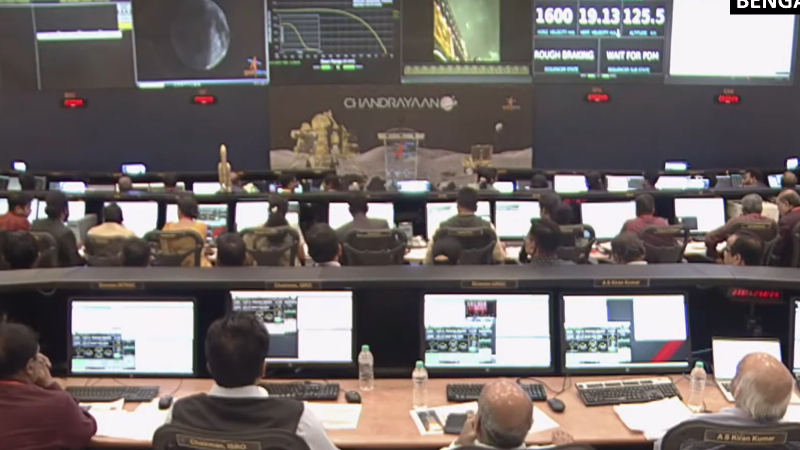
RECENTLY, we witnessed an incredible moment in history when India announced that its robots Vikram and Pragyan, from the Chandrayaan-3 mission, have landed on the moon’s unexplored South Pole, making it the first country to do so, and also only the fourth country ever to have probes reach the moon. Congratulations, India, for this amazing achievement!
It is worth noting that India is only one of two Asian countries with a space programme sophisticated enough to achieve this feat.
This raises interesting questions: what did they do to get to this position, and how can we and our regional counterparts learn from them?
On the surface, it may be easy to assume that the Indian Space Research Organisation has spent a lot to achieve this success.
However, reports noted that the Chandrayaan-3 mission was considered one of the cheapest in recent history, costing a mere US$74.43 million (RM345.36 million).
In fact, India’s total annual space budget is only US$1.5 billion (RM6.98 billion), far lower than the United States, Russia and China.
What India did get right was that, in the last few decades, it has invested heavily in its people, building a highly skilled, knowledgeable and capable talent pool in science, technology, engineering and mathematics.
According to the World Economic Forum, with 34% of tertiary students in STEM, India is producing the world's highest number of science, technology, engineering and mathematics (STEM) graduates annually.
Beyond that, the World Bank has reported that, at 43%, India has a higher percentage of female STEM graduates than developed nations like the US (34%), United Kingdom (38%), Germany (27%) and France (32%).
Organisations such as the Indian National Skill Development Corporation and the India STEM Foundation have also played critical roles in shaping the nation’s STEM workforce beyond their tertiary education.
No doubt, people make progress possible. And in India’s case, investing in STEM and building an innovative, dynamic and highly skilled pool of scientists and engineers has enabled them to make their moonshot idea a reality.
Coming back to the state of our own nation: how can we emulate India’s successes?
While we may still have some way to go before launching a probe into the moon, we have improved our efforts at nurturing our STEM talents in the last few decades.
For example, research showed that 47.18% of tertiary students in Malaysia are in STEM.
However, we can’t rely on tertiary enrolments alone. There must be more concerted efforts to equip STEM talents with industry-required skills and knowledge upon graduation.
We also need to explore and offer other pathways to STEM qualifications and careers for Malaysians who may not have gone through conventional education trajectories.
This requires extensive collaboration between the government, private sector industry players, and the nation’s academic institutions.
At HRD Corp, we have always been committed to driving these efforts.
Our levy programme enables employees in STEM jobs to continuously upskill and reskill to support their employers’ needs.
Our Rise4Wrd initiative, on the other hand, allows SMEs to tap into government funding to upskill their employees on the Internet of Things, cloud computing, big data analytics and augmented reality, among others.
Beyond that, we have also embarked on a serious mission to encourage Malaysians to embrace lifelong learning through programmes such as our National Training Week, which saw the participation of over 129,000 Malaysians over one week, and our premium online learning platform e-LATiH, which offers many STEM-related courses for free.
It is worth noting that e-LATiH recently reached 1,000,000 million enrolments, a testament to our Malaysian talents’ unrelenting quest for knowledge.
We are blessed to be a nation of diverse backgrounds and ethnicities. Our talents are not just multi-lingual and multi-cultural. They are also multi-talented and multi-capable, with varying skills, knowledge and abilities.
This, backed by our world-class infrastructure, excellent climate, and strategic location, gives us the perfect foundation to succeed.
Therefore, I am confident that by working together, we can encourage more Malaysians to venture into STEM education, offer more industry-relevant skills development programmes for STEM talents and, most importantly, create more high-value STEM jobs and careers to boost our high-income nation aspirations.
I strongly believe that by putting the right policies, initiatives, programmes and action plans in place and focusing consistently and holistically on our own human capital, we can build a nation that is not only filled with scientists, technologists, engineers and mathematicians but also compassionate, bold and dynamic people.
And who knows, maybe someday, like India, we too can shoot for the moon and land among the stars. – The Vibes, August 30, 2023
Datuk Shahul Hameed Dawood is chief executive of HRD Corp