BUDAPEST - "To be a good swimmer is in the genes of Hungarians."
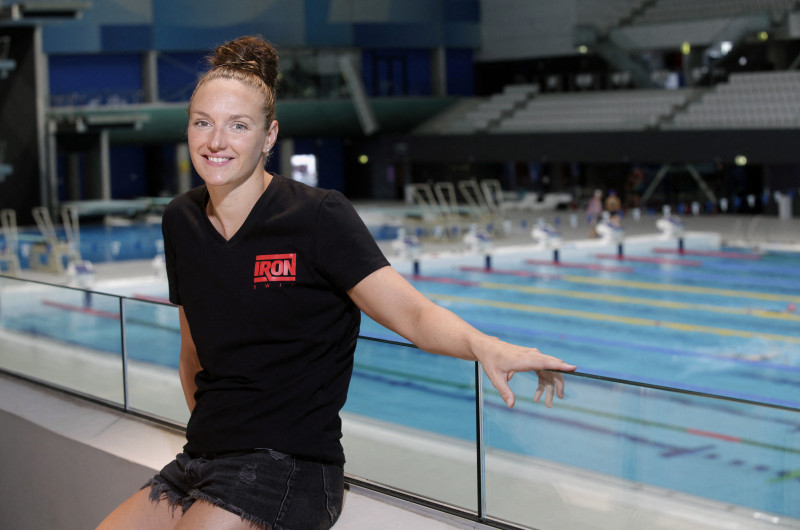
That's the view of triple Olympic champion Katinka Hosszu, one of the country's biggest stars in the pool.
The landlocked central European country, with a population of around 10 million, routinely punches above its weight in Olympic swimming events.
Top-class facilities including the Duna Arena in Budapest and a network of others that have opened in recent years underline how seriously the sport is taken in Hungary.
But for 32-year-old Hosszu, who plans to compete in four events in Tokyo at her fifth Games, decades-long pedigree is the key factor.
"When you start swimming as a Hungarian kid you have inspiring examples to follow, so we are carrying on in their path," Hosszu said at the Duna Arena pool complex.
Hosszu's hero when she was growing up was Krisztina Egerszegi, who won five individual gold medals over three consecutive Games between 1988 and 1996.
"For us Hungarians it isn't that 'maybe if you're good you can go to the Olympics one day'," said the swimmer nicknamed the "Iron Lady", who won three gold medals at the 2016 Rio Games.
"For myself it was expected that I not just go but that I win and not just once but again and again."
- 'Hungarian school' -
Hungary’s 38-strong swimming squad for Tokyo includes stars such as Hosszu and new sensation 21-year-old Kristof Milak, favourite to win the 200-metre butterfly after smashing Michael Phelps's world record in 2019.
"It defies sporting gravity that a country this size achieves as it does," Gergely Csurka, of the Hungarian swimming federation, said.
According to Csurka, the tradition is founded on successive generations of inspirational swimmers and coaches including Tamas Szechy, who steered Egerszegi to Olympic glory.
Considered the patriarch of Hungarian swimming, Szechy, who died in 2004, coached eight swimmers to 15 Olympic medals, including eight golds, from 1972 to 1996.
One of them, Tamas Darnyi, was unbeaten in medley events between 1985 and 1993 and won four Olympic golds.
The "Hungarian school" pioneered by Szechy was based on longer-distance medley swimming rather than specialist sprints, according to Csurka.
"Every kid with potential is trained in all four strokes but steered toward medley swimming, toward bearing 200m or 400m or more," he said.
As well as a nationwide talent-spotting network, Milak’s coach Attila Selmeci, a disciple of Szechy's, points to the other secret of Hungary's success.
"Work, work, work!" he said after a pre-Olympic training session with Milak in Kaposvar, southwest of Budapest.
"Both coaches and swimmers work very hard, morning to night, often at training camps far from their families."
- Love of water -
A deeper source of Hungary's love of water, however, can be traced to its centuries-old bathing and spa culture.
The country teems with more than 1,000 thermal water springs, including over 100 in Budapest alone, while Hungarians also flock to holiday spots such as Lake Balaton, central Europe's largest lake.
One of continental Europe's first indoor pools was opened in Budapest in 1930 and still functions as the national aquatic sports centre.
Designed by Alfred Hajos, the first modern Olympic swimming champion in 1896, the pool did not need a heating system because of the thermal water piped up from underground.
That meant Hungarian swimmers and water polo players could train all year round, unlike rivals from elsewhere.
More recently, Hungary's Prime Minister Viktor Orban, a big sports fan, has plunged state funding into building state-of-the-art pools around the country including the Duna Arena and Kaposvar complex, as well as coaching programmes for young children.
"No-one should be further than 20 minutes from a pool," said Hungary's state secretary for sport Tunde Szabo, herself an Olympic swimming medallist in 1992.
Back at the Duna Arena, Hosszu said that Hungarian swimmers are "lucky".
"We are well-supported, and that doesn't happen elsewhere." - AFP, 21 July, 2021