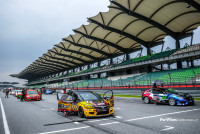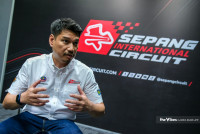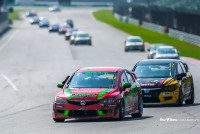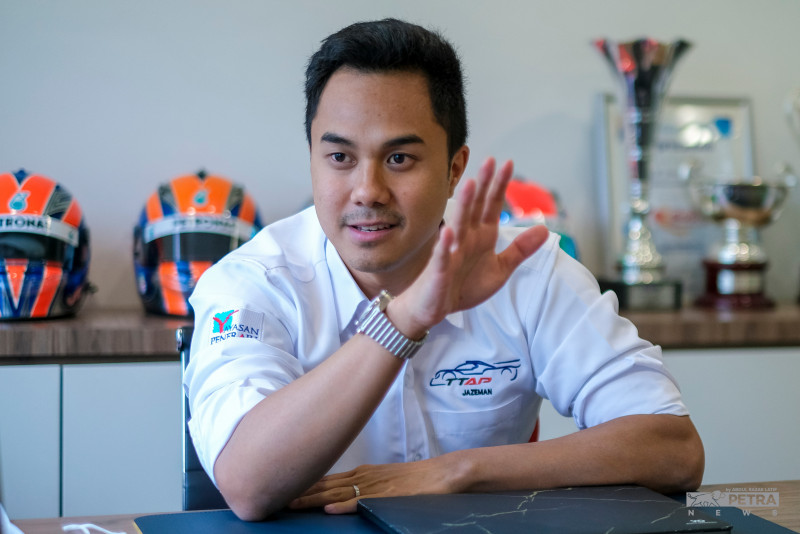
KUALA LUMPUR – Mention the name Jazeman Jaafar in Malaysia and one immediately thinks of the Mercedes Formula One driver that could have been.
Yet, the 29-year-old racer is still going strong at the top levels of international endurance racing.
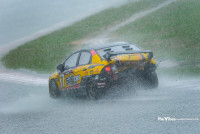
Jazeman is presently racing with Team Virage in the European Le Mans Series in his Le Mans Prototype 2 (LMP2) car.
The Vibes sat down with the speedster in an exclusive interview to hear what he had to say about his career, the future of motorsports in Malaysia, and how different types of racing bring their own sets of challenges.
The Vibes: You are now in European Le Man Series (ELMS) with Team Virage, how is that going after the first race in France?
Jazeman Jaafar: I participated in the World Endurance Championship (WEC) with a team called Jota as part of an all-Malaysian line-up with Nabil Jefri and Weiron Tan. We were the only Malaysians in WEC. We won a race and had two podiums, but the program folded at the end of 2018.
I still maintain a very good relationship with Jota because I know the team engineers and owners well. They’re an established team in Europe. Team Virage began as a Polish team based in Spain, with a Spanish co-owner, and Jota as their engineering team. When I received an offer from them, they explicitly told me, “Jazeman the engineering line-up is going to be the engineers you worked with at Jota, and your teammate is going to be Gabriel Aubry.” It was a no-brainer decision for me to join the team.
Obviously, being with a new team has its pros and cons. While you may have a strong foundation of capable people, the competition is so intense that every individual is required to squeeze a good performance. We didn’t know what to expect in the first race. We showed strong potential during the free practice being inside the top ten at seventh and could have finished fifth in qualifying if not because of a red flag. In the race we were up to sixth, second in class, but unfortunately got hit in the third hour which caused a bit of damage.
Despite such setbacks, I'm happy to be back racing in Europe at such a high level with my teammates and the Jota engineers. I wouldn’t say the coming races will be easy, but I feel that it’s a learning curve both ways with a new team environment.
TV: You were part of an all Malaysian line-up in 2018 with Jackie Chan DC Racing for the 24 Hours of Le Mans, how does racing together with your teammates make you feel?
JJ: The three of us came from different racing backgrounds. I was in the Petronas program for eight years, Nabil started someplace else and eventually joined Petronas while Weiron was racing in the US.
Synergising the three of us wasn’t exactly straightforward, but our goal was solely to perform well. We had to settle in and drive the team forward. It’s the same thing going into Le Mans. It was an immense pressure to race in front of 250,000 people, my first time, but we eventually delivered strong results which were a little surprising given that we were racing against a lot of ex-Formula One drivers. Among them are the greats Anthony Davidson and Pastor Maldonado, who have been in the game for a long period. We wanted to race against them, beat them, and outqualify them in each race. That motivation drove us, it was something special, and I don’t think it would happen again.
TV: Where do you see Malaysian motorsports heading towards post-pandemic?
JJ: I think it needs a fresh restart. We have an enormous amount of talent, whether it's drivers, riders, engineering talents, or mechanics. But the bridging of the platform needs to come closer. What I mean is you have MotoGP and other platforms that can provide a pathway for our talents to reach new heights.
Currently, pathways for four-wheel racing need a clearer direction. When F1 was here, it pushed me to want to drive in F1, an engineer to be in F1. Now when we don't have a jewel like that anymore, it's quite hard for one to harbor similar ambitious dreams.
As for myself, I used all my knowledge to start an engineering program called the Technology Transfer Apprenticeship Programme (TTAP), where I adopt five of Malaysia’s best engineering graduates for about six months, base them in the UK and have them follow Jota to all the races. They learn different aspects of racing such as data acquisition, telemetry, and engineering. When they get back, we guarantee them a job placement in the automotive industry. I think we need more of that kind of bridging to drive the industry forward.
Another motivation I get when I'm racing abroad is the endless amount of research and development. There is always innovation. In November I was in Bahrain for the WEC test, last week I was in France for ELMS. The innovation they've done in the space of three to four months is mind-blowing. The competition is so intense, where each team has its own specialties. We need a more innovative spirit in Malaysia to enhance the industry.
TV: You were placed as an executive director on the board of Sepang International Circuit (SIC), how do you think your experience and the new change in management can help lift Malaysian motorsports?
JJ: A fresh approach is what we all need. Unfortunately, the fresh team managing SIC was assembled during Covid-19 which hampered various activities, plans, and expansions. The new strategy needs to be more approachable and grounded. What I'm trying to say is certain events or teams can't be too secretive or insulated. We need more cross-partnership for Malaysian motorsports to restart.
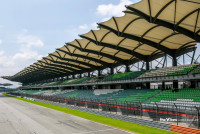
Regardless, I think the management team has done an enormous job to revive the industry post-Covid-19 in spite of the immense maintenance cost of a track facility operator – the drainage cost, the repainting works, the roofing. Keep in mind that SIC is a grade one circuit, the only one in the region. So, the management must preserve the circuit’s condition while maintaining the pricing, which they’ve admirably succeeded in doing so. Now MotoGP is back on the calendar and Super GT will commence in March 2023. There is hope for revival. What amazes me most is the sold-out tickets for every night track day. But SIC needs to grow even more than that.
TV: When you say that the circuit needs to grow more than that, what else can be done?
JJ: There are different disciplines in racing. SIC is a 300-hectare land with a master plan of providing facilities of all kinds of sports. There’s a hotel, and a theme park, but the core remains Formula One and MotoGP. Now, the track’s core has become mature enough for go-karting and other stuff.
But more can be done. There are other sports like Gymkhana, Autokhana, rally in the woods, drifting, and drag racing, which SIC should cater to. Even the karting track which I grew up with is still able to pull numbers despite experiencing some decline during the pandemic. Yet, it’s still active and the teams remain highly presentable and professional. The circuit just needs to be utilized so that people have a pathway to grow.
TV: You had the pleasure of driving the Mercedes F1 car for a bit. How was the experience?
JJ: It still feels like yesterday, to be honest. I drove for about six or seven occasions. I sincerely think anyone can drive an F1 car. The challenging part is to push the car to its absolute limit because you have 40 buttons with different driving modes. On top of that, there are at least 14 engineers working on the car so you must try to remember their names before understanding their roles, and then the mechanics and so on. Testing an F1 car is also a form of performance evaluation.
Toto Wolff and Ron Meadows were present when I did my test and my engineer was the same as Valtteri Bottas’. It’s not simply “I had the privilege of driving an F1 car, life is good.” No, it’s the pressure of being there. I had to do three years of simulator work with Mercedes before I got to drive the real car. It's not just a call-up where they say, “Hey we know you’ve been on the podium in Formula Three, I think it's time to test the car.” There was a process to get there. I had to do the simulator work, I had to know all the procedures and processes, I had to pass a fitness test in Austria and only then did I get to drive an F1 car. Yes, it’s great, but it wasn't an easy process.
TV: What kind of fitness level should an F1 driver have? You went through it. How is it different from other sports or compared to ELMS?
JJ: As I said earlier, there are 40 buttons on the steering wheel. There is immense pressure for you to drive the car to the limit all the time, which requires high-intensity core fitness. Imagine doing a run of 140 or 150 beats per minute, with a force resistance of 5 to 6 kilos every corner for an hour and a half. That’s what it feels like. At some point, your neck, core, and lower back start to give up.
There is no right way or wrong way to train. Jenson Button, who is 6ft 2in, is tall and heavy so he must try to keep his weight down. Then there’s Lewis Hamilton who does extreme sports with an intense amount of weight and strength conditioning. You need to be a fit all-rounder to drive an F1 car. The F1 program I did was quite intense because you need to complete the full Grand Prix distance, which takes at least one and a half hours, to earn your Super License.
TV: You were offered a seat for the 2016 season. What happened to that offer? And in the future, if another driver comes along, what can they do to ensure they get the seat?
JJ: That’s a great question. At that time I received one-plus-one-year offers from two F1 teams. As I said, it still feels like yesterday, even the contract is still sitting in a pile of letters in my kitchen. The opportunity, in my opinion, just came at the wrong place at the wrong time, politically and fundamentally.
I am very thankful to Petronas for believing in me for eight years, and I was very thankful to Mercedes AMG for developing me for five years. The time when I received the offer coincided with the oil price crash. There was widespread job retrenchment and even F1’s future, politically, was uncertain.
It is not enough to have just one sponsor to get into F1. You need a whole country behind you, like Sergio Perez. He had the support of the Mexican government and its machinery. We also tried to emulate that. We went to the Youth and Sports Ministry, to Petronas, to corporate sponsors. We were ready to fight it through but it’s not easy. It just takes one party to pull out for others to follow suit.
Amazingly, the F1 team decided to give me a counter-offer soon after that. Unfortunately, we couldn’t meet the timeframe needed to close the deal. It was really sad. Anyhow, I signed a deal in January with Mercedes AMG to be in the sports car programme. I thought sports cars had a future.
TV: What was the other team that offered you?
JJ: I had an offer from Force India at that time, and the other one was from Manor Racing, whose engine was supplied by Mercedes.
TV: You started karting at a young age of 6. How do you think more future talents can find their way into the sport, granted it’s an expensive sport to get into?
JJ: There are more ways now compared to when I started. I was six years old when I began my journey in Shah Alam. I could barely reach the pedals so they had to put wooden blocks for me and added cushions. Now you have the luxury of Esports to build your racing fundamentals. You can either buy one for about RM2000 with a second-hand steering wheel or you can just go to an academy and learn there. Karting now has more of an arrive-and-drive element, which means standardised go-karts. All you have to pay is just a flat fee. Insurance coverage in racing has also become greater now compared to my time.
Therefore, I think the cost element is more reachable nowadays. The issue is the direction to move forward. I think you can get a good fundamental in go-kart to race locally, if not regionally, but where do you head after that? Putting aside corporate sponsors, manufacturers are the only ones who can drive you forward. For example, now there is Toyota Gazoo Racing that has done a fantastic job, but we need more international platforms to come to Malaysia so that manufacturers can recognise our talents.
TV: Now you are racing in the European Le Mans Series, do you see yourself there in the near future?
JJ: There is a new category called hypercar, LMDH which is the new LMP1, the pinnacle of endurance racing. Porsche has signed up as well as Audi, Honda-Acura, GM, and at least another nine or ten manufacturers. I think that will be the future of endurance racing and my personal goal is to go to WEC and race at a pinnacle level in one of those cars.
I think that innovation is going to be the future because they’re not electrifying entirely, but they’re making everything sustainable. They’ve already started sustainable fuels in ELMS. I know that Porsche already has a V4 engine that can produce 700 horsepower, or 1000 horsepower, with battery which would probably be in our road cars in the next four to five years. That category is something I’m interested in the future, and I hope to see what our talents can do when it comes to Malaysia.
TV: Would you give the 24 hours of Le Mans another shot? Could we see a repeat of an all Malaysian driver line-up?
JJ: I do see myself going back into it but not this year. This year will be a platform for me to prepare for next year if an offer arrives. Right now, I have another program in GT racing with Johor Motorsports Racing Team (JMR) that races in the World GT Challenge Asia. The team is owned by the Sultan of Johor, and has two Mercedes AMG-GT3 cars.
They race in the Pro-Am (Professional-Amateur) category, and the amateur category is raced by two of his sons, Tunku Abdul Rahman and Tunku Abu Bakar. I raced with Tunku Abdul Rahman in 2019, and this year I’m racing with Tunku Abu Bakar, who is a rookie in the championship. We did the test in Australia earlier this year with the new cars. – The Vibes, April 23, 2022