IN an effort to level the global trade playing field, U.S. President Donald Trump has directed his economic team to develop a plan for reciprocal tariffs. The proposal, announced on Thursday, aims to impose tariffs on countries that tax U.S. imports, potentially sparking a broader international trade conflict.
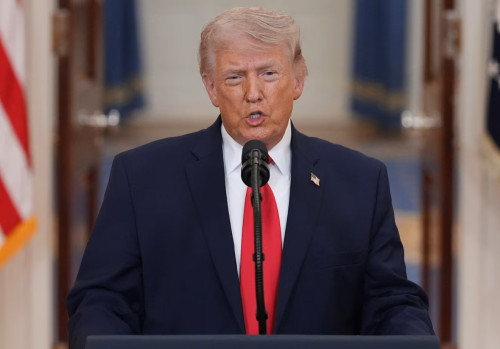
"I've decided, for the sake of fairness, that we will charge reciprocal tariffs—whatever tariffs other countries charge the United States, we will charge them back, no more, no less," Trump stated during a meeting with reporters in the Oval Office.
While the order does not immediately implement new tariffs, it sets in motion a comprehensive review of existing tariffs imposed by foreign nations.
Reuters reported today, the U.S. team will assess and calculate potential duties on imports to match those levied by other countries, considering non-tariff barriers such as vehicle safety standards that impact U.S. automotive exports, as well as value-added taxes that elevate the cost of American goods abroad.
The countries most affected by this directive include China, Japan, South Korea, and members of the European Union. Trump’s latest tariff proposals have raised concerns of a global trade war, exacerbating fears of rising U.S. inflation and market instability.
Wall Street responded with cautious optimism, relieved that the administration had not immediately implemented new tariffs. U.S. stocks gained ground, and global stock markets reached a new high, while U.S. Treasury yields declined.
Trump’s choice for Commerce Secretary, Howard Lutnick, assured that the administration would carefully evaluate each country’s trade policies, with studies expected to be completed by April 1. Lutnick’s team will also investigate long-standing trade imbalances that Trump has long criticized as detrimental to U.S. interests.
While Trump has historically positioned himself as a champion of low consumer prices, he acknowledged that some price increases could result from the tariffs in the short term, stressing that tariffs, in his view, are "great."
A senior White House official clarified that the administration would prioritize countries with the largest trade surpluses and highest tariff rates, aiming to implement tailored levies rather than a blanket tariff across the board. However, Trump has also left open the possibility of imposing a flat global tariff if negotiations do not yield results.
Tiffany Smith, vice president for global trade at the National Foreign Trade Council, welcomed the more strategic approach, expressing hope that it could lead to a reduction in tariffs and trade barriers through dialogue with trading partners rather than escalating tensions.
This announcement follows a series of actions by Trump to impose tariffs on steel and aluminum imports, with tariffs on Chinese goods already set in motion. Trump has also discussed potential tariffs on cars, semiconductors, and pharmaceuticals, including an impending announcement regarding car tariffs.
Josh Lipsky, director of the Atlantic Council’s GeoEconomics Center, emphasized the seriousness of Trump’s stance on tariffs, noting that such an approach would undoubtedly trigger international responses and could reshape global trade dynamics.
Indian Prime Minister Narendra Modi, who was in Washington for meetings with Trump, is leading a government that imposes some of the highest tariffs on U.S. goods, with Trump acknowledging this disparity in his comments.
Trade experts have noted that implementing the proposed reciprocal tariffs could be complex. The U.S. government might rely on several legislative provisions, including the Trade Act of 1974 or the Tariff Act of 1930, to justify the tariffs, though these have not been widely used in recent years. Additionally, the administration could invoke the International Emergency Economic Powers Act (IEEPA), a tool previously employed in the imposition of tariffs on China and other nations.
While the reciprocal tariff plan is still in the early stages, the Trump administration appears to be accelerating its trade agenda, prompting concerns that it could push the U.S. further into confrontation with its global trading partners. – February 14, 2025
Trump, Reciprocal tariffs, barriers